
How to Deal With a Neighbor’s Failing Septic System in Houston
A sewage odor, murky puddles, or unusually lush grass near a neighbor’s property can signal a septic problem, but those signs alone don’t confirm the cause. Knowing how to deal with a neighbor’s failing septic system in Houston starts with noting what you’ve observed, speaking calmly with the neighbor, and contacting the local health department if the concern isn’t addressed. Take care to keep children and pets away from any standing wastewater.
It’s understandable to worry about odors, possible contamination, or wastewater moving toward your yard, garden, or water source. A respectful conversation may help the property owner arrange an assessment before the issue worsens. This guide explains how to deal with a neighbor’s failing septic system in Houston: what warning signs to document, how to raise the concern, and when to involve local authorities without jumping to conclusions.
Key Takeaways
- Record where and when you notice possible runoff, especially after rain, to describe the concern clearly.
- Keep people away from wastewater and avoid using potentially affected areas to grow or harvest food.
- If a pond may be affected, water testing can help assess contamination concerns.
- If the neighbor can’t or won’t address the problem, raise the concern with the local health department.
- For a serious ongoing dispute, consider discussing your options with an attorney experienced in environmental law.
How to deal with neighbor’s failing septic system Houston
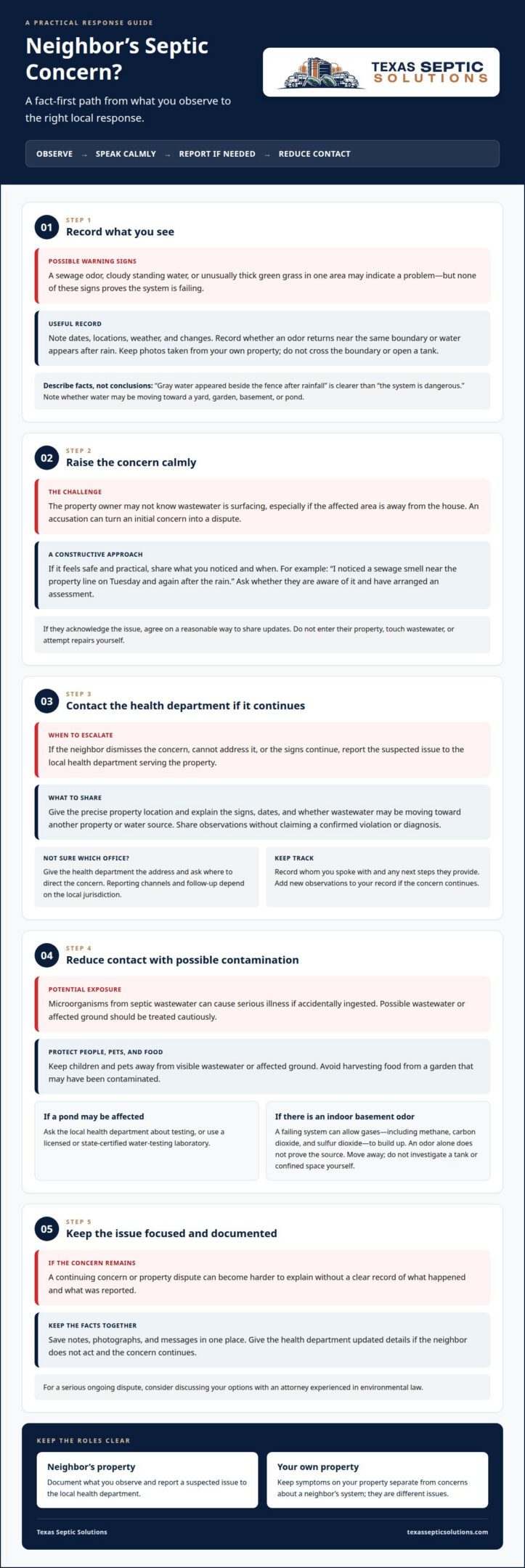
Start with observations, not accusations. A sewage odor, cloudy standing water, or unusually thick green grass in one area can indicate a septic problem. None of these signs proves the system is failing, but a pattern can help explain your concern. Note, for example, whether an odor repeatedly occurs near the same boundary or water appears after rain.
1. Record what you see. Write down dates, locations, weather conditions, and changes you notice. Describe the facts plainly: “Gray water appeared beside the fence after rainfall” is more useful than “the system is dangerous.” Keep photos taken from your own property, and don’t cross the boundary or open a tank. A clear record helps you explain the situation to the neighbor or local health department.
Separate direct observations from assumptions. A wet area can have several causes, while persistent sewage odors or wastewater surfacing deserve attention. Note whether water appears to flow toward a garden, yard, basement, or pond. During rain, wastewater can follow the natural movement of water or reach underground water systems, so recording when and where you notice it can help explain the concern.
2. Speak with the neighbor calmly. If it feels safe and practical, share what you observed and when. Be specific: “I noticed a sewage smell near the property line on Tuesday and again after the rain.” Ask whether they’re aware of it and have arranged an assessment. A respectful, factual conversation gives the owner a chance to respond without turning an initial concern into a dispute.
Your neighbor may not know wastewater is surfacing, especially if the affected area is away from the house. If they acknowledge the issue, agree on a reasonable way to share updates. Don’t enter their property, touch wastewater, or attempt repairs yourself. If they dismiss the concern or cannot address it, keep your observations and move to the next step.
3. Contact the local health department if the concern continues. Explain the location, signs, dates, and whether wastewater may be moving toward another property or water source. Share your observations without claiming a confirmed violation or diagnosis. The health department can advise how to report a possible public-health concern in the area and what information helps them assess it.
In Houston, describe the issue as a suspected failing septic system and provide the precise property location. Reporting channels and follow-up depend on the local jurisdiction, so start with the health department serving the area. If you’re unsure which office covers the property, give them the address and ask where to direct the concern. Record whom you spoke with and any next steps they provide.
4. Reduce contact with possible contamination. Keep children and pets away from visible wastewater or affected ground. Microorganisms from septic wastewater can cause serious illness if accidentally ingested. Avoid harvesting food from a garden that may have been contaminated. If pond water could be affected, ask the local health department about testing, or use a licensed or state-certified water-testing laboratory.
Treat a sewage odor inside a basement with caution. A failing system can allow gases, including methane, carbon dioxide, and sulfur dioxide, to build up and create health risks. An indoor odor alone does not prove its source. Move away from the affected area rather than investigating a tank or confined space yourself, and report the concern to the appropriate local authority.
5. Keep the issue focused and documented. Save your notes, photographs, and any messages in one place. If the neighbor does not act and the concern remains, give the health department the updated details. A continuing property dispute may also warrant a conversation with an attorney experienced in environmental law. For Houston residents considering how to deal with a neighbor’s failing septic system, a factual record, respectful communication, and appropriate reporting provide a practical path forward.
A neighbor’s failing septic system can allow pollutants to reach nearby yards, gardens, basements, or drinking water. Children or pets playing in a yard may accidentally ingest microorganisms from a failing system and become seriously ill. If pond water may be affected, it can be tested by a local health department or a private licensed or state- or provincially-certified water-testing laboratory. Ask your neighbor to address the problem; if they are unwilling or unable to act, contacting the health department may be necessary. You may also discuss the situation with an attorney experienced in environmental law.
Texas Septic Solutions
Texas Septic Solutions helps Houston homeowners address septic concerns on their own property with repair, maintenance, pumping, and new system installation. If wastewater or odors appear in your yard, or you suspect your own system has been affected, septic service can help address your property’s needs. The company’s work does not replace reporting a neighbor’s suspected failure to the local health department, but it can help when your own system needs attention.
If you notice symptoms on your own property, such as a persistent sewage odor or wastewater surfacing, Texas Septic Solutions can help assess and address the septic issue. Emergency septic service is available for urgent septic concerns.
Contact Texas Septic Solutions to discuss septic service for your property.
Take the Next Step With Confidence
If you’re considering how to deal with a neighbor’s failing septic system in Houston, keep the concern about their property separate from symptoms on your own. The local health department is the appropriate place to report a suspected issue on someone else’s property. If you notice changes to your own septic system, service for your property can address that separate problem.
Texas Septic Solutions can help with septic system repair, maintenance, and new system installation. Explain what you’ve observed on your property and what kind of help you need, so the conversation can focus on the right next step. You don’t have to solve a neighbor’s septic issue yourself to take care of your home.
Contact Texas Septic Solutions to discuss septic service for your property, and move forward with a clear plan.