
Septic-Safe Laundry Detergent Tips for Houston Homes
A “septic-safe” label may look reassuring, but it doesn’t tell the whole story. The term isn’t regulated, so choosing septic safe laundry detergent tips Houston homeowners can rely on means looking beyond the front of the bottle. It’s also understandable to worry that detergent or a busy wash day could strain your tank or drainfield.
Careful product use and steady water flow can help you protect your system without putting laundry on hold. This guide explains what to look for on detergent labels, why measuring the recommended amount matters, and how to space out loads rather than sending a large volume of water through the system at once. It also covers signs that may point to a septic issue, including recurring backups and slow drainage. These tips apply to septic-system owners in Houston, Cleveland, Cypress, Huffman, and Shepherd. If symptoms persist despite sensible laundry habits, arrange a professional assessment.
Key Takeaways
- Use septic safe laundry detergent tips Houston homeowners can apply to compare label claims, directions, dosage, and detergent format.
- Measure detergent as directed; adding extra detergent won’t necessarily make clothes cleaner.
- Build a wash-day routine that spaces loads and avoids unnecessary repeat cycles.
- Consider both detergent use and wastewater volume when looking for ways to reduce strain on your system.
- Recurring slow drains, backups, or unusual wet areas call for septic evaluation, not just a change in detergent.
Houston Septic-Safe Laundry Detergent: What Homeowners Need to Know
For homeowners looking up septic safe laundry detergent tips Houston, the key is to treat “septic-safe” as a starting point, not a promise. The wording can help narrow your options, but it doesn’t guarantee that a product suits every septic system or that any amount is harmless. A sensible approach combines careful label reading, measured detergent use, and attention to how much wastewater enters the system during wash day.
Septic-compatible use means using a product as directed in a working system, not using unlimited detergent or water without consequence. Detergent choice and household water volume are separate considerations. A product label addresses the detergent claim; it doesn’t tell you how many loads your system can handle in a short stretch. Spacing out laundry can help manage water flow, regardless of which detergent you choose.
Septic setups vary between properties in Houston, Cleveland, Cypress, Huffman, and Shepherd, so one laundry routine may not fit every home. Understanding the basic wastewater path can help you make practical choices without assuming a label alone can protect the tank and drainfield. The Septic Tank overview explains the basic components and treatment process.
What happens to laundry wastewater in a septic system?
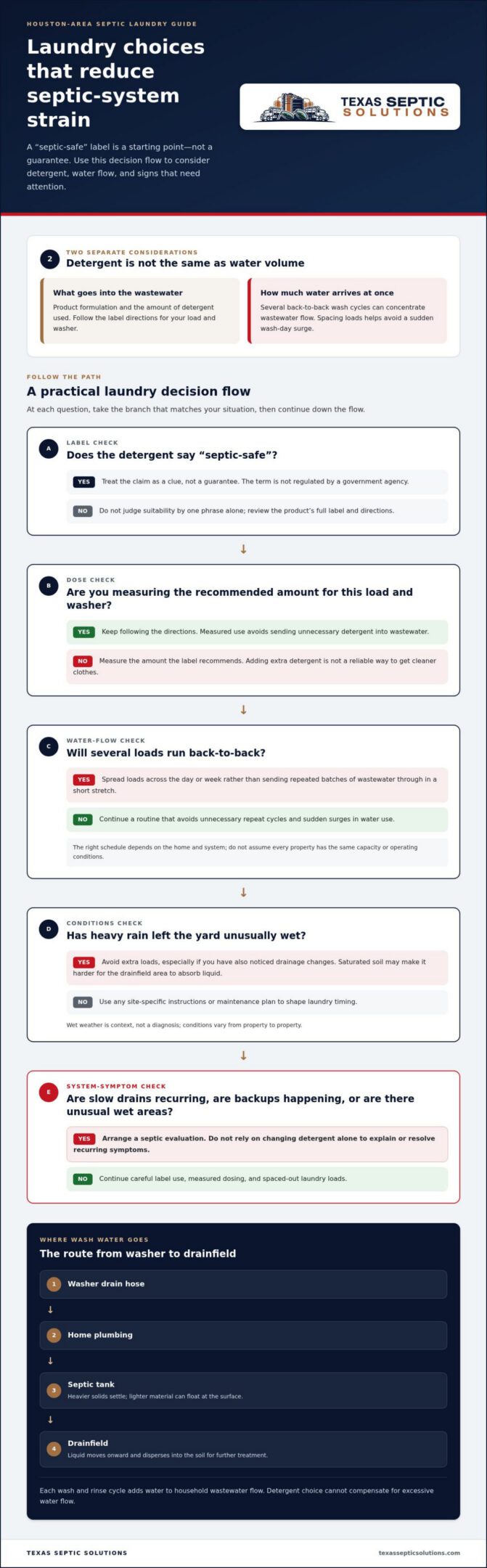
After a wash cycle, wastewater leaves the washer through its drain hose and enters the home’s plumbing. It then flows to the septic tank. Inside the tank, heavier solids settle to the bottom, while lighter material can float at the surface. The liquid between these layers moves onward toward the drainfield, where it disperses into the soil for further treatment. In plain terms, the tank holds and separates waste; the drainfield receives and disperses the treated liquid.
This route explains why a washing machine affects more than the detergent inside the appliance. Each drain cycle sends water into the plumbing and, ultimately, the septic system. Detergent is one part of that wastewater, while the volume and timing of wash cycles determine how much water arrives over a given period.
Does a septic-safe label guarantee a product is harmless?
No. The term “septic-safe” isn’t regulated by a government agency, so the claim comes from the product’s manufacturer. Label wording alone can’t establish that a detergent is suitable for every tank, drainfield, or household routine. It’s a useful clue, not a system-specific assessment or blanket guarantee.
Start with the directions. Measure the recommended amount for your load and washer instead of adding extra on the assumption that more detergent means cleaner clothes. Avoid unnecessary repeat cycles, too. For practical septic safe laundry detergent tips Houston homeowners can use, read the full label and consider water flow as well as the product claim. If drainage problems recur, don’t rely on a detergent change alone to explain or resolve them.
How Laundry Detergent and Wash-Day Water Affect Houston Septic Systems
Laundry can affect a septic system in two ways: through what’s in the wastewater and through how much wastewater arrives at once. Detergent formulation is a product-use consideration. Hydraulic loading is the water-flow side of the equation. A detergent marketed for septic systems won’t offset a sudden surge of household water.
Detergent choice cannot compensate for excessive water flow. Several consecutive wash cycles send repeated batches of wastewater into the plumbing, possibly at the same time as showers, dishwashing, and other water use. The EPA Septic System Care guidance also emphasizes managing water use to help protect septic systems. These septic safe laundry detergent tips Houston homeowners can put into practice work best when product use and wash-day timing are considered separately.
Why detergent dose and formulation deserve attention
Detergents contain surfactants, which help loosen oils and soil so they can rinse away, along with other ingredients that support cleaning, scent, or product stability. Those ingredients enter the wastewater, but that alone doesn’t mean a particular ingredient will damage every septic system. The outcome can depend on the product, the amount used, and the system’s condition, so avoid treating one ingredient name as a universal warning.
Follow the detergent label’s dosage directions for your load and washer. Adding more than directed isn’t a reliable way to get cleaner clothes, and it sends more product into the wastewater. When comparing options, review the full directions and claims rather than assuming a single “free from” statement proves the detergent is right for every property.
Why laundry timing matters as much as product choice
Each wash and rinse cycle adds water to the household wastewater flow. Running several loads back-to-back concentrates that flow into a short period. Spacing loads across the day or week gives wastewater a steadier path through the system instead of producing a wash-day surge. The right schedule depends on the home and system, so don’t assume every Houston-area property has the same capacity or operating conditions.
Local weather can matter, too. After heavy rain, soil around a drainfield may be saturated, which can make it harder for the area to absorb additional liquid. That’s useful context, not a diagnosis: rain alone doesn’t prove a septic system is failing, and conditions vary from property to property. If your system has site-specific instructions or a maintenance plan, use that guidance to shape laundry timing. Avoid extra loads when the yard is unusually wet, especially if you’ve also noticed drainage changes.
- Measure detergent according to the label instead of adding a little extra.
- Spread wash cycles out rather than running every load consecutively.
- Pay attention to unusual wetness or recurring drainage trouble, not weather alone.
If laundry adjustments don’t resolve recurring symptoms, a professional septic system evaluation can help identify whether the concern involves the tank, drainfield, or another part of the system.
How to Compare Septic-Safe Laundry Detergents Without Trusting the Label Alone
A useful comparison looks past the front-label promise and focuses on what you can verify and control: the directions, dose, product format, and support behind specific claims. “Septic-safe” is a manufacturer’s marketing claim, not proof that a detergent suits every septic setup. No detergent label makes repeated, high-volume laundry harmless. Compare products as a way to choose a detergent you can use as directed, not as a substitute for managing household water flow.
Which detergent label details should Houston homeowners review?
Start with dosage instructions. Check how the recommended amount changes with load size, soil level, or water conditions, and follow the directions for your washer. If a label mentions hard water, use that guidance rather than guessing at a larger dose. Conditions can vary across Houston, Cleveland, Cypress, Huffman, and Shepherd, so don’t assume every household needs the same amount.
Next, note claims such as “biodegradable,” “phosphate-free,” or “septic-safe,” but don’t treat any one claim as decisive. Look for a clear explanation and reliable support for the wording. If a product claims a septic certification, verify that the named certification exists and applies to the product. The University of Arkansas Cooperative Extension’s Septic System Operation and Maintenance provides broader context on household products and system care, but a general resource doesn’t certify an individual detergent.
Liquid, powder, pods, or sheets: what should you compare?
Judge formats by how easily you can use the intended amount consistently. A measuring cap may make it easier to adjust a liquid dose; a powder scoop or premeasured pod may be convenient, but follow its package directions for your washer and load. Sheets also have product-specific instructions. Format alone doesn’t establish septic suitability, so compare the directions and substantiation instead of assuming one type is always best.
Use this simple checklist to compare options side by side:
Label language
Record claims such as “septic-safe.” Treat them as claims to assess, not guarantees.
Directions
Check whether instructions explain dosing for your load and washer.
Dosage
Compare the recommended amount and any stated adjustments for water conditions.
Format
Consider whether you can use the directed dose reliably, without adding extra.
Verified claims
Look for support behind statements about biodegradability, phosphates, or certification instead of relying on broad wording.
Measured use is more practical than assuming extra detergent will clean better. Too much product isn’t a dependable fix for a difficult load, and it adds more detergent to the wastewater. Choose an option whose instructions you can follow, then keep your laundry schedule in mind: a product claim addresses detergent, not the amount of water sent through the system during a busy wash day. That distinction is central to septic safe laundry detergent tips Houston homeowners can apply with confidence.
Houston Laundry Habits That Help Reduce Septic-System Strain
A steady routine can help prevent laundry from sending a sudden rush of wastewater through your septic system. The goal isn’t to follow a universal limit on loads. Household size, washer use, and septic-system design vary, so build a schedule that spreads water use and fits your property. These septic safe laundry detergent tips Houston homeowners can use pair thoughtful wash-day timing with simple, consistent habits.
How should you spread laundry loads through the week?
When your schedule allows, distribute laundry across several days instead of running every load back-to-back. Spacing cycles helps avoid a concentrated wastewater surge, but it doesn’t automatically reduce the total water used. Coordinate with other household members, too. If laundry is already running, consider postponing another water-intensive task, such as a long shower or dishwasher cycle, until later.
- Plan around household needs. Identify busy laundry periods, then move some loads to quieter days or different times.
- Measure detergent. Follow the product directions for the load and washer rather than adding extra.
- Keep washer settings consistent. Use settings that suit the load and appliance; avoid choosing extra water or rinse options without a reason.
- Skip unnecessary repeat cycles. Check the load and settings before restarting a wash or rinse cycle.
- Coordinate water use. Let household members know when several loads are planned so other high-water tasks can be spread out too.
This routine doesn’t require a strict number of loads per day. If laundry needs vary week to week, focus on avoiding a long run of consecutive loads when you can. Spacing manages the timing of wastewater; it doesn’t guarantee that a system can handle any volume without strain.
What should you change when the drainfield area is wet?
Houston-area rain can leave yards wet, but conditions differ across properties. Keep roof runoff and surface water from flowing toward the drainfield. Check where downspouts discharge, and avoid directing runoff across the area where treated wastewater disperses into the soil. A wet yard after rain isn’t, by itself, proof of a septic problem. Persistent pooling, unusual wetness, or slow drainage deserves closer attention.
- Notice whether wet areas persist after surrounding ground has dried.
- Watch for slow drains or backups that recur, rather than assuming detergent is the cause.
- Use system-specific maintenance guidance, since a routine that suits one property may not suit another.
If you see ongoing pooling or drainage changes, get guidance tailored to your system instead of simply changing laundry products. A Texas septic system maintenance guide can help you understand the care your system needs. For recurring symptoms, schedule septic system maintenance with Texas Septic Solutions to help identify whether the issue needs professional attention.
When Laundry Problems Point to a Septic Issue in the Houston Area
A detergent change may help you adjust your laundry routine, but it can’t identify or fix a septic-system problem. One slow drain after a busy wash day is different from recurring slow drains, repeated backups, or a wet area that stays unusually soggy. Pay attention to patterns, especially if symptoms return after you’ve spaced out loads and followed the product directions.
These signs don’t confirm a particular cause. A backup or wet patch can have more than one explanation, and guessing from a detergent label could delay the right response. If problems keep happening, stop treating them as a laundry-only issue and arrange a professional assessment.
Which warning signs deserve more than a detergent change?
Watch for slow drainage in more than one fixture, sewage backing up into the home, or persistent pooling and unusual wetness near the drainfield. Note when the symptoms occur and whether they repeat, but don’t assume laundry caused them. If your septic system has an alarm, take it seriously and follow the system-specific instructions. For guidance, see what to do when a septic tank alarm goes off.
- Isolated concern: A single laundry issue that doesn’t recur may call for reviewing detergent use and washer settings.
- Recurring concern: Slow drains that return, repeated backups, or persistent wet areas deserve professional attention.
- Urgent concern: Sewage backing up into living spaces or an active system alarm should not be managed by changing detergent alone.
Keep track of what you’ve noticed, such as which drains are affected and whether symptoms follow heavy water use or wet weather. That information can help a septic professional assess the situation. Avoid using detergent changes as a substitute for addressing repeated warning signs.
How can local septic service help protect system performance?
The right next step depends on an assessment of the system. Septic pumping removes accumulated solids from the tank. Maintenance helps address routine system-care needs, while repair responds to a problem that requires fixing. These services serve different purposes, so pumping alone shouldn’t be treated as the answer to every drainage symptom.
Texas Septic Solutions provides septic pumping, maintenance, repair, and 24/7 emergency service in Houston, Cleveland, Cypress, Huffman, and Shepherd. If detergent and wash-day adjustments haven’t stopped recurring symptoms, professional service can help identify what kind of attention the system needs. Don’t wait for a label change to solve a problem it can’t diagnose. Request septic service from Texas Septic Solutions for help with recurring Houston-area septic concerns.
Build a Wash-Day Routine You Can Keep
A septic-friendly routine doesn’t need to make laundry complicated. Choose a detergent you can measure consistently, plan loads around your household’s schedule, and pay attention to changes in how drains behave. Those habits help you make informed decisions instead of relying on a label to solve every concern. Keep your septic safe laundry detergent tips Houston close at hand, then adjust your routine when household needs or property conditions change.
If slow drainage, backups, or wet areas keep returning, look beyond laundry products. A professional assessment can help clarify what your system needs and point you toward an appropriate next step. Texas Septic Solutions provides septic pumping, maintenance, repair, and emergency service for homeowners in Houston, Cleveland, Cypress, Huffman, and Shepherd.
Request septic service from Texas Septic Solutions to address a concern with your Houston-area septic system.
Frequently Asked Questions
Is any laundry detergent safe for a septic system?
No detergent can be guaranteed safe for every septic system. A product marketed for septic use may be a reasonable option, but its label isn’t a substitute for directions or system-specific care instructions. Use the amount stated for your load and washer. For example, don’t add an extra capful just because a load is muddy; check whether the product label recommends a different dose for heavily soiled clothes.
Can laundry detergent damage a septic tank or drainfield?
Detergent used according to its directions isn’t automatically harmful, but excessive or unsuitable product use can add unnecessary material to wastewater. That doesn’t mean one named ingredient will damage every tank or drainfield. If trouble starts after a detergent change, consider whether several wash cycles or other water use happened around the same time. Recurring symptoms need an assessment, since they can’t identify detergent as the cause.
How often should I do laundry if my home has a septic system?
There isn’t one weekly load limit that suits every household and septic setup. For septic safe laundry detergent tips Houston homeowners can use, plan around your household’s needs and any system-specific instructions. A shared calendar can help household members avoid stacking laundry, long showers, and dishwasher use in the same short window. Spacing cycles manages when wastewater enters the system; it doesn’t necessarily lower the total water used.
What ingredients should I avoid in septic-safe laundry detergent?
There isn’t a universal ingredient list that proves a detergent is unsuitable for every septic system. Read the full label, follow warnings and dosage directions, and look for reliable support behind claims such as “biodegradable” or “phosphate-free.” Don’t assume that excluding one ingredient guarantees compatibility, or that a single ingredient automatically harms every tank. If you have system-specific product guidance, use it when comparing labels.
Does septic-safe detergent prevent septic backups?
No. A detergent label can’t prevent a backup or correct an existing system problem. Backups can have different causes, and switching products won’t diagnose them. If wastewater returns through a drain, note where it appears and whether other fixtures are affected, then seek a professional assessment. Don’t keep running wash cycles to test whether a new detergent solves a recurring backup.
What should Houston homeowners do if laundry causes slow drains or pooling?
If slow drains or pooling recur, stop treating the issue as detergent-related alone. Avoid running several consecutive loads, note which fixtures drain slowly, and record whether wet areas remain after rain has passed. Homeowners in Houston, Cleveland, Cypress, Huffman, and Shepherd should seek system-specific professional guidance for persistent symptoms. A qualified assessment can help determine whether pumping, maintenance, or repair is appropriate, rather than leaving you to guess at the cause.