
How to Choose the Right Size Septic Tank in Texas (2026)
The biggest septic tank isn’t automatically the right one for your Texas home. Bedroom count provides an important starting point, but household water use, site conditions, system type, and local requirements also shape the final design. The question of how to choose the right size septic tank Texas homeowners should ask doesn’t have a one-number answer.
Bedroom count is useful because it helps estimate a home’s needs. But a tank that’s too small, or larger than the design calls for, can lead to avoidable complications. The right approach is to consider the household’s expected wastewater flow alongside property-specific factors.
This guide explains the main inputs used to determine septic tank capacity and how soil, site conditions, and system type fit into the decision. Use the checklist to prepare for a site evaluation and identify what to confirm with a Texas septic designer, installer, or local permitting authority.
Key Takeaways
- Bedroom count and household use help estimate demand, but they don’t determine final tank size on their own.
- Tank capacity, wastewater design flow, and the drainfield’s ability to treat wastewater are related but distinct considerations.
- A property-specific checklist can help you prepare for a site evaluation and gather the details a designer needs.
- Before choosing a system, confirm which local authority reviews the OSSF application and what approvals apply.
- Ask a professional to explain the proposed capacity, system components, site fit, and approval process.
Choosing a Septic Tank Size in Texas Starts With Your Property
Short answer: Household demand is a starting point, not the full sizing decision. To understand how to choose the right size septic tank Texas homeowners need to look beyond bedroom count and consider design flow, system type, site conditions, and local review. A tank’s capacity is only one part of an onsite sewage facility (OSSF), and a larger tank can’t make an unsuitable site work.
What does septic tank size mean?
Septic tank size usually refers to its capacity, measured as liquid volume. Daily wastewater flow is a separate design input that estimates how much wastewater the system must handle. Inside the tank, heavier solids settle and lighter materials float, separating from the liquid effluent. The effluent then moves to a treatment area, such as a drainfield. For a plain-language overview of how a septic tank works, see the foundational explanation on Wikipedia.
The tank and drainfield have different jobs. Tank capacity supports the settling and separation process, while the treatment area must suit the soil and site. If a tank is undersized for the applicable design, it may not provide the intended capacity for the expected wastewater load and can contribute to solids reaching downstream components. Choosing a larger tank won’t correct poor soil absorption, limited space, or an unsuitable overall design.
Why is bedroom count only a starting point?
For a residential design, bedroom count can help estimate household wastewater demand. It’s a useful first clue, but it doesn’t show exactly how much wastewater a household will produce or which design suits a specific property. Actual use and the method used to calculate design flow also matter.
For example, a three-bedroom home gives a designer a starting point for estimating expected demand. It doesn’t establish the final tank capacity or show that a conventional drainfield will suit the lot. Current rules and the applicable local review process determine which calculation method and minimums apply. Don’t treat a general online estimate as an approved design.
Quotable summary: The right septic tank size depends on household demand, design flow, system type, and a property-specific site review.
A homeowner estimate can help you prepare questions, but a design for a particular property must account for site findings and applicable approvals. Before comparing tank options, confirm current requirements with the relevant Texas authority and a professional familiar with the property.
How Texas Septic Tank Sizing Uses Design Flow and Site Conditions
Once household demand provides a starting point, the design review connects expected wastewater flow with the property’s ability to treat and disperse it. Design flow is the estimated amount of wastewater a system must handle. It helps inform system sizing, but it doesn’t determine tank capacity, drainfield layout, or site suitability by itself.
Check the calculation method and any applicable thresholds against current requirements and local review. The Texas Commission on Environmental Quality (TCEQ) provides official OSSF information. The relevant local permitting authority can clarify how those requirements apply to a specific property. Don’t rely on an online estimate as a final design.
Which household and building details affect design flow?
Gather information that helps a professional understand how the property will be used. For a home, that may include bedroom count, expected occupancy, plumbing fixtures, and planned additions. For a commercial property, intended use and wastewater assumptions may differ from those for a residence. A home sizing chart shouldn’t be used to estimate a business system.
Share planned changes early. Adding bedrooms or changing how a building is used could affect design assumptions. Ask the reviewer which current calculation method applies and what property details they need. Verify Texas design-flow tables, calculations, and thresholds for the project rather than assuming a general guide applies.
How do soil and the drainfield affect the system choice?
A site evaluation helps determine whether the property can support the proposed treatment and dispersal approach. Soil conditions are one design input, along with available space and other site characteristics. The evaluation informs how effluent can be treated after it leaves the tank. It doesn’t mean that a certain system type is automatically right for a particular area.
That matters across Cleveland, Houston, Cypress, Huffman, and Shepherd. Even nearby properties can have different constraints, so a neighbor’s system or local reputation isn’t a substitute for reviewing your lot. Ask what the evaluation found, how those findings shape the proposed drainfield, and whether the plan fits the intended use.
In short, tank capacity describes the tank, while the site’s soil and drainfield determine how effluent can be treated and dispersed. If you’re planning a new system, Texas Septic Solutions can discuss property-specific installation considerations without guessing at capacity before evaluation. Learn about new septic system installation.
Compare Septic Tank Sizing Factors Before Choosing a System
A useful comparison separates what each design input can tell you from what still needs professional review. No single factor, including household size or tank volume, establishes the right system for every property. Use this framework to organize your questions before comparing options.
| Factor | What it helps establish | What it cannot establish alone |
|---|---|---|
| Household demand | Provides a starting point based on bedroom count, occupancy, and intended use. | The final tank capacity or whether the property can support a proposed system. |
| Estimated design flow | Helps estimate the wastewater amount the system must handle. | The drainfield layout, soil suitability, or approval of the complete design. |
| Site assessment | Identifies property conditions relevant to treatment and wastewater dispersal. | A specific tank capacity without considering demand and system design. |
| System type | Frames which treatment approach may be considered for the property. | Whether a system is suitable or approved without a site-specific review. |
| Local approval | Confirms whether the application and proposed design meet applicable review requirements. | A guarantee of performance if the system is not properly designed, installed, and maintained. |
For Texas property owners, choosing a septic tank size is a project-specific decision, not a universal capacity recommendation. Residential and commercial projects should be assessed separately, based on each property’s intended use and expected wastewater demand.
Residential versus commercial septic tank sizing
For a home, bedroom count and expected occupancy can help frame residential wastewater assumptions. A business may have a different use pattern and demand, so a household sizing chart isn’t an appropriate stand-in. Before requesting a review, document the property’s intended use, typical occupancy pattern, plumbing details, and any planned changes. These details help the professional and local reviewer evaluate the project on its own terms.
Conventional and alternative system considerations
Site constraints and treatment design can affect which system options are considered. A conventional system may be evaluated differently from an alternative approach, such as an aerobic treatment unit. Naming a system category doesn’t confirm that it fits the property. Suitability and applicable requirements must be checked for the specific site. Tank capacity alone can’t establish whether the overall system will be approved or perform as intended.
If you’re planning a replacement, the project may involve more than selecting a tank. Review the Texas septic system replacement cost guide as you prepare project questions. Then confirm the proposed capacity, system components, site fit, and local review with the professionals and authority handling your property’s application.
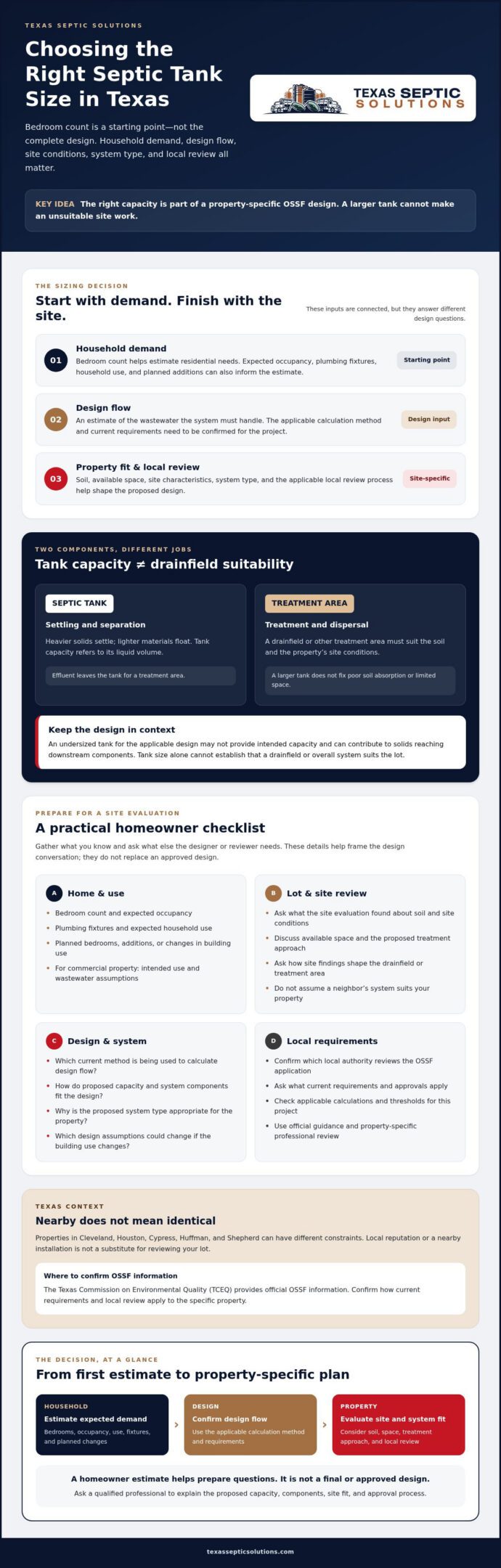
Use This Texas Septic Tank Sizing Checklist Before Requesting a Design
A little preparation can make a sizing review more useful. If you’re researching how to choose the right size septic tank Texas properties need, use this sequence to organize the facts and confirm what applies to your project. This checklist helps you prepare. It isn’t a substitute for a site-specific design or local approval.
- Gather property details. Note the bedroom count, property use, anticipated occupancy, water source, and any planned additions.
- Clarify how the property will be used. Describe typical occupancy patterns and intended use, especially for a commercial property or a building with planned changes.
- Collect available records. Set aside property plans, previous septic records, and existing permit documents. If you don’t have them, ask the local authority or a qualified professional what information is available or needed.
- Arrange a site evaluation. Ask what site information is needed before design and how the findings may affect the proposed treatment and dispersal approach.
- Review the design and verify approval. Confirm the proposed tank capacity, system components, and treatment area. Then identify who reviews the OSSF application and what local approval process applies.
What should you confirm with the designer and local authority?
First, identify the county or other local permitting authority for the property. Confirm who reviews the OSSF application, which current TCEQ rules and local requirements apply, and what documents or site information are needed. Requirements and review processes can vary, so don’t assume another property’s permit or a generic online chart settles your project.
Ask the designer to explain how household assumptions, site findings, and any planned expansion shaped the proposal. If you may add bedrooms or change how a building is used, raise that before the design is finalized. Make sure the discussion covers both the tank capacity and the treatment or dispersal area. Tank size alone doesn’t describe the complete system.
Before proceeding, check that you understand:
- What demand assumptions the proposed design uses.
- How the site evaluation informed the system components and treatment area.
- Which authority reviews the application and what approval steps remain.
- Whether future changes could require a new review or affect the proposal.
After installation, care remains part of responsible system ownership. For a general overview of ongoing care, see the Texas septic system maintenance guide. For help discussing property-specific considerations for a new system, explore new septic system installation support.
Get a Property-Specific Septic Tank Size and Installation Plan
Household details help frame the question, but the final recommendation should account for estimated design flow, site findings, the proposed system, and applicable review. For anyone researching how to choose the right size septic tank Texas properties require, the goal isn’t to select a number from a chart. It’s to understand why a proposed capacity fits the project and how it works with the rest of the system.
How to evaluate a proposed tank size
Ask the professional to explain the assumptions behind the proposal, including the property’s intended use and expected demand. Check that the recommendation connects tank capacity to the site assessment and the design of the treatment or dispersal area. Consider the tank as part of a complete system, not a stand-alone purchase.
Before moving ahead, confirm who will review the OSSF application and whether the proposal addresses current requirements and applicable local review. A clear explanation should help you understand:
- Why the proposed capacity fits the project assumptions.
- How site findings shaped the selected system components and treatment area.
- Which approvals or reviews apply to the property, and who confirms them.
If the explanation is unclear, ask for clarification before comparing equipment or committing to a plan. A professional review should help you see what is established, what still needs confirmation, and how any planned expansion could affect the design.
When to ask for installation or replacement guidance
Seek a property-specific assessment when planning new construction, replacing a system, or making a significant change to how a building is used. Share the location, intended use, available records, and planned changes at the outset. Those details help determine the appropriate next-step discussion without promising a tank size before the property has been evaluated.
An existing system may need attention for reasons other than its original sizing. Pumping, maintenance, or repair concerns differ from planning a new system or replacement, and the appropriate service depends on what’s happening. Describe the symptoms or project goal so the issue can be discussed in the right context.
Texas Septic Solutions provides new septic system installation for residential and commercial clients. If you’re in Cleveland, Houston, Cypress, Huffman, or Shepherd, share your location and project details to discuss potential next steps. Talk with Texas Septic Solutions about your septic system.
Move Forward With a Septic Plan That Fits Your Property
The right answer to how to choose the right size septic tank Texas property owners need starts with household or project details, then accounts for design flow, site conditions, system type, and local review. Tank capacity matters, but it’s only one part of a complete septic system. A property-specific proposal should explain how the tank and treatment area work together and what approvals apply.
Before choosing a system, gather your property information and ask how the design assumptions and site findings shape the proposed plan. Confirm the applicable review process with the local authority, especially if you’re planning construction, replacement, or a change in property use.
Texas Septic Solutions provides new septic system installation for residential and commercial clients, with local coverage that includes Cleveland, Houston, Cypress, Huffman, and Shepherd. Share your location and project details to discuss next steps without guessing at tank size before evaluation. Talk with Texas Septic Solutions about your septic system.
Frequently Asked Questions
How many gallons should a septic tank be in Texas?
There isn’t one tank capacity that suits every Texas property. Bedroom count and household size can help start an estimate, but the right answer to how to choose the right size septic tank Texas homeowners need also depends on design flow, system type, site conditions, and applicable local requirements. Treat online charts as general guidance, not a final design. Ask a qualified septic professional and the authority reviewing your property’s application to confirm the proposal.
Is septic tank size based on the number of bedrooms?
Bedroom count can help estimate wastewater demand for a residential design, but it isn’t the only sizing rule. A professional may also consider intended occupancy, how the property is used, estimated design flow, site findings, and the proposed system. Before using a bedroom-based chart to choose or buy a tank, confirm the current calculation method and local requirements. A preliminary estimate can help you prepare, but it doesn’t establish an approved design for your lot.
Can I choose a larger septic tank to avoid problems?
No. A larger tank doesn’t replace a system designed for the property. The tank, treatment components, and drainfield or dispersal area need to work together. Increasing capacity alone may not address unsuitable site conditions or a mismatch between the design and expected wastewater flow. Ask the professional to explain why the proposed capacity fits the project assumptions and how the site evaluation shaped the rest of the system.
Do commercial properties need a different septic tank size?
Commercial properties need a project-specific assessment, not a residential bedroom-based chart. Expected wastewater demand depends on the business’s intended use and operating assumptions, so share details about the activity, occupancy pattern, and any planned changes with the qualified professional reviewing the project. Confirm which current TCEQ rules and local review process apply before settling on a tank capacity or system type. Don’t infer a commercial design from a nearby home’s system.
Does Texas require a permit for a septic tank installation?
Requirements depend on the project and the authority responsible for its review. Check current Texas Commission on Environmental Quality (TCEQ) OSSF information and contact the applicable local permitting authority or authorized agent to confirm the process, required documents, and approvals for your property. Don’t assume another county’s steps apply to your project. A qualified professional can help you identify which design details and records to discuss with the reviewer.
How do soil conditions affect septic tank sizing in Texas?
Soil and site conditions help determine whether a proposed treatment and dispersal approach suits the property. They don’t set tank capacity in isolation. A site evaluation gives the professional information needed to assess system options and the treatment area. Conditions can vary between nearby lots, including around Cleveland, Houston, Cypress, Huffman, and Shepherd. Ask for a property-specific assessment instead of choosing a system based on regional assumptions or a neighbor’s setup.
Who can confirm the right septic tank size for my property?
A qualified septic professional can review household or project details, estimated design flow, site findings, and the proposed system. The local authority reviewing the OSSF application can clarify applicable requirements and approval steps. Ask how the proposed capacity was selected and how the treatment area fits the plan. Texas Septic Solutions offers new septic system installation for residential and commercial clients in Cleveland, Houston, Cypress, Huffman, and Shepherd. Share your location and project details to discuss next steps.