
Cypress TX Septic Permit Requirements: 2026 Homeowner Guide
About 20% of new homes built across Texas rely on on-site sewage facilities, yet few steps derail a residential build faster than unapproved wastewater plans. Getting a handle on Cypress TX septic permit requirements means aligning broad state standards from the TCEQ with strict Harris County health mandates before anyone breaks ground.
If you feel overwhelmed by technical soil morphology reports, confusing aerobic unit rules, or the fear of a rejected application, you aren’t alone. It’s completely normal to want clarity before committing your time and budget to site excavation.
You can master the Cypress and Harris County septic permitting process, mandatory site requirements, and installation steps without unexpected delays. Ahead, we break down the necessary paperwork, engineering evaluations, and county inspection milestones required to secure your official Notice of Approval to Operate.
Key Takeaways
- Learn how Harris County regulates On-Site Sewage Facilities (OSSFs) under state TCEQ rules to keep your property fully compliant.
- Discover why Northwest Harris County clay soils often eliminate traditional drain fields and make aerobic systems necessary.
- Follow the exact roadmap for Cypress TX septic permit requirements, guiding you smoothly from initial soil testing to your Authorization to Construct.
- Understand long-term operational obligations, including mandatory service contracts and scheduled inspections for aerobic treatment units.
- Find out how licensed professionals manage site engineering and county filings to help you secure an official Notice of Approval to Operate without delays.
Understanding Septic Permitting in Cypress: Rules and Regulating Bodies
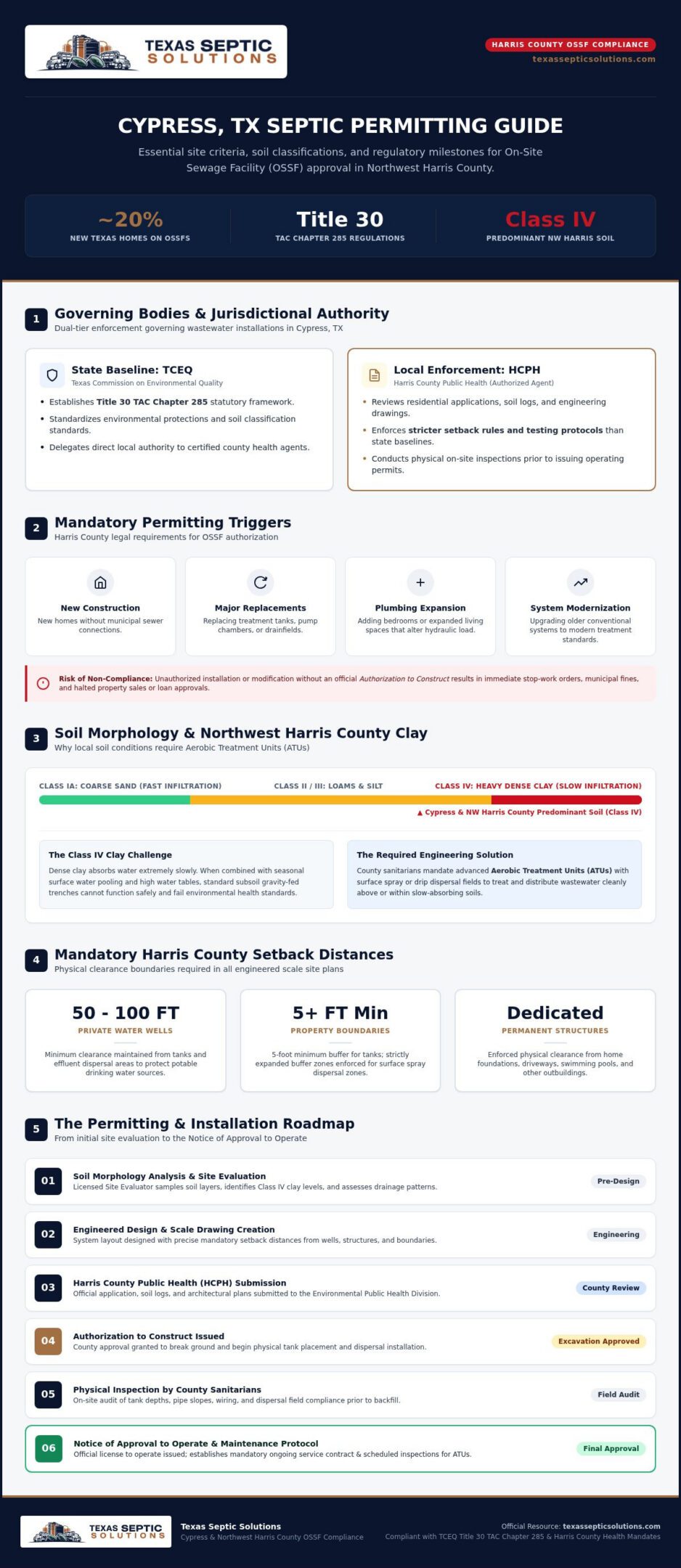
Every private wastewater setup in Texas falls under Title 30 of the Texas Administrative Code (TAC), Chapter 285. In legal terms, the state designates these systems as On-Site Sewage Facilities (OSSFs). While state statutes establish foundational environmental rules, local enforcement does not happen from Austin. Understanding the governing bodies is the first step toward satisfying Cypress TX septic permit requirements without facing regulatory surprises.
Texas permits counties to take direct jurisdiction over local wastewater systems. In Cypress, local health authorities enforce these mandates directly on every parcel. Attempting to install or modify an OSSF without an official Authorization to Construct brings serious consequences, including immediate stop-work orders, steep municipal fines, and red tape that halts property sales or loan approvals.
The Role of Harris County Public Health (HCPH)
Harris County acts as the official TCEQ Authorized Agent for unincorporated Cypress communities. The HCPH Environmental Public Health Division reviews all residential wastewater applications, architectural site plans, and soil data. Before your system goes live, county sanitarians perform comprehensive physical inspections. Harris County also enforces stricter setback limits and testing protocols than the state baseline, meaning state approval guidelines alone won’t suffice.
When Is a Septic Permit Legally Required in Cypress?
A permit is non-negotiable for virtually any major wastewater project. Many homeowners understand what a septic system is, but few realize that altering one demands strict government oversight. You must pull an official permit when:
- Building a new residential property on any lot without municipal sewer access.
- Replacing an existing treatment tank, pump chamber, or dispersal field.
- Substantially altering plumbing loads, such as adding bedrooms or living spaces.
- Upgrading an aged conventional system to modern treatment standards.
If you need to overhaul an aging setup, review our detailed guide on septic system replacement cost in Texas to understand the structural scopes, engineering hurdles, and logistical workflows involved. Planning these details early ensures your installation aligns with county code from day one.
Core Site Requirements for a Cypress Septic Permit Approval
Securing permit approval in Harris County depends on your dirt. While many homeowners assume they can install any wastewater system they prefer, the physical characteristics of your land dictate the engineering. Fulfilling Cypress TX septic permit requirements begins with demonstrating that your property can safely process effluent without threatening the local water table.
Every application submitted to Harris County must include a comprehensive site evaluation and engineered scale drawing. These documents map out every critical physical boundary on your parcel, ensuring the proposed setup satisfies both state mandates and strict regional environmental protections.
Soil Morphology and Site Evaluation Standards
Before designing your system, a licensed site evaluator must perform a thorough soil morphology analysis. The Texas Commission on Environmental Quality (TCEQ) categorizes soils from Class Ia (coarse sand) to Class IV (dense clay). Northwest Harris County predominantly features Class IV heavy clays. These dense soils absorb water very slowly, which almost always prevents the use of traditional gravity-fed trenches.
Regional drainage patterns and shallow water tables complicate approvals even further. When poorly absorbing clay combines with seasonal surface water pooling, standard subsoil drainage fails. In these conditions, county sanitarians require advanced Aerobic Treatment Units (ATUs) equipped with surface spray or drip dispersal fields to ensure sanitary wastewater management.
Crucial Setback Distances in Harris County
Site plans must feature precise scale drawings that maintain mandatory physical clearances. The county rejects incomplete submissions immediately if setback distances are missing or compromised. Essential boundaries include:
- Private Water Wells: Keep tanks and effluent dispersal areas between 50 to 100 feet away to safeguard potable drinking sources.
- Property Boundaries: Maintain at least 5 feet between tanks and property lines, with larger buffer zones enforced for spray dispersal.
- Permanent Structures: Ensure dedicated clearance from home foundations, driveways, swimming pools, and outbuildings.
- Recorded Easements: Preserve access lanes for regional drainage, utilities, or roadways without building any system components over them.
Overlooking a pipeline easement or underestimating property line buffers will send your plans back for costly revisions. If you are preparing to build or upgrade, working with trusted local specialists like Texas Septic Solutions ensures your site evaluation and engineered blueprints meet county expectations on the very first submittal.
Conventional vs. Aerobic System Permitting Requirements
Choosing between a conventional setup and an aerobic unit completely changes your regulatory roadmap under Cypress TX septic permit requirements. System selection determines who can draft your plans, what technical documentation Harris County demands, and what legal responsibilities you carry long after installation wraps up.
While both configurations safely manage residential wastewater, they function under distinct mechanical principles and regulatory tiers. Conventional systems rely on anaerobic digestion inside a septic tank before gravity feeds effluent into subsurface gravel or chamber trenches. Aerobic Treatment Units (ATUs) introduce oxygen to treat wastewater to a much higher standard before distributing it across your yard through specialized spray heads or subsurface drip lines.
Permitting Conventional Septic Systems
Conventional systems present a simpler administrative process, but they are rare in Cypress. Harris County only approves them on properties blessed with coarse, highly permeable soils and deep groundwater tables. For these select parcels, a licensed OSSF installer or registered sanitarian can draft the site plan without needing an engineer’s stamp. Once approved and installed, the county doesn’t require homeowners to hold an active, third-party service contract, leaving ongoing upkeep to the homeowner’s discretion.
Permitting Aerobic Treatment Units (ATUs)
Because dense clay dominates the local landscape, most Cypress builds require an aerobic configuration. Harris County enforces strict compliance measures for ATUs from initial design through daily operation:
- Engineered Blueprints: All aerobic plans require detailed technical calculations and official stamps from a licensed Texas Professional Engineer (PE).
- Two-Year Initial Policy: State and local codes mandate that your initial permit submission includes an executed two-year service agreement with a licensed provider.
- Strict Inspection Frequency: Harris County enforces inspections every three months, exceeding the state baseline to ensure mechanical aerators, pumps, and chlorinators run properly.
Securing an active septic system maintenance plan isn’t merely an operational safeguard; it is a permanent legal condition of your operating permit. Staying educated on mandatory septic system maintenance Texas regulations helps you plan ahead, avoid county non-compliance citations, and keep your mechanical system working without interruption.
The Step-by-Step Cypress Septic Permitting Process
Fulfilling Cypress TX septic permit requirements involves a strict linear progression. Skipping steps or doing work out of sequence causes rejected applications and costly construction stops. Harris County requires specific milestones before any contractor drives a shovel into your soil.
First, a certified site evaluator analyzes your property to produce a formal soil morphology report. Next, a Texas Professional Engineer or registered sanitarian designs a custom wastewater system tailored to your specific lot lines, estimated daily water usage, and natural drainage paths. Only after these technical plans are finalized can your package move into the county review queue.
Application Submission and Documentation Checklist
Harris County processes permit packages through its online ePermits portal. Your submission must arrive completely intact to avoid immediate administrative rejection. Your filing package requires several key documents:
- Completed HCPH OSSF Application: Official forms outlining property owner information, designer details, and planned daily hydraulic loads.
- Proof of Ownership: A recorded deed or county tax statement matching the exact legal boundary description.
- Affidavit to the Public: A notarized document filed with the Harris County Clerk acknowledging that an aerobic system operates on the property.
- Initial Maintenance Contract: A signed, fully executed two-year service agreement with a licensed maintenance provider for all aerobic installations.
- Engineered Plans: Comprehensive scale drawings showing tanks, dispersal fields, electrical lines, and mandatory setback buffers.
Once county officials review and approve the submittal, they issue an Authorization to Construct. You cannot dig trenches or place tanks until you hold this document in your hands.
Inspections and Final Authorization to Operate
Securing the construction permit does not mean your project is complete. As work proceeds, county sanitarians conduct site visits to verify real-world installation quality against your approved blueprints. They inspect open trenches, tank structural integrity, anti-buoyancy measures, and aggregate bedding before anything is covered with backfill.
After your contractor finishes the mechanical setup, inspectors run electrical checks, alarm tests, and pressure head distribution evaluations on spray or drip systems. Once the work passes, the county issues your official Notice of Approval to Operate. This certificate provides the legal authorization needed to hook into home plumbing and obtain your residential certificate of occupancy.
Permit paperwork doesn’t have to stall your project. You can reach out to Texas Septic Solutions to handle your soil analysis, engineering submittals, and county inspections from start to finish.
Navigating Permitting Obstacles with Licensed Professionals
Most permit delays do not stem from bad intentions. They happen because of small drafting errors, missing site easements, or unverified soil assessments. Incomplete submittals and inaccurate plot scales remain the primary reasons applications stall within the county review system. Meeting Cypress TX septic permit requirements demands technical accuracy that leaves zero room for guesswork.
Professional oversight shields property owners from administrative bottlenecks. A seasoned contractor manages the complex web of state regulations and county health rules, transforming a confusing permitting journey into a streamlined construction timeline. By coordinating directly with evaluators and engineers, licensed professionals prevent costly inspection failures before the county ever arrives on site.
Resolving Failed Inspections and Aging Non-Compliant Systems
A failed county inspection halts progress immediately. If an inspector finds unapproved tank materials, improper trench depth, or uncertified wiring, they will deny your operating authority on the spot. Without that paperwork, building officials will not issue your home’s certificate of occupancy, leaving new builds and major renovations sitting in legal limbo.
Older systems present similar headaches. When an aged tank collapses or drain fields fail, making unpermitted spot fixes only compounds your legal liability. If you encounter active system failures, reviewing verified septic system repair standards helps you correct malfunctions legally while pulling the required retrofit permits.
Turnkey Permitting and Installation Solutions in Cypress
Managing multiple contractors, site evaluators, and county sanitarians on your own quickly turns into an administrative nightmare. Choosing a turnkey provider eliminates the stress of coordinating separate entities. With over 20 years of hands-on installation and repair experience across Greater Houston, our team bridges the gap between engineering theory and county compliance.
We streamline every stage of the Cypress TX septic permit requirements process. Our specialists oversee your initial soil analysis, commission stamped engineering designs, and manage the entire online submission pipeline with Harris County. Once trenching begins, our dedicated field supervisors meet county sanitarians on your property for open-bedding and final operating tests. You can trust Texas Septic Solutions to deliver reliable, code-compliant installations that safeguard your property value and protect local groundwater for decades to come.
Take Control of Your Cypress Septic Permitting Today
Installing or replacing a wastewater system shouldn’t leave you stranded in county paperwork. Meeting Cypress TX septic permit requirements comes down to thorough preparation: securing an accurate soil morphology report, designing an engineered layout that respects local setbacks, and staying ahead of ongoing aerobic service contracts. Taking these proper steps ensures your installation passes county reviews on schedule.
You don’t have to tackle the bureaucracy alone. Backed by over 20 years of hands-on installation and permitting expertise across Greater Houston, our family-owned team provides complete turnkey service. We manage your site evaluations, engineering blueprints, county portal filings, and on-site health department inspections while backing our work with dependable 24/7 client support.
Ready to break ground without red tape or project delays? Contact Texas Septic Solutions today to schedule your consultation and keep your installation moving forward with total confidence.
Frequently Asked Questions
Do I need a permit to replace an existing septic tank in Cypress, TX?
Yes, replacing a tank requires an official permit before work starts. Harris County considers a tank replacement a major structural modification, not a simple repair. You must submit updated system specifications and pass county bedding and plumbing connection inspections before putting the new tank into service.
Who issues septic permits for residential properties in Cypress?
Harris County Public Health (HCPH) Environmental Public Health Division issues residential septic permits for Cypress. While the state’s TCEQ establishes foundational wastewater laws, Harris County serves as the local Authorized Agent. They process paperwork, review site evaluations, and send field sanitarians to perform mandatory on-site construction inspections.
How long does it take to get a septic permit approved in Harris County?
Permit processing usually takes several weeks once a complete application package is submitted. Timelines depend heavily on the county’s current application volume and the accuracy of your engineering submittals. Missing site dimensions, unverified property easements, or incomplete maintenance affidavits will immediately stall your file in review.
Can a homeowner design and install their own septic system in Cypress?
No, Cypress homeowners cannot design or install their own systems. Meeting Cypress TX septic permit requirements requires professional licensing. Soil evaluations must be conducted by certified site evaluators, aerobic setups require plans stamped by a licensed Texas Professional Engineer, and physical installation must be completed by a state-licensed OSSF installer.
Why are aerobic systems more common than conventional systems in Cypress?
Dense clay soils throughout Northwest Harris County prevent conventional systems from functioning properly. Class IV clays absorb wastewater very slowly, causing standard gravel drain fields to surface or back up. Aerobic systems actively treat effluent to a higher standard, allowing clean surface spray application that complies with local environmental regulations.
What happens if I install a septic system without a permit in Harris County?
Installing an unpermitted septic system triggers immediate stop-work orders and substantial daily fines from Harris County. You risk having your property red-tagged, which halts building occupancy permits and residential utility connections. In addition, unpermitted systems surface during property title transfers, killing real estate sales and mortgage approvals.
What documents are required to apply for an OSSF permit in Cypress?
Applying under Cypress TX septic permit requirements demands a complete technical packet. You need a signed HCPH application form, recorded property deed, detailed soil morphology report, and scaled engineering schematics. For aerobic systems, you must also include a recorded county deed affidavit and a signed two-year initial maintenance agreement.