
How to Extend the Life of Your Drain Field in Cypress: A Homeowner’s Guide
You might be sitting on a five-figure ticking time bomb, and it isn’t your foundation or your roof; it’s your drain field. In Cypress, where the heavy “black gumbo” clay soil already fights against proper drainage, a single mistake in your daily routine can lead to a messy, expensive failure. We know how stressful it is to see water pooling in the yard and wonder if a massive repair bill is coming your way. Learning how to extend the life of your drain field Cypress doesn’t have to be a guessing game of which “septic safe” labels to trust.
We agree that maintaining a septic system in our local soil is a unique challenge that requires more than just luck. This guide promises to give you the specific habits and maintenance steps that prevent field failure and save you thousands in replacement costs. We’ll walk you through a clear checklist of septic-safe habits, explain how to manage your household water usage, and show you how to handle the specific drainage issues of Harris County clay. You’ll finish this article with a professional plan to keep your backyard clean and your bank account intact.
Key Takeaways
- Learn why Cypress “black gumbo” clay is so tough on septic systems and what you can do to keep your soil draining properly.
- Discover the specific water management habits that show you how to extend the life of your drain field Cypress by avoiding hydraulic overload.
- Identify the household “chemical killers” that destroy beneficial bacteria and which “septic-safe” products are actually safe for your pipes.
- Understand the importance of effluent filters and routine pumping as your primary defense against costly sewage backups.
- Get clear guidelines on landscaping and physical protection to prevent root damage and soil compaction over your absorption area.
Understanding Your Cypress Drain Field: Why Soil Matters
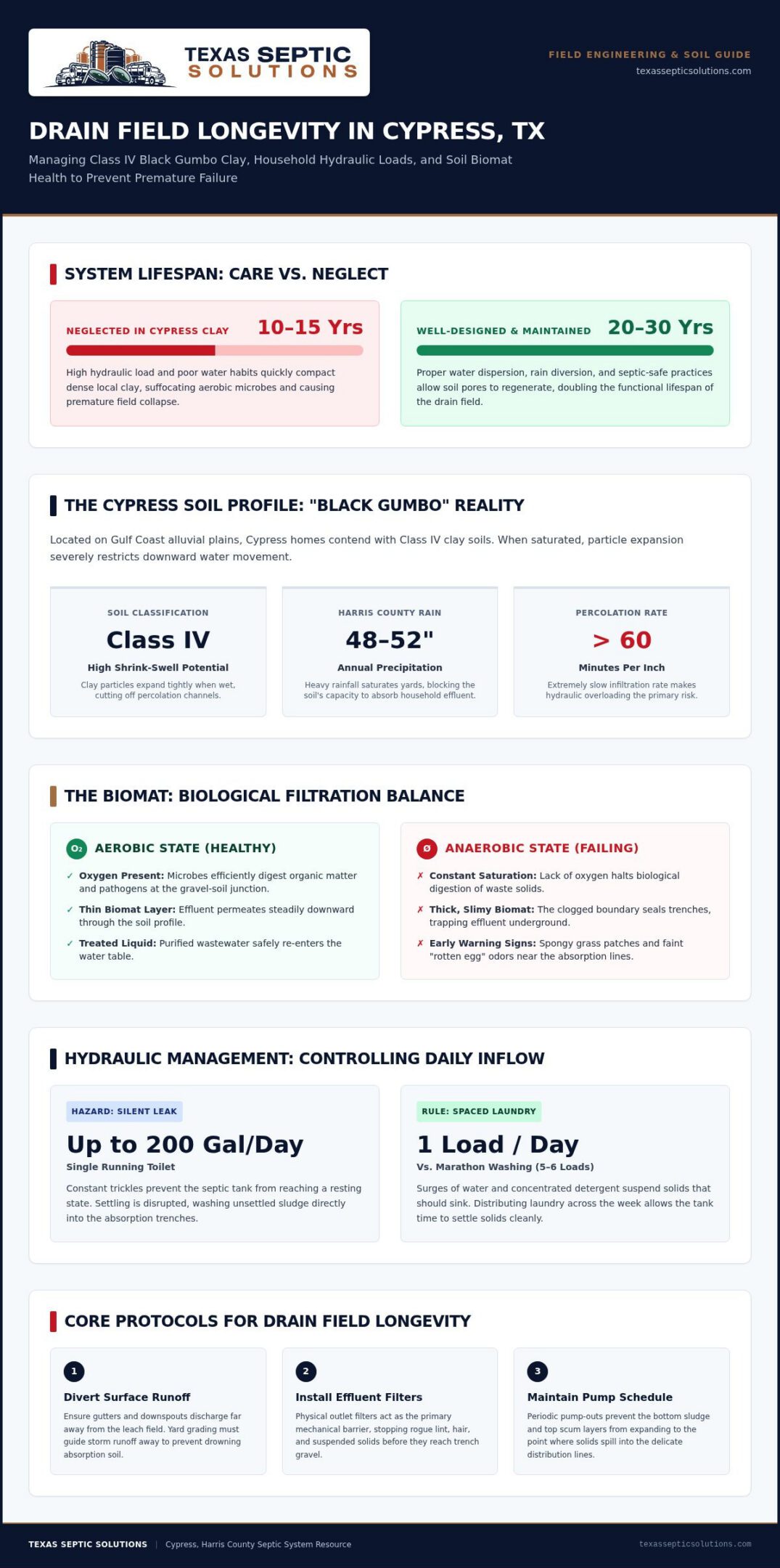
The drain field is the final, most critical stage of wastewater treatment. While your septic tank catches solids, the soil in your backyard actually purifies the liquid effluent. Understanding septic drain field mechanics and soil filtration is the first step in knowing how to extend the life of your drain field Cypress. In a perfect world, a well-designed system should last 20 to 30 years. However, the heavy clay common in Harris County means neglected systems often fail in as little as 10 to 15 years.
The Challenge of Heavy Clay in Cypress, TX
Cypress sits on the Gulf Coast alluvial plains, which are dominated by “Black Gumbo” soil. This Class IV clay has a high shrink-swell potential, meaning the soil particles swell tightly when wet and prevent water from percolating downward. Our region averages 48 to 52 inches of rainfall annually. This high volume, combined with soil that has a percolation rate often exceeding 60 minutes per inch, makes over-saturation the leading cause of premature field death. If the ground is already soaked from a storm, it simply cannot absorb your household wastewater.
How a Healthy Drain Field Functions
A functional field relies on a “biomat.” This is a thin layer of beneficial bacteria that lives where the gravel meets the soil. These microbes digest organic matter and pathogens as effluent passes through. To stay healthy, these bacteria need oxygen. When a system functions correctly, aerobic bacteria efficiently break down waste in the top layers of soil. Oxygen is the most important ingredient for this process; without it, the biological treatment stops.
If your soil becomes constantly saturated, it turns anaerobic. This environment lacks oxygen and causes the biomat to grow too thick and slimy. This “clogged” state prevents water from leaving the trenches, leading to backups or surface pooling. Recognizing these signs early is vital. If you notice spongy grass or a faint “rotten egg” smell near your lines, your soil’s ability to treat waste is likely compromised. Protecting this delicate balance between water, soil, and bacteria is the secret to a long-lasting system.
Mastering Water Management: The Number One Longevity Secret
Water is the vehicle that carries waste through your system, but too much of it becomes a destructive force. Hydraulic overloading occurs when the volume of water entering the tank exceeds its capacity to process it. When you flush a toilet or run a sink, that water needs time to sit so solids can settle to the bottom and fats can float to the top. If the flow is constant, those solids are pushed directly into your absorption lines, where they clog the soil pores. Understanding how to extend the life of your drain field Cypress starts with controlling the faucet.
Maintaining a strict household water budget is essential for system health. Silent leaks are often the biggest culprits of early failure. A single running toilet can dump up to 200 gallons of extra water into your system every day. This constant trickle prevents the tank from ever reaching a state of rest, effectively “washing” sludge into your field. Following EPA drain field care guidelines regarding water conservation and leak repair can prevent this slow-motion disaster.
The ‘One Load a Day’ Laundry Rule
Many families save all their laundry for a “marathon Saturday.” While this is convenient for your schedule, it is a nightmare for your septic system. Doing five or six loads in a row sends a massive surge of water and concentrated detergent into the tank. This surge suspends solids that should be sinking, carrying them straight into the drain field. We recommend spacing out your laundry to one load per day. This simple change gives your tank the settling time it needs to keep your lines clear and your bacteria healthy.
Diverting Rainwater and Runoff
Your drain field already has a full-time job processing household wastewater. It shouldn’t have to deal with Texas thunderstorms too. If your gutters or downspouts point toward your leach field, you are effectively drowning the soil. Saturated soil cannot “breathe” or absorb effluent properly. Check the grading around your yard to ensure surface water flows away from the absorption area. If you notice your yard stays soggy after a rain, scheduling professional septic system maintenance can help identify drainage issues before they lead to a total field collapse. Keeping the area dry allows the soil to remain porous and efficient, protecting your long-term investment.
Septic-Safe Habits: What to Keep Out of Your Pipes
Your septic system is a living biological filter, not a trash can. Every item you send down the drain affects the delicate balance of bacteria required to treat waste. If you want to know how to extend the life of your drain field Cypress, start by looking at what goes into your pipes. Many common household habits act as slow-acting poisons to your system’s longevity.
The biggest offender is often labeled “flushable.” Wipes, even those marketed as septic-safe, do not break down like toilet paper. They snag on tank baffles and eventually find their way into the distribution lines, causing physical blockages. Similarly, garbage disposals are a major burden. They can increase the sludge layer in your tank by up to 50 percent; this makes it much harder to keep solids out of the soil. Grease is another silent killer. Fats, oils, and grease (FOGs) solidify in your pipes and eventually coat the drain field soil, effectively waterproofing the area you need to stay porous.
The Truth About Septic Additives and Enzymes
Many homeowners reach for store-bought additives hoping for a quick fix. However, a healthy tank naturally produces all the bacteria it needs to function. Some additives can even be harmful by liquefying the sludge layer, which allows small particles to escape the tank and clog your drain field. Maintaining a natural bacterial balance through proper waste disposal always beats relying on chemical shortcuts.
Household Cleaners: The Good, The Bad, and The Ugly
Chemical killers like concentrated bleach and caustic drain cleaners destroy the biomat bacteria that purify your effluent. We recommend switching to phosphorus-free and biodegradable detergents to keep your system healthy. Identifying truly safe products means looking past marketing gimmicks and checking for labels that specify “biodegradable” or “non-toxic.” According to Texas A&M AgriLife OSSF maintenance recommendations, regular care and mindful habits are far more effective than any miracle product. For safe, effective cleaning, a simple mixture of white vinegar and baking soda works wonders without harming your system’s biological health. Learning how to extend the life of your drain field Cypress is really about choosing products that support, rather than destroy, your tank’s natural ecosystem.
Physical Maintenance and Landscaping Best Practices
Protecting the physical structure of your system is just as vital as managing what goes down the drain. Many homeowners assume that a thriving, bright green patch of grass over their septic lines is a sign of a healthy yard. In reality, that “lush green grass” is often a warning sign. It suggests the field is failing to absorb liquid properly, forcing effluent to the surface where it over-fertilizes the turf. If you notice one area of your lawn looks significantly better than the rest, it’s time for a professional inspection.
Maintaining Your Effluent Filter
Your effluent filter is the last line of defense for your soil. Located in the outlet tee of the septic tank, this device catches tiny particles like lint, hair, and grit before they can enter the distribution lines. If you want to know how to extend the life of your drain field Cypress, an effluent filter installation is the cheapest field insurance you can buy. These filters should be checked and rinsed during every routine maintenance visit. If your drains start running slow, the filter might be doing its job too well by blocking debris. Cleaning the filter is a simple task that prevents a much larger, more expensive soil failure.
Root Intrusion and Surface Protection
Landscaping over a drain field requires a specific strategy. You should only plant shallow-rooted vegetation, such as Bermuda or St. Augustine grass, over the absorption area. Avoid trees and large shrubs, as their roots are naturally drawn to the moisture and nutrients in septic lines. A safe rule of thumb is to keep trees at a distance at least equal to their mature height. Roots that puncture or wrap around lateral lines can cause immediate hydraulic failure.
Physical weight is another major threat to your system’s longevity. You should never drive or park anything heavier than a standard lawnmower on the field. Vehicles, trailers, and even heavy livestock can compact the Cypress clay soil. This compaction seals off the oxygen that aerobic bacteria need to treat waste and can physically crush the buried pipes. If you suspect your soil has been compacted or roots have already moved in, schedule septic system maintenance to assess the damage before it leads to a backup. Keeping the surface clear and the soil loose allows your drain field to breathe and function for decades.
Professional Care: Your Partner in Longevity
Professional care is the ultimate safety net for your home’s utility health. While your daily habits form the foundation of system longevity, periodic expert intervention is what prevents a small issue from becoming a total field collapse. Pumping your tank every three to five years is a non-negotiable requirement for protecting your soil. This process removes the accumulated sludge and scum that even the healthiest bacteria can’t break down over time. If you wait until your drains gurgle or the yard smells to call for help, you’ve likely already allowed solids to migrate into your absorption lines. Enrolling in a professional septic maintenance plan acts as an essential insurance policy, ensuring that your system is evaluated before failures occur. It’s the most effective way to manage the long-term health of your property.
The Anatomy of a Professional Inspection
A professional inspection goes far beyond just emptying the tank. We examine the structural integrity of the baffles, which are the physical barriers that keep solids where they belong. We also test the septic tank alarm and pump functionality to ensure your system can communicate with you if something goes wrong. Our technicians look for early warning signs of field “ponding,” which is when effluent sits too high in the soil profile. We also check the effluent filter to ensure it’s clean and correctly seated. Catching these issues during a scheduled visit is the best way to understand how to extend the life of your drain field Cypress without facing the stress and cost of a total replacement.
Customized Care for Cypress Properties
Every property in Cypress is unique. A household of two has very different needs than a family of six, and our pumping schedules reflect that reality. We combine local expertise in septic system repair with a neighborly approach that values long-term relationships. Texas Septic Solutions supports the Cypress community with 24/7 emergency services, ensuring you’re never left dealing with a backup alone in the middle of the night. Whether you have a conventional gravity system or a complex aerobic unit, our team understands the specific Harris County permitting and maintenance requirements. Contact us today for a comprehensive system health check. We’ll help you manage your utility so it continues to serve your home reliably for decades.
Protect Your Property With Proactive Septic Care
Your drain field is a critical investment that relies on a balance of smart habits and professional oversight. By managing your daily water budget and keeping harmful chemicals out of your pipes, you’ve already taken the biggest steps toward long-term success. Remember that protecting the physical environment of your yard is just as important; keep heavy vehicles away and ensure your effluent filter remains clean to prevent soil clogging. Understanding how to extend the life of your drain field Cypress gives you the power to avoid sudden failures and expensive replacements.
As a locally owned and operated partner, we’re here to help you maintain that balance. Whether you need a routine check-up or a comprehensive maintenance plan to serve as your system’s insurance, our team is ready to support you. We even offer 24/7 emergency service for those unexpected moments when you need a reliable expert fast. Don’t wait for a backup to act. Schedule your Cypress septic inspection and pumping today with Texas Septic Solutions. Taking care of your system today ensures it takes care of your home for years to come.
Frequently Asked Questions
How many years does a typical drain field last in Cypress, TX?
A properly maintained drain field in Cypress typically lasts between 20 and 30 years. However, our local “Black Gumbo” clay soil is notoriously slow-draining and prone to saturation. If a system is neglected, that lifespan can drop to as little as 10 to 15 years. Consistent maintenance and water management are the only ways to reach the 30-year milestone in Harris County’s difficult soil conditions.
Can I use a garbage disposal if I have a septic system?
You can use a garbage disposal, but we strongly advise against it to protect your system’s longevity. Disposals send finely ground food waste into the tank, which can increase the sludge layer by up to 50 percent. This extra organic load prevents solids from settling properly and eventually pushes them into your absorption lines. If you must use one, plan for more frequent pumping to avoid field clogging.
What is the best type of grass to plant over my leach field?
Bermuda and St. Augustine are the best grasses to plant over your leach field in Cypress. These varieties have shallow root systems that provide excellent surface stabilization without interfering with buried pipes. Avoid any plants with deep, water-seeking roots like willow trees or large shrubs. Healthy turf also helps with evapotranspiration, which assists the soil in processing effluent more efficiently during our humid Texas summers.
How often should I have my septic tank pumped to protect the field?
We recommend pumping your septic tank every 2 to 3 years to protect your drain field. While general guidelines sometimes suggest a longer interval, the heavy clay in Cypress makes frequent service a smarter choice. Regular pumping prevents the sludge layer from overflowing into your distribution lines and causing permanent soil damage. This simple task is the most effective way to learn how to extend the life of your drain field Cypress.
Are septic tank additives actually helpful or just a waste of money?
Most septic tank additives are a waste of money and can actually be harmful to your system. A healthy tank naturally contains all the bacteria it needs to function correctly. Some chemical additives can liquefy the sludge layer, causing those solids to float and exit the tank into your drain field. This leads to premature clogging and hydraulic failure. Stick to regular pumping and mindful habits rather than relying on “miracle” fixes.
What are the first signs that my drain field is starting to fail?
The first signs of failure often include gurgling pipes, slow drains, or a persistent sewage odor in the yard. You might also notice patches of unusually lush, bright green grass over the absorption lines, which indicates the soil isn’t absorbing liquid correctly. In more advanced stages, you’ll see “ponding” or actual sewage surfacing in the yard. If you spot these issues, contact us for an inspection before the damage becomes permanent.
Will a leaky toilet really ruin my entire septic system?
Yes, a leaky toilet can absolutely ruin your septic system. A single running toilet can dump an extra 200 gallons of water into your tank every day. This constant flow causes hydraulic overloading, which flushes solids out of the tank before they can settle. In our local clay soil, this extra volume quickly saturates the field and can lead to a total biological failure in just a few months.
Is it safe to use bleach in my laundry if I have a septic tank?
It’s safe to use small amounts of bleach occasionally, but excessive use will kill the beneficial bacteria in your tank. These microbes are essential for treating waste before it reaches your drain field. If you kill the bacteria with harsh chemicals, the waste won’t break down properly, leading to a thick, slimy buildup that clogs the soil. We recommend switching to oxygen-based bleaches or biodegradable detergents to keep your system’s ecosystem healthy.