
Liberty County Septic Regulations: The 2026 Homeowner’s Reference Guide
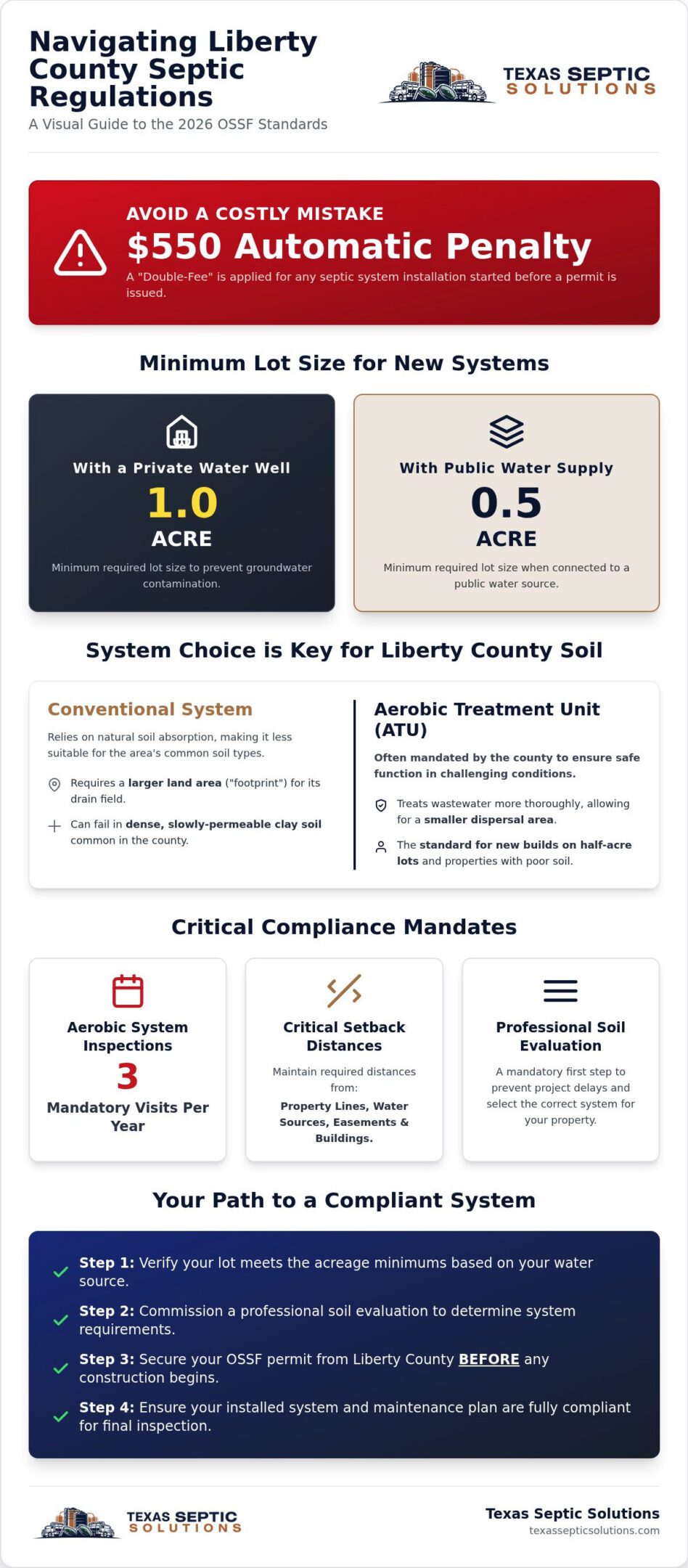
Installing a septic system in Liberty County without a permit isn’t just a risk; it’s an automatic $550 double-fee penalty that stalls your construction before it even begins. We understand that trying to decode Liberty County septic regulations can feel like reading a foreign language, especially when you’re caught between complex soil reports and strict acreage minimums. You’re likely wondering if your half-acre lot is even eligible for a permit or if the county’s heavy clay soil will force you into a more expensive aerobic system.
This guide simplifies the 2026 OSSF standards so you can master the lot size requirements and maintenance schedules needed to get your permit approved the first time. We’ve translated the government jargon into a clear plan for your property. You’ll learn the exact minimums for public versus private water sources, the mandatory inspection intervals for aerobic units, and how to navigate the permitting process without the stress of unexpected delays. Whether you’re building in Cleveland or the southern reaches of the county, we’ll help you ensure your system is fully compliant and ready for a successful final inspection.
Key Takeaways
- Understand the specific acreage minimums required for your property, whether you’re using a private well or a public water supply.
- Avoid the $550 double-fee penalty by securing the correct permits before any construction starts on your land.
- Navigate the latest Liberty County septic regulations to ensure your aerobic system meets the mandatory three-visit annual inspection schedule.
- Identify the critical setback distances needed to keep your system compliant and protect your property’s water sources.
- Learn how professional soil evaluations prevent project delays caused by the county’s challenging clay soil conditions.
Understanding Liberty County OSSF Regulations in 2026
Under Texas law, any system that treats wastewater on your property is technically an On-site Sewage Facility (OSSF). In our neck of the woods, these systems are more than just a utility; they’re a critical part of protecting our local groundwater. Because East Texas often deals with high water tables and dense clay soils, the 2026 Liberty County septic regulations focus heavily on preventing environmental contamination. The Liberty County Permits and Inspections Department, located in Cleveland, serves as the primary authority for ensuring every new build meets these strict safety standards.
The county acts as a “Designated Representative” for the Texas Commission on Environmental Quality (TCEQ). This means that while the state sets the broad environmental goals, Liberty County officials are the ones who actually review your site plans, walk your property, and issue your final green tag. They have the local expertise to know which systems will fail in our specific soil and which will stand the test of time. Working within this framework ensures that your home remains safe and your property value stays intact.
TCEQ vs. Liberty County: Who Sets the Rules?
Texas environmental laws create a hierarchy where the state provides the minimum requirements, but local authorities can implement more rigorous standards. Liberty County often chooses stricter paths because our local soil morphology isn’t always “septic friendly.” In many parts of the county, fine clay prevents traditional gravity systems from draining properly. As a result, the county might require an aerobic system even if state minimums suggest otherwise. We’ve seen this local oversight save homeowners thousands in future repair costs by mandating the right system from day one.
The Legal Consequences of Non-Compliance
Cutting corners on paperwork is a costly mistake. If you begin installing a system before your permit is issued, Liberty County applies a “Double Fee” penalty. This turns a standard application into an immediate $550 headache. Beyond the financial hit, the county can issue health department citations or even place liens on your property that prevent you from selling or refinancing in the future. An OSSF permit is a legal requirement for all systems discharging over 5,000 gallons per day. Staying compliant with Liberty County septic regulations isn’t just about following rules; it’s about protecting your investment and your neighbors.
Lot Size and Acreage Standards for New Septic Systems
Before you buy land or start planning a home in Cleveland, you need to know exactly how much space you have for waste treatment. Liberty County septic regulations establish clear thresholds based on your water source to prevent groundwater contamination. For subdivisions platted after June 1, 1986, the rules are straightforward: if you have a private well, you need at least 1.0 acre. if you’re connected to a public water supply, that minimum requirement drops to 0.5 acres. These rules exist to ensure that effluent doesn’t compromise the very water you and your neighbors drink.
Even if your lot was platted before 1986, don’t assume you’re automatically cleared for a standard system. While these “grandfathered” lots might be smaller than current minimums, they must still comply with Texas’s statewide OSSF regulations regarding performance and safety. If your small lot sits on the heavy, slowly-permeable clay common in the southern part of the county, a traditional gravity system simply won’t drain. In these cases, Liberty County septic regulations often mandate an aerobic treatment unit to ensure the system functions safely within a confined space.
Acreage Minimums for Conventional vs. Aerobic Systems
The choice between a conventional and an aerobic system often comes down to your soil’s absorption rate. Conventional systems require a larger “footprint” for their drain fields to allow water to seep into the ground naturally. On smaller lots, there often isn’t enough physical space to install a field that meets safety standards. This is why aerobic systems are the standard for new builds on half-acre lots. They treat waste more thoroughly before it ever hits the ground, which allows for a much smaller dispersal area. In developing areas, these density regulations prevent “septic clusters” that could overwhelm the local environment and cause system failures across an entire neighborhood.
Calculating Your Build-able Area
Your total acreage isn’t the same as your usable acreage. When we map out a system, we have to subtract several factors first. Utility easements, property line setbacks, and right-of-ways all take a bite out of your available space. If your property is in a floodplain, placement becomes even more restricted. You’ll need to account for these constraints long before the first shovel hits the dirt. Getting an early start on your new septic system installation planning helps you avoid the frustration of finding out your dream home layout won’t leave enough room for a legal septic system. We always recommend a professional site evaluation to identify these boundaries before you finalize your building plans.
Liberty County Setback Requirements and Site Constraints
Once you’ve confirmed your lot size meets the minimums discussed earlier, the next step is determining exactly where your system can sit. Setback requirements are the “buffer zones” that keep effluent away from your home, your water, and your neighbors. According to the Liberty County Order for On-Site Sewage Facilities, these distances are non-negotiable. For instance, you must maintain a minimum distance of 5 feet from property lines and 10 feet from your home’s foundation or swimming pool. These gaps prevent wastewater from undermining your slab or leaking into your backyard oasis.
Surface water protection is equally vital in our region. If your property borders a creek, pond, or even a standard drainage ditch, Liberty County septic regulations require specific setbacks to prevent runoff. Generally, you’ll need to keep the dispersal area at least 75 to 100 feet away from the high-water mark of any lake or river. This is especially critical for those building near the Trinity River, where seasonal flooding can complicate system placement. We also look for underground utilities; keeping your tanks away from power lines and water mains ensures that future repairs won’t turn into a multi-utility disaster.
Protecting Your Water Source
The most critical setback involves your drinking water. If you use a private well, your septic tanks must be at least 50 feet away, and the drainage field must stay 100 feet back. This isn’t an arbitrary number. When a well pumps water, it creates a “cone of depression” in the water table that can actually pull nearby contaminants toward the well head. If your neighbor’s well is right on the property line, you’re still responsible for maintaining that 100-foot distance from their well, not just your own. We often have to coordinate with adjacent landowners to ensure everyone’s water stays clean and compliant.
Managing Site Constraints in Cleveland and Cypress
In areas like Cleveland and Cypress, the land isn’t always a flat, dry canvas. Heavy clay soils dominate the landscape, which means water doesn’t move through the ground quickly. If your lot has significant slopes or elevation changes, gravity might pull effluent toward a neighbor’s yard before it can be treated. We often apply septic system repair principles when designing new layouts to troubleshoot these potential failures before they happen. By understanding how a system breaks down over time, we can place your OSSF in a spot that accounts for both the soil’s limitations and the natural flow of the land.
Maintenance Mandates and Inspection Schedules
Once your system is in the ground, the work isn’t over. Liberty County septic regulations require that every aerobic system remains under a valid maintenance contract for its entire lifespan. The county follows a strict “Rule of Three,” which means a licensed provider must inspect your system every four months. These three annual visits ensure that the mechanical components, such as aerators and pumps, are functioning correctly. This proactive approach prevents raw sewage from surfacing in your yard and protects the local environment.
Reporting is a major part of this process. After each visit, your maintenance provider must submit an inspection tag to the County Designated Representative. This creates a paper trail that proves your system is operating within state and local safety parameters. While some property owners consider maintaining their own systems, the technical requirements and reporting hurdles often make professional oversight the more reliable choice. Keeping these records up to date is the only way to avoid unwanted attention from the Permits and Inspections Department.
The Aerobic Maintenance Contract Explained
A legal maintenance agreement is more than just a piece of paper; it’s your proof of compliance. A septic system maintenance plan keeps you in good standing with the county by automating your inspection schedule and reporting. If you let your contract lapse, you risk heavy fines and potential “lockout” orders. In extreme cases, the county can deem a property uninhabitable if the septic system isn’t under a professional’s care. We’ve seen how quickly a small mechanical failure can turn into a total system replacement when maintenance is ignored.
Preparing for the County’s Final Inspection
Before you can legally use your new OSSF, you must pass a final walk-through. Field inspectors, like Norma Ibarra, perform a thorough check of the entire installation. They look for specific details: the depth of the tanks, the spray head coverage, and the integrity of the electrical wiring. Common reasons for failure in Liberty County include improper tank bedding or spray patterns that cross property lines. We always recommend having your installer present during this final sign-off. This allows us to make immediate adjustments if the inspector identifies a minor issue, which saves you from paying for a second inspection and waiting weeks for a follow-up visit.
We take the stress out of compliance by managing your inspections and paperwork from day one. Contact us to schedule your maintenance and ensure your system stays permit-ready all year long.
Navigating Compliance with Texas Septic Solutions
Understanding Liberty County septic regulations is a great first step, but putting that knowledge into practice requires a team that knows the local landscape inside and out. We act as your advocate and bridge to the Liberty County Permits and Inspections Department. Our team handles the heavy lifting, from the initial soil morphology study to the final inspection tag. By managing the technical design and the bureaucratic paperwork, we ensure your project moves forward without the common delays that plague DIY permit applications.
We provide an all-encompassing service model that covers every stage of your system’s life. This starts with a design that accounts for the specific clay content of your soil and ends with a professional installation that meets every setback requirement we’ve discussed. Once your system is live, our custom maintenance plans are built specifically to satisfy the 2026 county standards. We don’t just install a tank and leave; we stay on your team to manage the mandatory reporting and inspection schedules that keep your home in good standing.
System failures don’t happen on a schedule. If an alarm triggers or a component fails an inspection, we offer 24/7 support to resolve the issue immediately. This readiness is part of our commitment to being a one-stop resource for Liberty County property owners. We’ve seen every possible scenario in the field, and we remain unfazed by the challenges of East Texas terrain. Our goal is to provide the stability and promptness you need to keep your household running smoothly.
Our Partnership with Liberty County Homeowners
We’ve built our reputation on being a reliable local authority in Cleveland, Houston, and Shepherd. Our proximity to these areas allows for rapid response times, whether you’re in the middle of a new build or facing an emergency repair. We take over the complex paperwork and coordination with county inspectors so you can focus on the rest of your construction project. We are dedicated to providing “neighborly expert” service that treats your property with the same care and accountability we would give our own.
Your Next Steps for a Compliant System
Getting your system permit-ready starts with a professional soil site evaluation. This critical first step dictates the type of system you can install and where it must be placed to satisfy Liberty County septic regulations. While you prepare for your build, we recommend reviewing our septic system maintenance Texas guides to understand the long-term care your OSSF will require. Contact us today for a consultation on your Liberty County project, and let’s get your installation started on the right foot.
Secure Your Property with Expert OSSF Guidance
Building or maintaining a home in East Texas shouldn’t be defined by regulatory stress. By understanding the specific lot size minimums and the mandatory “Rule of Three” inspection schedule, you’ve already taken the biggest steps toward a permit-ready property. Compliance with Liberty County septic regulations ensures that your investment is protected and your local environment remains safe for years to come. Whether you’re navigating the heavy clay soils of Cleveland or planning a new build near the Trinity River, having a reliable local authority on your side makes all the difference.
Texas Septic Solutions is built to handle the high-pressure demands of unexpected failures and the routine tasks of long-term upkeep. Our licensed and insured installers bring expert knowledge of local OSSF codes to every project. We provide the stability you need with 24/7 emergency repair availability and professional maintenance plans that satisfy county contract requirements. Don’t let paperwork or technical hurdles stall your progress.
Ensure your Liberty County project is 100% compliant—Contact Texas Septic Solutions today!
We’re ready to help you secure a system that works as hard as you do and stays compliant for the long haul.
Frequently Asked Questions
Do I need a permit to repair my septic system in Liberty County?
You generally need a permit for any major repair that alters the system’s design or footprint. While minor fixes like replacing a broken lid or a clogged aerator might not require a full application, moving a line or replacing a tank falls under Liberty County septic regulations. It’s always best to check with the Permits and Inspections Department first to avoid the double-fee penalty for unauthorized work.
What is the minimum lot size for a septic tank in Liberty County?
The minimum lot size depends on your water source for any subdivision platted after June 1, 1986. If your property uses a private well, you must have at least 1.0 acre to install a septic system. If you’re connected to a public water supply, the requirement decreases to 0.5 acres. These standards ensure there’s enough space to prevent effluent from contaminating your drinking water or neighboring properties.
Can I install my own septic system if I live on the property?
No, you cannot install your own system in Liberty County even if you live on the property. The county requires all OSSF installations to be performed by a licensed contractor who is registered with the state and the local permit office. This ensures the system is built to the engineered design and passes the mandatory site inspection before being covered. Attempting a DIY installation can lead to significant fines and a refusal of the final permit.
How often does Liberty County require septic inspections?
Aerobic septic systems must be inspected three times per year, or roughly every four months. This “Rule of Three” is a mandatory requirement for all aerobic units under a maintenance contract. These recurring checks verify that the aerator, pump, and spray heads are functioning correctly. After each visit, a licensed provider submits an inspection tag to the county to prove your system remains in full compliance with local health standards.
What happens if my septic tank alarm goes off in the middle of the night?
If your alarm sounds, immediately silence the buzzer and minimize your water usage to prevent a backup. An alarm usually indicates a high water level or a mechanical failure in the pump or aerator. Because these issues often happen at inconvenient times, we provide 24/7 emergency support to address the problem quickly. Avoid flushing toilets or running the dishwasher until a technician can diagnose the system and restore proper function.
How much does a septic permit cost in Liberty County for 2026?
The standard permit fee for a new residential septic system in Liberty County is $275 for 2026. You should also expect a state TCEQ fee of $10 to be added to the total. If your property is located within a floodplain, you’ll need an additional building permit, which starts at $125 plus a square-footage fee for living space. These fees cover the cost of plan review and the final field inspection.
Are aerobic systems mandatory in all parts of Liberty County?
Aerobic systems aren’t technically mandatory by law in every corner of the county, but they’re often the only viable option due to our soil. Much of Liberty County consists of fine clay that doesn’t allow water to drain quickly enough for a traditional gravity system. During your mandatory soil evaluation, a professional will determine if your land can handle a conventional field. In most new developments, aerobic units are required to meet modern safety standards.
How do I find my property’s soil morphology report?
You don’t find an existing soil report; you must have one performed specifically for your permit application. You’ll need to hire a licensed soil scientist, sanitarian, or engineer to conduct a site evaluation on your property. They’ll analyze the soil layers and water table to determine which Liberty County septic regulations apply to your build. This report is a mandatory prerequisite that tells the designer exactly what type of system your land can support.