
How to Find Septic Tank Records in Texas: A Step-by-Step Homeowner Guide (2026)
Imagine you’re standing in your backyard with a shovel, staring at a patch of grass that might, or might not, be hiding your septic tank. It’s a frustrating spot to be in, especially when the previous owner didn’t leave behind a single scrap of paperwork. You shouldn’t have to guess where your lines are or worry about digging in the wrong spot just to perform basic maintenance.
We understand how stressful it feels when you’re stuck dealing with confusing government websites or missing site maps. This guide explains exactly how to find septic tank records in Texas using the latest 2026 state and county resources. You’ll learn how to track down your official OSSF permit and download a PDF of your site diagram directly from the source.
We’ll walk you through the TCEQ’s digital tracking systems, help you identify which local county authorities hold your files, and provide a clear plan of action if your property predates modern record-keeping. By the time you’re done reading, you’ll know exactly who to call and where to look to get the answers you need.
Key Takeaways
- Identify exactly what paperwork you need, including “as-built” drawings that show the precise layout of your On-Site Sewage Facility (OSSF).
- Master how to find septic tank records in Texas by navigating the TCEQ Central Registry and locating your specific county’s authorized agent office.
- Navigate the search for older systems by understanding the “Grandfather Clause” and learning physical locating techniques like tracing cleanout lines.
- Learn to interpret technical site maps so you can pinpoint tank components and ensure your property remains compliant with state setback requirements.
- Discover when to transition from a DIY search to professional locating services that use advanced tools like electronic transmitters and pipe cameras.
Understanding Texas OSSF Records: What You Are Looking For
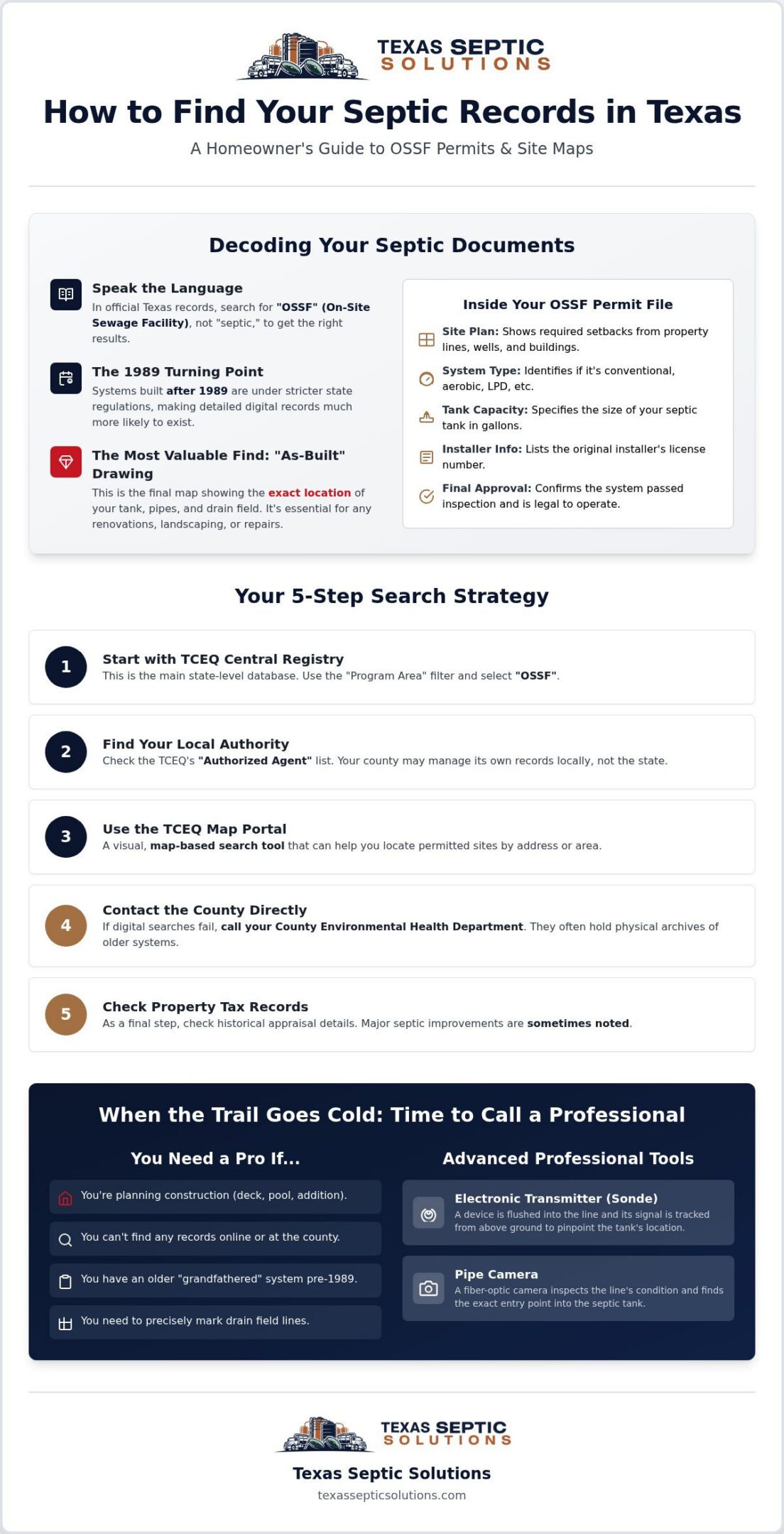
When you start digging into property files, you’ll notice that Texas government agencies rarely use the word “septic.” Instead, they use the technical term Onsite Sewage Facilities (OSSF). This term covers everything from traditional gravity systems to modern aerobic units. Knowing this terminology is the first hurdle in learning how to find septic tank records in Texas. If you search local databases for “septic,” you might hit a dead end; searching for “OSSF permits” usually yields the results you need.
The year 1989 serves as a major turning point for Texas homeowners. This was when the state implemented stricter, more uniform OSSF regulations. If your home was built after 1989, there’s a much higher chance that a detailed permit exists in a government database. For older properties, records are often “grandfathered,” meaning the system might have been installed before modern documentation was required. In these cases, finding a paper trail requires a bit more detective work.
The “as-built” drawing is the crown jewel of septic records. This isn’t just a theoretical design; it’s a map created after the installation that shows the exact location of the tank, the routing of the pipes, and the layout of the drain field. Having this document is vital if you’re planning a home renovation. It ensures you don’t accidentally build a deck or a pool over your lines, helping you avoid a massive septic system repair caused by heavy machinery or structural interference.
Key Components of a Texas Septic Permit
A complete OSSF permit file contains several specific documents you’ll want to download. Look for the site plan, which details the required setbacks from your home, water wells, and property lines. It should also specify the system type, such as aerobic or conventional, and the total tank capacity. Finally, the record will list the original installer’s license number and the date of the final inspection. This inspection date confirms the system was legally approved for use.
Why Your County Health Department is Your Best Friend
While the state sets the rules, the Texas Commission on Environmental Quality (TCEQ) often delegates authority to “Authorized Agents.” These are usually county health or environmental departments. These local offices are often the only places where physical archives of older systems are kept. When you’re figuring out how to find septic tank records in Texas, calling the county office is often faster than clicking through state websites. They can also clarify the difference between a “Permit to Construct,” which is just the initial application, and the “Notice of Approval,” which is the final legal document you actually need.
How to Search for Septic Records Online in Texas
Digital archives have made the process of tracking down property data much faster, but you have to know which database to unlock. In the Lone Star State, the search begins at the state level before narrowing down to your local office. Learning how to find septic tank records in Texas is often a process of elimination between different portals. Start with this five step sequence:
- Start with the TCEQ Central Registry Query tool to see if a state-level permit exists.
- Check the TCEQ Authorized Agent list to see if your county manages its own records locally.
- Use the Texas Commission on Environmental Quality (TCEQ) map-based portal for a visual search of permitted sites.
- Contact your local County Environmental Health Department directly if digital searches come up empty.
- Search your county’s property tax records, as major septic improvements are sometimes noted in historical appraisal details.
While you wait for search results to load, reviewing the EPA guide to septic system care is a smart move. It helps you understand exactly what components, like distribution boxes or lateral lines, you should be looking for on any maps or diagrams you discover.
Navigating the TCEQ Central Registry
When using the Central Registry tool, the “Program Area” filter is your most important setting. You must select “OSSF” to filter out irrelevant industrial or water quality permits. When searching by address, keep it simple. Try entering just the house number and street name without “Street” or “Avenue” to avoid formatting errors. If you find a Regulated Entity Number (RN) but no documents, it means a record exists but hasn’t been digitized. You’ll need to call the regional TCEQ office with that RN number to request a copy.
County-Specific Online Portals (Harris, Liberty, Montgomery)
For homeowners in Harris, Liberty, or Montgomery counties, the county’s own environmental or permits page is often more reliable than the state site. Look for tabs labeled “Public Records” or “Permit Search.” These local databases are updated more frequently and often include the specific site diagrams that show exactly where your tank is buried. If the online search comes up empty, many local offices allow you to request a record search via email. If digital tools fail to provide the answers you need, the team at Texas Septic Solutions can assist with professional locating to get your maintenance back on track.
What to Do If Your Texas Septic Records Are Missing
It’s a common scenario across East Texas: you’ve searched the databases, called the county, and still come up empty-handed. If you are struggling with how to find septic tank records in Texas for an older home, you might be dealing with a “grandfathered” system. Before 1989, state-wide regulations were less stringent, and many rural systems were installed without the formal OSSF permits we see today. If your property falls into this category, you’ll need to rely on physical evidence and historical research rather than digital archives.
The Texas landscape often gives away the location of hidden components if you know what to look for. Look for areas where the grass is unusually lush and green, even during a dry summer; this often indicates the drain field location. Conversely, a slight depression in the soil might mark the spot where a tank lid was buried decades ago. Don’t confuse a standard property survey with a septic site map. A survey shows your house and property lines, but it rarely includes the underground utility layout. You’ll need a dedicated site diagram for that, which is why physical locating becomes so necessary.
Physical Locating Techniques for Homeowners
You can often narrow down the search by locating the main sewer line cleanout outside your home. This is typically a white PVC pipe with a screw-on cap. From there, the main line usually runs straight to the tank, often 10 to 20 feet away from the foundation. Using a thin soil probe rod, you can gently tap the ground to feel for the solid resistance of a concrete or plastic lid. Just remember the golden rule of Texas excavation: always call 811 before you do any significant digging to ensure you don’t hit power or gas lines.
Legal Requirements for “Lost” Systems
Missing records can create hurdles during a property transfer or renovation. While Texas law doesn’t always require you to create a new record for a functioning grandfathered system, many lenders and buyers will insist on a professional inspection before closing. If the system fails that inspection, a lack of original permits makes it harder to determine the current capacity. This often complicates the planning phase for a septic system replacement, as designers won’t have a baseline to work from. In some jurisdictions, like when searching for Travis County septic records, you can file a formal Public Information Act request to see if any historical hand-written files exist in physical archives that haven’t been scanned yet.
How to Read Your Septic Site Map and Locate Components
Once you’ve successfully navigated the state databases and learned how to find septic tank records in Texas, you’ll likely receive a scanned PDF of your original site map. This document is your blueprint for property maintenance. It identifies the “Cleanout,” which is the access point where your main sewer line leaves the house, and distinguishes it from the “Inlet” and “Outlet” pipes of the tank itself. Understanding these labels is vital because it tells you exactly where the waste enters the treatment process and where it exits toward the drain field.
The map also highlights critical setback requirements mandated by the Texas Commission on Environmental Quality (TCEQ). Standard rules usually require tanks to be at least 5 feet from property lines and 5 to 10 feet from building foundations. By comparing these distances to the physical layout of your yard, you can verify if your system was installed according to code. Identifying the “Disposal Area” or drain field is equally important. This section of your property, along with the designated “reserve area,” must remain clear of all structures. You should never drive, park, or build over these zones, as heavy vehicles can crush lateral lines and compact the soil, leading to system failure.
Decoding Map Symbols and Terminology
Texas OSSF maps use specific shorthand that can be confusing at first glance. If you have a conventional gravity system, look for the “D-Box” symbol, which represents the distribution box that routes effluent to different lines. “Distribution Lines” are often shown as a series of parallel dashed lines. Inside the tank, the map might note a “T-Baffle,” which prevents solids from escaping into the drain field. For those with aerobic systems, the “Disposal Area” usually indicates the location of spray heads or drip irrigation lines. Always check the scale and the North arrow on the map to orient yourself correctly before you start measuring.
Measuring from Fixed Points
To pinpoint the tank without digging up your entire yard, use a 100 foot tape measure to match the distances shown on your map. The most effective method is “triangulation.” Measure the distance from two fixed corners of your house to the tank center as indicated on the drawing. Where those two measurements intersect is where you should find your lid. Once you’ve located it, consider installing a permanent riser or a simple stake. This makes future inspections much easier. If the map is too faded to read or doesn’t match what you see on the ground, Texas Septic Solutions can provide professional locating services to find your components with precision.
When to Hire a Professional Locating Service in Texas
Sometimes the paper trail ends before you find the answers you need. Even if you have mastered how to find septic tank records in Texas, the physical reality of your backyard might not match the old diagrams. If your tank is buried deeper than a standard soil probe can reach, or if the property has been regraded over the years, professional locating becomes a necessity. We use specialized electronic flushable transmitters, known as Sondes, to solve this problem. A technician flushes the Sonde down a toilet or drops it into a cleanout; it travels through the line and stops at the tank. An above-ground receiver then pinpoints the exact location and depth with remarkable accuracy.
CCTV pipe inspections provide another layer of clarity for complex properties. By threading a high-resolution camera through your sewer lines, we can identify hidden junctions, root intrusions, or blockages that might be masking the tank’s location. The most efficient way to handle this is by combining a tank search with a routine pumping service. This allows us to find the system, open it safely, and clear out the waste in one visit. Once the components are found, we can help you update your records with a professional site diagram. This ensures you never have to repeat the stress of a “lost” system search in the future.
The Risks of DIY Locating
Trying to find a buried tank on your own carries both physical and financial risks. It is very easy to accidentally crack a PVC inlet pipe or puncture a lid with a heavy metal probe rod. If you have an aerobic system or a large home, you might actually have a multi-tank setup. DIYers often find the first tank and assume the job is done, missing the second or third tank that also requires service. Most importantly, never attempt to open a septic tank alone. Lethal gases like methane and hydrogen sulfide can build up inside; additionally, an old lid could crumble under weight, leading to a dangerous fall.
Next Steps After Locating Your System
Finding the tank is only the first step in protecting your investment. Once the location is confirmed, it is the perfect time to schedule a septic system maintenance Texas checkup. This inspection ensures that your baffles are intact and your effluent levels are healthy. To save yourself from future digging, we recommend installing a riser. This brings the access point to the surface, allowing for easy inspections without disturbing your landscaping. If you are still struggling with how to find septic tank records in Texas or cannot find your tank lids, contact Texas Septic Solutions for a professional site assessment. We bring the tools and local expertise to get your system back on the map.
Secure Your Property’s Future with Accurate Records
Finding your property’s OSSF documents doesn’t have to be a mystery. By using the TCEQ registry or contacting your local county health department, you can often secure the digital files needed for your next renovation or maintenance checkup. If the paper trail has gone cold for an older home, remember that physical clues like lush grass or cleanout pipes are your best starting points. Knowing how to find septic tank records in Texas is a vital skill for every homeowner; however, you don’t have to navigate the technical details alone.
Whether you need a professional site diagram or a routine pump-out to find a buried tank, our team is ready to assist. Need help finding or servicing your septic system? Contact Texas Septic Solutions today! We are local experts serving Cleveland, Houston, and surrounding areas. Our team specializes in OSSF record recovery and system mapping; plus, we provide 24/7 emergency support when you need it most. You can move forward with confidence knowing your system is accurately mapped and professionally maintained.
Frequently Asked Questions
Is there a central database for all septic systems in Texas?
No, there isn’t one single master database for every system in the state. While the TCEQ maintains a Central Registry, many populous counties act as Authorized Agents and manage their own permitting data locally. You’ll need to check both state registries and your specific county environmental health office to conduct a thorough search.
What if my county doesn’t have an online septic permit search?
You should call the county environmental health department or the permit office directly if an online portal isn’t available. Many Texas counties still maintain physical archives for older systems that haven’t been digitized yet. You can also file a formal Public Information Act request to have a clerk search their paper records for your property address.
How much does it cost to get a copy of my septic records in Texas?
Digital copies found through online portals are typically free to download. If you need a physical copy from a county office, you might pay a nominal per-page fee for printing and administrative time. While the original permit application fees range from $125 to $500 depending on the county, retrieving an existing record is usually an inexpensive or free process.
Can a Realtor help me find septic tank records during a home sale?
Realtors can often assist by reviewing the Seller’s Disclosure Notice or checking with the title company for past permits. However, if the paperwork wasn’t preserved by previous owners, they’ll likely use the same state and local resources described in this guide. Learning how to find septic tank records in Texas is a smart move for any buyer or seller to ensure a smooth closing.
What is the most common reason septic records are missing?
The most common reason is that the system was installed before 1989, which was the year Texas implemented stricter state-wide OSSF regulations. Many rural systems built before this era were never officially permitted or mapped. This lack of documentation is a frequent challenge when researching how to find septic tank records in Texas for historical properties.
Does a property survey show the location of the septic tank?
Standard property surveys usually don’t include the location of septic tanks or drain fields. A survey focuses on property boundaries, easements, and the footprint of permanent structures like the house. To find your underground utility layout, you specifically need an “as-built” drawing, which is a separate document often found in your OSSF permit file.
Should I call 811 before probing the ground for my septic tank?
You should always call 811 before you start probing or digging in your yard. Even if you’re only using a thin metal rod to tap for a lid, you don’t want to accidentally strike an underground power line, gas pipe, or water main. It’s a free service that keeps your DIY search safe and prevents costly utility damage.
What do I do if my septic tank alarm is going off but I can’t find the tank?
You should call for emergency septic service immediately if your alarm is sounding and you can’t locate the system. An alarm typically indicates a high-water event or a pump failure that could lead to a backup in your home. Professionals use electronic Sondes to find the tank quickly, even if it’s buried deep or hidden by thick landscaping.