
Harris County Septic System Regulations: The 2026 Homeowner’s Compliance Guide
Did you know that a simple lapse in your maintenance contract can escalate into a misdemeanor violation under current local orders? For many homeowners in unincorporated areas, trying to decipher the Harris County septic system regulations feels like learning a second language while your backyard is under construction. It’s stressful to wait four to ten weeks for a permit while wondering if you’ve missed a critical piece of paperwork in the ePermits portal.
We understand that you want a functional home, not a legal headache. That’s why we’ve created this comprehensive guide to help you navigate the red tape with confidence. You’ll gain a clear understanding of the permitting process, learn how to stay compliant with 2026 standards, and find out how to secure a licensed partner to handle the heavy lifting. We’re covering everything from soil analysis requirements to the final inspection, ensuring your system remains a silent, reliable part of your property.
Key Takeaways
- Understand how to navigate the Harris County Office of the County Engineer’s ePermits system to avoid common application delays and paperwork errors.
- Learn the essential steps for starting your project, including when a feasibility study is required and how to choose the right licensed professional for your design.
- Stay in full compliance with Harris County septic system regulations by understanding the mandatory maintenance contracts required for all aerobic systems.
- Identify the specific design differences between residential and commercial systems to ensure your property meets the latest 2026 standards.
- Discover how partnering with a local expert can simplify the complex permitting process and provide long-term protection for your home’s functionality.
Understanding the Legal Framework for Septic Systems in Harris County
Under Texas law, any system that treats and disposes of sewage on your property is officially called an On-Site Sewage Facility (OSSF). While you might simply call it a septic tank, the state views it as a critical piece of public health infrastructure. The baseline for safety across the entire state is Title 30 of the Texas Administrative Code, Chapter 285, often just called 30 TAC 285. This rule sets the minimum standards for design and installation, but it isn’t the final word for residents here. Because our region faces unique drainage challenges, Harris County septic system regulations are often more stringent than the state’s minimum requirements.
Harris County operates under a “Local Order.” This means the county has adopted specific rules that override or add to the state’s baseline to protect our local environment. These regulations aren’t just bureaucratic hurdles; they directly impact your property value and the safety of your community. Understanding how septic systems work within this specific framework is the first step toward a successful installation or repair project. A system that doesn’t meet these local standards can’t be legally operated, which could stall a home sale or lead to costly retrofits.
TCEQ vs. Harris County Local Orders
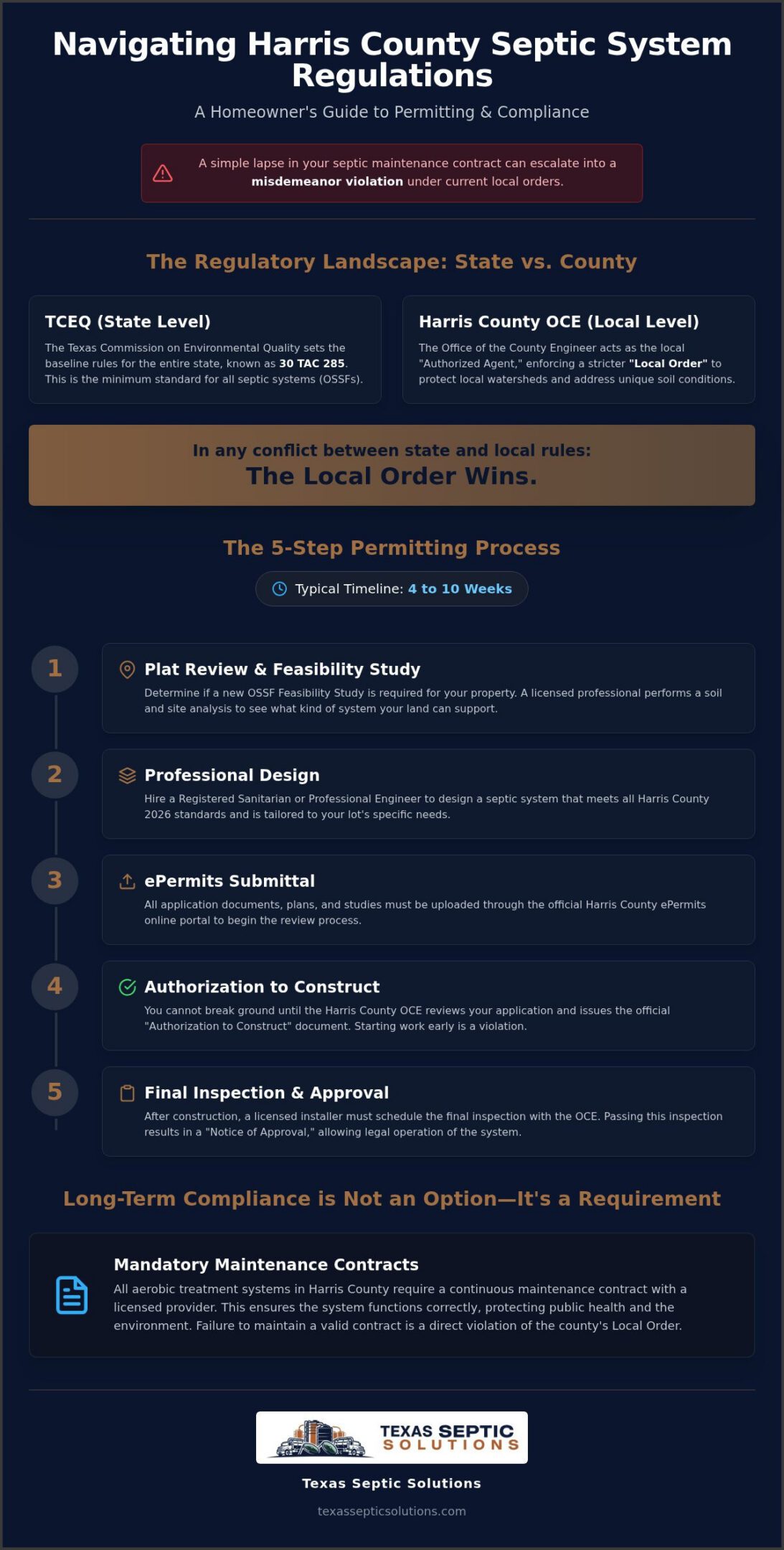
The Texas Commission on Environmental Quality (TCEQ) sets the broad rules for the state, but they delegate authority to local governments. In our area, the Harris County Office of the County Engineer (OCE) acts as the “Authorized Agent.” This hierarchy means that when local rules are stricter than state standards, the local order wins. These variations exist primarily to protect Harris County watersheds from contamination, especially given our clay-heavy soil and high water tables. If you don’t follow these local mandates, you risk more than just a system failure. Non-compliance can lead to significant daily fines or even a summons to the Justice of the Peace Courts for misdemeanor violations.
Who Regulates Your System?
If your property is in an unincorporated part of the county, the OCE’s Watershed Protection Division has direct oversight of your system. For those within city limits, a different municipal authority might apply, but the OCE remains the primary gatekeeper for most rural and suburban residents. Because the Harris County septic system regulations are so technical, the county requires a licensed professional for all regulatory interactions. You can’t submit your own designs or perform your own site evaluations. A Registered Sanitarian or Professional Engineer must prepare your plans to ensure they meet the specific 2026 standards for drainage and environmental safety.
Navigating the Permitting and Feasibility Process in 2026
Securing a permit for your property is often the most time-consuming part of any construction project. In 2026, the Harris County septic system regulations require a multi-step approval process before a single drop of wastewater can enter your system. While these rules follow the statewide Texas septic regulations, the local Office of the County Engineer (OCE) adds specific layers of oversight to protect our groundwater. Most homeowners find the process takes anywhere from four to ten weeks, so it’s vital to start early.
This administrative hurdle applies to various property enhancements; for example, those installing a new pool with Voss & Sons, LLC must also navigate specific site evaluations and engineering requirements to ensure compliance and safety.
The journey begins with five critical milestones:
- Step 1: Plat Review. You must determine if an OSSF Feasibility Study was already conducted for your plat or if a new one is required.
- Step 2: Professional Design. You’ll need to hire a Registered Sanitarian or Professional Engineer to design a system tailored to your specific lot.
- Step 3: ePermits Submittal. All residential applications must be uploaded through the Harris County ePermits portal.
- Step 4: Authorization to Construct. You cannot break ground until the OCE issues this specific document.
- Step 5: Final Inspection. Once construction is complete, a licensed installer must provide at least 24-hour notice to schedule the final OCE inspection and receive your Notice of Approval.
If the technical side of the ePermits portal feels overwhelming, our team can manage the new septic system installation paperwork from start to finish.
The Feasibility Study: Soil and Site Evaluation
A feasibility study is the foundation of your entire design. A licensed professional will perform a soil analysis to see how well your land handles water. In Harris County, our heavy clay soil often dictates the need for aerobic treatment rather than traditional gravity systems. Rejections often happen when designs don’t account for proper setbacks from water wells or property lines. Topography also plays a role; your system must be positioned to avoid flooding and ensure long-term functionality.
Permit Documents and ePermit Requirements
Your digital submittal must be complete to avoid delays. This includes detailed site maps, technical system designs, and a signed maintenance affidavit. Harris County doesn’t publish a flat base fee for OSSF permits; instead, the exact amount is confirmed once your application is reviewed in the portal. To keep your project moving, ensure your designer includes every required attachment. Missing a single signature on a maintenance contract can reset your 4-10 week waiting period.
Maintenance Contracts: A Legal Requirement, Not an Option
In Harris County, owning an aerobic septic system comes with a specific set of legal obligations. Unlike traditional gravity systems, aerobic units are essentially miniature wastewater treatment plants. Because they use mechanical parts and disinfection, the county requires a continuous maintenance contract with a licensed provider. This isn’t just about system health; it’s a core part of Harris County septic system permitting and long-term compliance. Without a valid contract on file, your permit can be revoked, making it illegal to occupy the home.
Local orders mandate that your system is inspected every four months. These three annual visits ensure that the discharge meets environmental safety standards before it’s released into the environment. Your maintenance provider is responsible for submitting these reports directly to the county via their digital tracking system. If a report is missed or a contract expires, the county’s automated system flags your property for enforcement. Staying ahead of these inspections is the most effective way to avoid an expensive, unplanned septic system repair that could have been caught early during a routine check.
What a Legal Maintenance Visit Includes
A professional inspection goes far beyond a quick visual check. Your technician will test chlorine residual levels to ensure the water is being properly disinfected before it hits your lawn. They also check the air compressor and aerator, which are the “lungs” of your system. A standard visit typically involves:
- Measuring sludge accumulation to determine when the next pumping is necessary.
- Cleaning the air filters and spray heads to prevent backpressure and pump strain.
- Verifying that all electrical components, including the control panel, function correctly.
If your septic tank alarm starts going off, it’s often a sign of a pump failure or a high-water event. A valid maintenance contract ensures you have a professional ready to respond before a small glitch becomes a major failure.
Avoiding Misdemeanor Violations
The Harris County Office of the County Engineer takes compliance seriously. If you fail to maintain a valid contract, the case can be referred to the Justice of the Peace Courts. These are handled as Class C misdemeanor violations, which can result in daily fines until the property is brought back into compliance. The simplest way to protect yourself is to keep a current septic system maintenance plan on file with a trusted provider. If your current contract is nearing its expiration date, don’t wait for a notice from the county. Reach out to a licensed partner to renew your agreement and ensure your reporting remains seamless. Following Harris County septic system regulations doesn’t have to be stressful when you have a reliable team handling the paperwork and technical checks for you.
Residential vs. Commercial Septic Regulations
While most homeowners focus on standard residential rules, property managers and business owners must navigate a separate set of Harris County septic system regulations. The county distinguishes between these two categories based on waste volume and wastewater strength. A typical single-family home produces predictable domestic waste, but a commercial site might generate thousands of gallons daily or handle chemicals and fats that a standard system can’t process. If your property serves a business, a church, or multiple dwellings, you’re likely operating under commercial standards. These systems require more frequent testing and reporting to ensure the higher volume doesn’t overwhelm the local soil and watersheds.
Special Rules for Food Establishments
Restaurants and food service businesses face the most rigorous standards in the county. Because “high-strength” wastewater from commercial kitchens contains elevated levels of organic matter, a standard aerobic unit isn’t enough. The Office of the County Engineer (OCE) requires these designs to carry a Professional Engineer (PE) seal. You’ll also need a properly sized grease trap to intercept fats, oils, and grease before they reach the treatment tank. Without this, your system will fail quickly, leading to backups and health code violations. Compliance for food establishments also involves more frequent sampling to verify that the treated water meets strict discharge limits. If you’re struggling with a system that can’t keep up with your kitchen’s output, our team offers 24/7 emergency septic service to get your business back online.
Multi-Family and Large-Scale OSSF Rules
RV parks, mobile home communities, and small retail centers fall into a unique regulatory bracket. These sites often experience “surge flows” where water usage spikes at specific times of the day. To manage this, Harris County often mandates the installation of flow meters and larger equalization tanks. These components help spread the waste load evenly over 24 hours, preventing the system from being “washed out” during peak hours. It’s also important to remember that any expansion of your facility, like adding more RV spots or office space, requires a permit amendment. Your existing Authorization to Construct only covers the capacity listed on the original application. Operating beyond that capacity is a direct violation of local orders and can lead to immediate enforcement action from the Watershed Protection Division. Additionally, for property managers planning to upgrade their communication infrastructure during these expansions, click here for expert cabling solutions.
Ensuring Long-Term Compliance with Texas Septic Solutions
Managing a property in unincorporated areas shouldn’t feel like a full-time job in government relations. While the Harris County septic system regulations are designed to protect our local water supply, the technical requirements for applications and maintenance can be overwhelming for any homeowner. We take the stress out of the equation by acting as your professional liaison with the Office of the County Engineer. From the initial ePermits submittal to the final walkthrough, we handle the red tape so you can focus on your home. Our team understands the local landscape and the specific preferences of county inspectors, ensuring your project moves forward without unnecessary friction.
Staying compliant is a long-term commitment that goes beyond the initial installation. A proactive approach is the only way to avoid the misdemeanor violations mentioned earlier in this guide. Investing in professional septic system maintenance in Texas is your best defense against both mechanical failure and legal liability. We design our maintenance programs to satisfy every requirement of the Harris County Local Orders, providing the automated reporting and regular technical checks you need to keep your permit in good standing. You’ll never have to wonder if your paperwork was filed or if your system is meeting environmental standards.
Expert Design and Installation Services
Every successful system starts with a design that respects the unique soil conditions of your lot. We work closely with licensed installers and engineers who are deeply familiar with the 2026 environmental standards. This expertise allows us to integrate soil testing, site evaluation, and system design into one seamless process. Because we know what Harris County inspectors look for during the “Authorization to Construct” phase, we build systems that pass inspection the first time. This attention to detail prevents the costly reinspection fees and project delays that often plague DIY or inexperienced attempts at installation.
Emergency Response and Compliance Safety
System failures don’t wait for business hours, and a malfunctioning aerobic unit can quickly become a code-critical issue. If your system stops treating waste correctly, you aren’t just facing a mess; you’re facing a potential violation of Harris County septic system regulations. Our 24/7 emergency support provides the rapid septic system repair needed to restore functionality before the county takes notice. We prioritize transparency and promptness, ensuring that any mechanical glitch is resolved before it escalates into a legal or environmental headache. Contact us today for a comprehensive compliance audit of your Harris County system to ensure you’re fully protected for the year ahead.
Secure Your Property’s Future Today
Staying ahead of Harris County septic system regulations doesn’t have to be a source of constant stress. We’ve explored how a clear understanding of the permitting process and a commitment to mandatory maintenance contracts can protect you from misdemeanor violations and costly system failures. By following the 2026 guidelines for soil testing and professional design, you ensure your home remains a safe and valuable asset. It’s all about being proactive rather than waiting for a notice from the county or an unexpected backup in your yard.
Our team of licensed and insured OSSF specialists is ready to help you navigate the ePermits system with ease. We offer 24/7 emergency availability and the deep local knowledge required to satisfy every Harris County inspector. Let us handle the technical details and the legal paperwork so you don’t have to. Schedule your Harris County compliance consultation with Texas Septic Solutions today!
We’re proud to serve our neighbors and keep our local watersheds clean. Your system is in good hands with experts who care about this community as much as you do. Let’s work together to keep your property running smoothly.
Frequently Asked Questions
Do I really need a maintenance contract for my septic system in Harris County?
Yes, a maintenance contract is a legal mandate for all aerobic systems under Harris County septic system regulations. The county requires this agreement to ensure your system continues to treat wastewater safely. If you let your contract lapse, your operating permit becomes invalid. This can lead to legal notices or fines from the Watershed Protection Division. It’s the only way the county can verify that your system isn’t harming the local environment.
How often does Harris County require septic inspections?
Harris County requires a minimum of three inspections per year, spaced approximately four months apart. These regular checks are necessary for aerobic systems to verify chlorine residuals and mechanical parts like aerators. Your licensed provider must submit these reports directly to the Office of the County Engineer. Staying on this schedule prevents small mechanical issues from turning into major failures that require emergency repairs.
What happens if I build a septic system without a permit in Harris County?
Constructing a system without a permit is a serious violation that often results in Class C misdemeanor charges. You’ll likely face daily fines until the situation is resolved. In many cases, the county will force you to dig up the system so an inspector can verify the installation. This process is far more expensive than simply following the correct Harris County septic system regulations from the start of your project.
How do I submit my maintenance contract to the Office of the County Engineer?
You don’t typically submit the contract yourself; your licensed maintenance provider handles the digital upload. They use the Harris County ePermits portal to file the required maintenance affidavit on your behalf. It’s a good idea to ask your provider for a confirmation receipt once they’ve completed the submittal. This ensures your property remains in good standing and avoids any automated compliance warnings from the county’s tracking system.
Can I perform my own septic maintenance in Harris County?
No, homeowners in Harris County cannot legally perform their own maintenance on aerobic septic systems. The law requires a licensed OSSF Maintenance Provider to conduct the inspections and file the necessary reports. This rule ensures that testing for chlorine and sludge levels is performed accurately by a trained professional. Attempting to DIY your maintenance won’t satisfy the county’s reporting requirements and could lead to a lapse in your legal compliance.
What is an OSSF Feasibility Study and when do I need one?
An OSSF Feasibility Study is a technical evaluation used to see if a piece of land is suitable for a septic system. You’ll need one if you’re subdividing land or if your specific lot doesn’t have a prior OSSF approval on the recorded plat. This study looks at soil types, topography, and drainage patterns. It’s a critical first step that determines if your construction plans are actually viable under local rules.
How long does it take to get a septic permit in Harris County in 2026?
In 2026, you should plan for the permitting process to take between four and ten weeks from start to finish. This window includes the time needed for your engineer to design the system and for the county to review the technical submittals. Delays often happen if paperwork is missing or if the ePermits portal is experiencing a high volume of applications. Starting your application early is the best way to keep your project on track.
Is a soil test required for every new septic installation?
Yes, a professional soil analysis is a mandatory requirement for every new septic system installation in the county. A licensed professional must perform a site evaluation to identify the soil texture and any restrictive horizons like rock or groundwater. This data is the most important factor in your system’s design. Without a documented soil test, the Office of the County Engineer won’t issue an “Authorization to Construct” for your property.