
Septic System Soil Test Cost in Houston: 2026 Homeowner’s Guide
Your soil test isn’t just a hurdle for a permit; it’s the single most important document that decides whether your Houston property needs a standard drainfield or a much more expensive aerobic system. Most homeowners expect a quick “perc test,” but they’re often surprised by the complexity of our local “gumbo” clay. It’s stressful to plan a budget when you aren’t sure if you’ll need to rent a backhoe or if your land will even pass inspection. We know that uncertainty about the septic system soil test cost Houston market rates can make starting a new build feel like a gamble.
You deserve a clear, professional roadmap for your property. In this 2026 guide, we’ll break down the factors that influence professional site evaluation fees and why a simple percolation test isn’t enough for Harris County regulations. You’ll learn how Houston’s unique soil dictates your system design and how to avoid hidden fees like equipment rentals. By the end, you’ll have the confidence to hire a local expert who understands exactly how to handle the challenges of Texas clay, ensuring your home stays functional for years to come.
Key Takeaways
- Learn why a comprehensive Texas Site Evaluation is the mandatory first step for your permit, going far beyond a simple percolation test.
- Budget accurately by identifying the septic system soil test cost Houston homeowners face, including often-overlooked expenses like backhoe rentals.
- Understand how Houston’s “gumbo” clay (Class IV soil) directly influences your system design and can shift your requirements toward an aerobic system.
- Get a checklist to vet local evaluators to ensure your soil report is accurate, preventing expensive system failures or redesigns down the road.
- Discover the step-by-step timeline from your initial soil probe to breaking ground on a custom-designed septic installation.
Understanding the Soil Test: Site Evaluation vs. Perc Testing in Houston
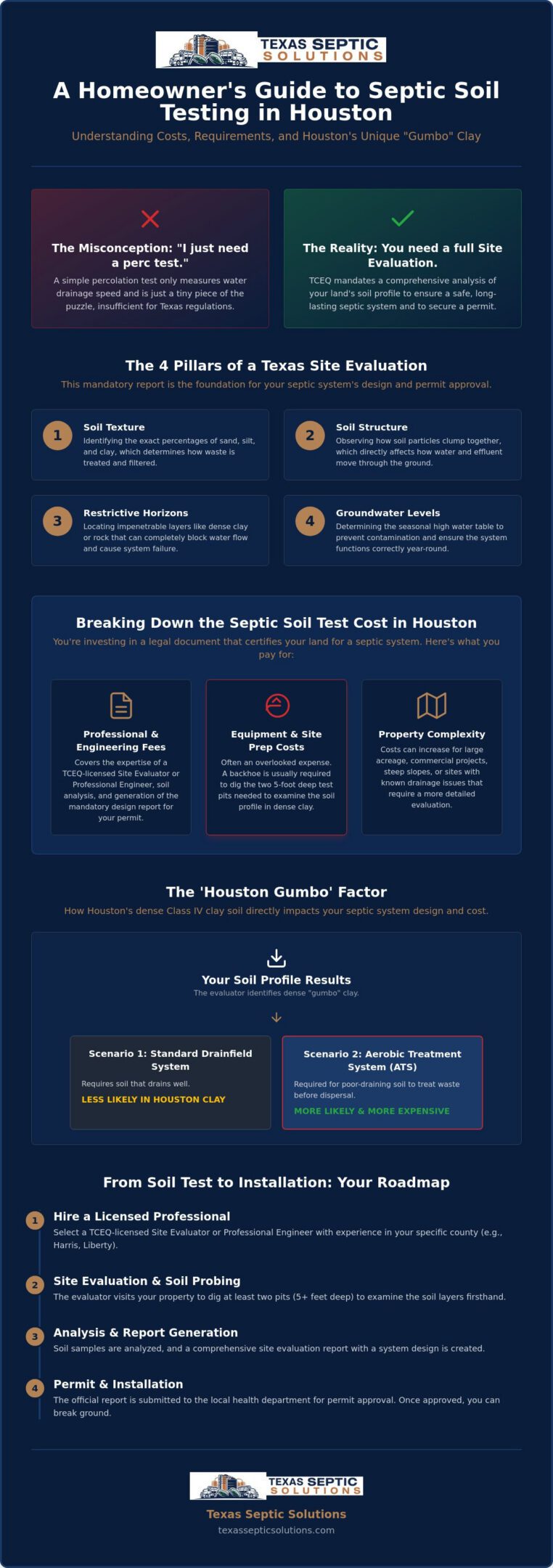
Getting your land ready for a new home involves several steps; few are as critical as the initial site evaluation. Many people search for a Percolation test when they really need a full Texas Site Evaluation. While a perc test measures how fast water drains through a hole in the ground, it’s only one small piece of the puzzle. In Texas, specifically for an On-Site Sewage Facility (OSSF), the state requires a much more comprehensive look at your land. This data is the foundation where septic system design and installation begins. Without it, you’re essentially guessing where your wastewater will go.
A proper site evaluation looks at four main factors:
- Soil Texture: Identifying the specific percentages of sand, silt, and clay in your yard.
- Soil Structure: Observing how the soil particles clump together, which affects how water moves.
- Restrictive Horizons: Finding rock layers or dense clay that stops water flow entirely.
- Groundwater Levels: Determining how close the seasonal water table is to the surface to prevent contamination.
TCEQ Requirements for Houston Area Homeowners
The Texas Commission on Environmental Quality (TCEQ) sets the rules for every property owner. They don’t just want to know how fast water drains; they want to see a “Soil Profile.” This means your evaluator will typically dig two holes, at least five feet deep, to examine the different layers of earth. You can’t just have a neighbor with a shovel do this. State law mandates that only a licensed Site Evaluator or a Professional Engineer (PE) can perform these tests. This ensures that the septic system soil test cost Houston residents pay results in a report that actually holds up during the permitting process.
Why a Soil Test is Non-Negotiable for Your Permit
If you’re building in Harris or Liberty County, your local health department won’t even look at your application without a signed soil report. These officials use your soil data to approve or deny your permit. This is why the septic system soil test cost Houston property owners invest in is so vital. It is the only way to prove your land can handle waste safely. Proactive planning and a solid design are the first steps toward long-term septic system maintenance Texas homeowners rely on to keep their properties safe. Bypassing this step or looking for the cheapest, fastest option often leads to “gumbo” clay clogging your lines within just a few years.
Breaking Down the Septic System Soil Test Cost in Houston
Planning your budget for a new septic system requires looking beyond the sticker price of the tank itself. The total septic system soil test cost Houston residents encounter usually depends on three main variables: the evaluator’s professional fee, the equipment needed to dig the pits, and the complexity of your property. While a basic test in other parts of Texas might be cheaper, Houston’s dense clay requires a more rigorous approach. You aren’t just paying for a hole in the ground; you’re paying for a legal document that certifies your land is safe for wastewater treatment.
Professional Fees and Engineering Labor
Expect to pay for the expertise of a TCEQ-licensed site evaluator or a professional engineer. These pros often offer flat-fee packages for residential properties, but the price can climb if you have a large acreage or a commercial project that requires more than the standard two test pits. This fee doesn’t just cover the time spent on your land. It includes the labor of analyzing soil samples and producing the mandatory written design report. This report is the legal document your county health department requires for permit approval. In areas like Huffman or Cypress, the complexity of the “gumbo” clay often requires more detailed engineering, which can push professional fees toward the higher end of the local market range. Geotechnical engineers may also charge more if the site has a history of drainage issues or steep slopes that complicate the design.
Equipment and Site Preparation Costs
One of the most common “hidden” costs is the machinery required to perform the test. To conduct a proper soil profile evaluation, a licensed pro needs to see at least five feet into the earth. Hand-digging through heavy Houston clay is nearly impossible and extremely time-consuming. Most evaluators require a backhoe or mini-excavator to be on-site. Backhoe rentals in the Houston area typically range from $200 to $500, and this is often a separate charge from the evaluator’s professional fee. While some homeowners consider the “DIY” option of digging their own pits, most pros prefer to bring their own operator. An experienced operator knows exactly how to dig without collapsing the sidewalls, which is vital for an accurate soil reading.
If your lot is heavily wooded or covered in debris, you might also face site preparation costs. Heavy equipment needs a clear, stable path to reach the testing location. We often recommend that homeowners clear brush or low-hanging limbs beforehand to avoid additional hourly labor charges from the equipment operator. If you’re feeling overwhelmed by the logistics of coordinating machinery and engineers, Texas Septic Solutions can help you manage the transition from soil testing to a full system installation.
The ‘Houston Gumbo’ Factor: How Local Soil Impacts Your Budget
“Houston Gumbo” is more than just a local nickname. It’s a technical reality that dictates how you manage wastewater on your property. This heavy, Class IV clay is characterized by extremely fine particles that pack together tightly. When it rains in East Texas, this soil absorbs water and expands, leaving almost no room for additional effluent to filter through. This density is the primary reason many properties in Harris County fail a traditional percolation test. If the water can’t move down through the soil, a standard gravity-fed drainfield simply won’t work.
The results of your site evaluation are the primary driver of your total project budget. When a test reveals dense clay, it typically “forces” the design toward an aerobic treatment system. While these systems are more complex than conventional ones, they’re often the only safe way to manage waste in our local environment. Ignoring these soil realities or hoping for a “lucky” result often leads to significant trouble. We’ve seen that septic system repair is much more frequent on properties where the initial design didn’t account for the unique stresses of Houston’s heavy clay. A thorough soil report prevents these expensive failures by ensuring the system matches the land’s actual absorption capacity.
Class IV Clay vs. Class I Sandy Loam
Texas evaluators categorize soil from Class I to Class IV. Class I soils are sandy and allow water to move freely. You might find these in parts of Cleveland or north of Liberty, where cheaper conventional systems are still viable. However, the septic system soil test cost Houston property owners pay usually confirms the presence of Class IV clay. This soil type requires the advanced treatment found in Aerobic Treatment Units (ATUs). These units treat the water to a higher standard before spraying it over the lawn or using drip irrigation, bypassing the drainage issues of the clay altogether.
Seasonal Impact on Testing Costs
Houston’s weather can directly affect your testing timeline and expenses. Heavy rainfall and a high water table often delay site evaluations because pits can’t be safely dug or accurately read when they’re full of water. If you schedule testing during a particularly wet season, your evaluator might need to dig more pits than usual to find a suitable, non-saturated location. This extra labor can increase your total septic system soil test cost Houston. For the best results, try to schedule your site evaluation during the late spring or summer. The ground is drier then, which allows for a much clearer view of the soil profile and a faster turnaround on your permit application.
Saving Money vs. Cutting Corners: A Homeowner’s Decision Guide
When you’re comparing quotes, it’s tempting to go with the lowest number you see. But in our experience, the septic system soil test cost Houston homeowners pay upfront is a small fraction of what a failed design costs down the road. Choosing the right evaluator is about more than finding a bargain. A “cheap” soil test often results in an undersized system or a design that doesn’t account for the seasonal water table. If your initial design is flawed, you might face a massive septic system replacement cost much sooner than expected. A quality site evaluation provides what we call the “Value of Design.” This means the evaluator takes the time to find the most efficient location on your lot, which can save you thousands in unnecessary installation labor and materials.
A detailed soil report acts as a blueprint for your contractor. If the report is vague, the installer might over-engineer the system to “be safe,” adding extra spray heads or a larger tank than you actually need. By investing in a precise evaluation, you’re buying insurance against inflated installation quotes. Before you sign any contract, use this quick checklist to vet your evaluator:
- Verify their TCEQ Site Evaluator license is active and in good standing.
- Ask how many tests they’ve performed specifically in Harris or Liberty County clay.
- Confirm they provide a stamped, permit-ready report that local health departments will accept.
- Ask if they include a specific recommendation for the system type based on your soil profile.
What to Look for in a Soil Test Quote
Don’t just look at the bottom line. Ensure the quote includes the filing of the report with your local county health department. Some evaluators charge a base fee but then add “pass-through” costs for backhoe rentals or travel time. You want a quote that clearly states whether equipment is included or if you’re responsible for hiring a separate operator. Most importantly, verify that the professional will provide a clear recommendation for the system type. You don’t want a pile of raw data; you want a clear path forward for your permit.
The True Cost of a Failed Perc Test
If your first test pit fails to drain, don’t panic. Finding a “fail” during the testing phase is significantly cheaper than discovering it after your system is in the ground. A failed test usually requires the evaluator to dig in a secondary location to find better soil. While this might slightly increase your immediate septic system soil test cost Houston, it prevents the need for “engineered” soil solutions later. These solutions involve hauling in specific sand and loam to replace the clay, which can double your installation costs. Contact Texas Septic Solutions today to ensure your site evaluation is handled by experts who know Houston soil.
Next Steps: From Soil Test to Septic Installation
Once the field work is finished, you’ll receive a detailed site evaluation report. This document acts as the bridge between your raw land and a functioning home. In the Houston area, the timeline from receiving this report to breaking ground usually takes a few weeks. This period depends mostly on how fast the county health department processes your permit application. We take the data from your report to build a custom system that respects your property’s specific limits. It ensures that your septic system soil test cost Houston investment leads to a design that actually works for your lifestyle.
Using precise data from your evaluation helps us avoid the “one size fits all” trap. If your soil profile showed dense clay layers, we can pinpoint the exact depth and location for your tanks and dispersal lines. This level of precision ensures your system isn’t just compliant with Texas law; it’s built for long-term durability. Once the installation is complete, your focus should shift toward protecting that investment. Every new system works best when paired with a septic system maintenance plan to keep your mechanical components running and your warranty valid.
Reviewing Your Design Options
Your soil report will list a specific “Application Rate.” This number tells us exactly how much wastewater your ground can safely absorb per square foot. If you have the heavy clay common in our region, this rate will be quite low. A low rate means you either need a very large footprint for a conventional leach field or the high-efficiency dispersal of an aerobic system. Comparing these footprints is about more than just yard space. It’s about how you plan to use your property. Aerobic systems often save space but require more frequent mechanical check-ups than a gravity-fed drainfield. Understanding these maintenance requirements now prevents surprises after your landscaping is finished.
Why Texas Septic Solutions is Houston’s Trusted Choice
Navigating the strict regulations in Cleveland, Cypress, and Houston requires a partner who understands the local landscape. We pride ourselves on being a “neighborly expert” who remains unfazed by the challenges of East Texas soil. Whether you’re dealing with a complex new build or need a reliable team for long-term care, we have the experience to guide you through every step. We offer 24/7 support because we know that utility issues don’t always happen during business hours. Choosing a local authority ensures that your project stays on track and meets all TCEQ standards.
Contact us for a comprehensive site evaluation and installation estimate.
Secure Your Property’s Future with Professional Site Evaluation
Handling the complexities of Houston’s “gumbo” clay doesn’t have to be a stressful process. By understanding the septic system soil test cost Houston property owners face, you’ve already taken the first step toward a successful build. A thorough site evaluation is your best defense against future system failures and expensive redesigns. Whether you are in Cleveland, Cypress, Huffman, or Shepherd, the data from your soil profile will determine if a conventional or aerobic system is the right fit for your land. It’s about getting the design right the first time so you don’t have to worry about it later.
At Texas Septic Solutions, we have spent over a decade providing expert design tailored specifically for Houston’s unique clay soils. Our team of fully licensed and TCEQ-compliant evaluators is ready to help you move from permit approval to a long-lasting installation. We pride ourselves on being the neighborly experts you can rely on for everything from initial testing to 24/7 emergency support. Let us take the guesswork out of your utility planning with a professional, local approach. We are here to ensure your property remains functional and compliant for years to come.
Schedule Your Houston Site Evaluation with Texas Septic Solutions
Frequently Asked Questions
How much does a perc test cost in Houston for a standard residential lot?
A percolation test in the Houston area typically costs between $700 and $2,000. This price range reflects the intensive labor required to navigate our local clay and the necessity of specialized equipment for digging deep soil profile pits. While the state average for these tests is lower, Houston’s unique geology requires a more comprehensive evaluation to meet strict permit standards.
Can I perform my own septic soil test in Harris County?
No, you cannot perform your own soil test for a permit application. Texas law mandates that all site evaluations and soil profile analyses must be conducted by a TCEQ-licensed Site Evaluator or a Professional Engineer. This requirement ensures that the data is accurate and that your system is designed to protect the local groundwater and public health.
How long does a septic soil test take to complete?
The physical on-site portion of a soil test usually takes between two and four hours to complete. However, the entire process takes longer because you must wait for the final written report. Expect to receive your technical design documents within several days of the site visit, as the evaluator needs time to analyze the soil samples and draft the mandatory reports.
What happens if my soil test fails in the Houston area?
If your initial test location fails, your evaluator will typically move to a secondary spot on your property to find better drainage. In most cases, a “failed” perc test in Houston’s “gumbo” clay doesn’t mean you can’t build. Instead, it simply means you will be required to install an aerobic system rather than a conventional gravity-fed drainfield.
Is a soil test required for a septic system replacement or just new builds?
Yes, a soil test is generally required for most septic system replacements. If you are upgrading your system or moving its location, the county must verify that the current soil conditions can support the new design. This step is vital to ensure your septic system soil test cost Houston investment leads to a long-lasting and fully compliant replacement system.
Do I need a separate soil test for an aerobic system?
No, you do not need a separate test specifically for an aerobic system. The standard Texas Site Evaluation identifies your soil type and tells the designer which system is required. If the report identifies Class IV clay, it automatically indicates that an aerobic treatment unit is the most viable and safe option for your specific property.
How long is a septic soil test report valid in Texas?
Most septic soil reports remain valid as long as the property remains in its original state. However, if you clear large sections of land, add significant amounts of fill dirt, or if local regulations change, a new evaluation might be necessary. It is always best to check with your local health department if your report is more than a few years old.
Does the cost of the soil test include the septic permit fee?
No, the soil test fee is entirely separate from the county permit filing fees. In the Houston area, permit fees can range from $250 to $2,000 depending on your specific county and the type of system being installed. Your septic system soil test cost Houston covers the professional engineering labor and the mandatory report, not the government administrative charges.