
Septic System Permit Texas: The Complete 2026 Homeowner Guide
Did you know that in 2025 alone, the state issued over 43,000 permits for on-site sewage facilities? Many homeowners view the septic system permit Texas requires as just another bureaucratic hurdle or a hidden tax. In reality, that permit is your property’s safety blueprint. It ensures your specific soil, whether it’s the heavy clay of Harris County or the sandy loam of East Texas, can actually handle wastewater without contaminating your yard. With local authorities like Kerr County recently eliminating the 10-acre exemption in June 2026, staying compliant is more critical than ever to avoid costly legal issues.
It’s completely normal to feel overwhelmed by the government jargon and the fear of getting hit with a “red tag” for unpermitted work. We understand that you want your home project to move forward without unexpected delays. This guide is designed to strip away the confusion and give you a clear, stress-free path to approval. You will learn the latest 2026 TCEQ requirements, how to handle the mandatory soil evaluation, and exactly what steps to take to secure your permit from the county with total confidence.
Key Takeaways
- Understand the legal requirements of On-Site Sewage Facility (OSSF) permits to ensure every construction or repair project stays within 2026 state guidelines.
- Follow a step-by-step roadmap from the initial site evaluation to the final inspection to guarantee your system is built for long-term reliability.
- Clarify the 10-acre rule criteria and discover the correct way to secure a septic system permit Texas requires, even on larger rural properties.
- Navigate the unique environmental challenges and specific local regulations for Harris, Liberty, and San Jacinto counties without the stress of government jargon.
- Discover how professional design and “turnkey” services can manage the entire permitting process for you, reducing future maintenance costs and legal risks.
Understanding Texas OSSF Permit Requirements
Texas law uses the formal term On-site Sewage Facility (OSSF) to describe what most homeowners simply call a septic system. While the name sounds technical, the purpose is straightforward. These systems treat wastewater on properties where a city sewer connection isn’t available. Currently, over 2 million septic systems operate across the state, and roughly 1 in 5 new Texas homes built this year will rely on one. Because these systems handle biological waste, the Texas Commission on Environmental Quality (TCEQ) acts as the statewide referee. They set the minimum safety standards that every system must meet to protect our shared groundwater.
Securing a septic system permit Texas requires is your primary defense against property devaluation. A permitted system proves to future buyers, lenders, and neighbors that your home isn’t a hidden environmental hazard. Without this legal documentation, your property is essentially “off the grid” in a bad way, which can lead to forced shutdowns or expensive emergency replacements during a home sale. It’s about ensuring that the water your family uses remains safe and that your investment in your land stays protected for the long haul.
Is a Permit Always Required in 2026?
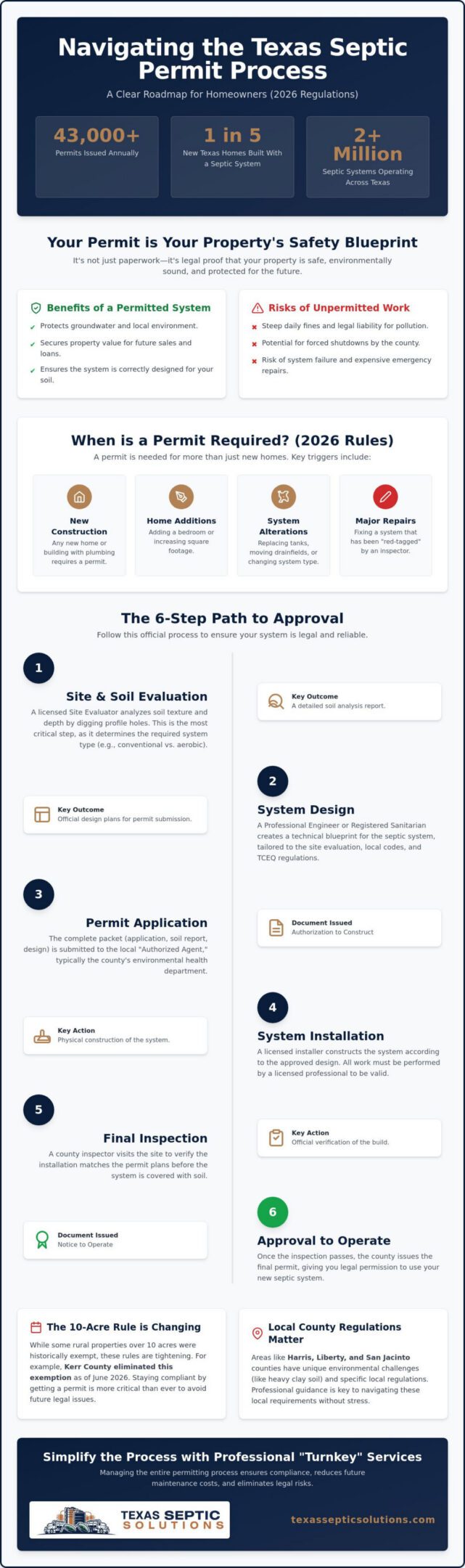
In 2026, the rules are clearer than ever. You absolutely need a permit for any new construction, but you also need one for “alterations” to an existing system. Many homeowners don’t realize that certain home improvements trigger a permit requirement. You generally need to update your permit if you:
- Add a bedroom or increase the square footage of your home.
- Replace a tank or move a drainfield to a new location.
- Change the type of treatment system, such as moving from conventional to aerobic.
- Repair a system that has been “red-tagged” by a county inspector.
The consequences of skipping the paperwork are steep. Local authorities can issue daily fines that quickly exceed the cost of the permit itself. More importantly, unpermitted work can lead to system failure because the design was never checked against your specific soil conditions.
The Risks of DIY or Unlicensed Septic Work
Texas law is very specific: almost all septic work must be performed by a licensed installer. While a “can-do” attitude is great for painting a fence, it’s dangerous when handling wastewater. If you bypass the permitting process or hire an unlicensed contractor, you assume all the legal and financial liability. If that system fails and pollutes a nearby creek or a neighbor’s well, the cleanup costs and legal fees fall squarely on your shoulders. For those facing a system breakdown, it’s better to consult a professional guide on septic system repair to see how to stay compliant while getting your utilities back online. Professional oversight ensures your system is built to last and keeps you in the county’s good graces.
Steps to Securing Your Texas Septic Permit
The journey toward a legal septic system starts long before the first shovel hits the ground. Every septic system permit Texas issues follows a strict chronological order to ensure the final installation is safe for the environment. Most homeowners don’t deal directly with the state. Instead, you’ll work with a local “Authorized Agent.” This is typically your county’s health or environmental department, which has been granted authority by the Texas Commission on Environmental Quality (TCEQ) to review plans and perform inspections locally.
You’ll need a team of licensed professionals to navigate this roadmap. This usually includes a Site Evaluator to test the ground, a Professional Engineer or Registered Sanitarian to design the system, and a licensed Installer to do the work. The process results in two critical documents. First, you receive an “Authorization to Construct,” which is your green light to begin the installation. After the system is in the ground but before it’s covered, an inspector visits the site. Once they approve the build, you receive the “Notice to Operate,” which is the final legal blessing to start using your system.
Site Evaluation and Soil Testing
Every permit application begins with a professional soil analysis. In Texas, your soil’s texture and depth dictate exactly what kind of system you can install. If you have deep, well-draining soil, you might qualify for a standard conventional permit. However, if you’re dealing with the heavy, “tight” clays common in the Houston area, the county will likely require an aerobic system permit. The evaluator digs “profile holes” to check for groundwater levels and restrictive horizons, ensuring your wastewater won’t pool on the surface or contaminate deep aquifers. Working with a team that handles new septic system installation from the initial soil test to the final approval can save you weeks of back-and-forth with county officials.
The Application and Review Timeline
Once your design is ready, you’ll submit it to the county along with the required fees and a detailed site map. In 2026, most Texas counties aim for a review turnaround of about 30 days, though high-growth areas around Houston can occasionally take longer. Your application must include specific design specs and a scaled drawing showing exactly where the tanks and drainfield will sit in relation to property lines and water wells. Common delays usually stem from incomplete site maps or failing to account for required “setbacks” from buildings. Ensuring these technical details are perfect the first time is the best way to avoid a permit denial.
The 10-Acre Rule and Permit Exemptions
There’s a common saying in rural Texas that “ten acres means no rules.” When it comes to wastewater, that’s a dangerous misunderstanding that can lead to heavy fines. While the state does offer an exemption from the standard septic system permit Texas usually requires, it isn’t a free-for-all. This exemption is a specific legal carve-out, not a total bypass of safety standards. Even if you don’t have to file the formal permit paperwork, you’re still legally obligated to follow the Texas Commission on Environmental Quality (TCEQ) regulations regarding how the system is built and maintained. The goal is still the same: preventing your waste from becoming your neighbor’s problem.
Think of the 10-acre rule as a “permit-lite” option rather than a “no-permit” option. You’re exempt from the application process, but you aren’t exempt from the law. If your system fails or causes a nuisance, the county still has the authority to step in. We’ve seen many property owners build without oversight, only to find out years later that their system doesn’t meet state standards, making it impossible to sell the land without a complete and costly teardown.
Qualifying for the 10-Acre Exemption
To qualify, your property must meet three very strict criteria. First, it must be a single-family dwelling on a tract of land that is 10 acres or larger. Second, every part of the system, including the tanks and the entire drainfield, must stay at least 100 feet away from all property lines. This “setback” is where most people run into trouble, especially if they want their home near a road or a fence line. Finally, you still must have a site evaluation performed by a licensed professional. You can’t just guess where the best soil is. The state still requires that the system be designed to handle the specific soil conditions of your acreage.
When Even Large Tracts Need a Permit
Ownership of a large plot doesn’t automatically grant you an exemption. Local authorities have the right to be stricter than the state. As we saw in June 2026 with Kerr County, many local governments are completely eliminating the 10-acre exemption to protect their groundwater. You’ll also lose your exempt status if:
- The property is located near a public water supply or a sensitive aquifer.
- You decide to subdivide the land into smaller lots.
- The system serves a commercial business or more than one house.
- The land is located in a county that has officially opted out of the exemption.
Before you start digging, check with your local “Authorized Agent.” It’s much cheaper to verify your status now than to pay for a “red-tag” stop-work order later. If you’re planning a new septic system installation, we can help you determine if your specific tract truly qualifies for an exemption or if a standard permit is the safer path for your property’s future value.
Local Permitting in Houston and East Texas
While the state sets the baseline, getting a septic system permit Texas residents can actually use depends on which side of the county line you stand on. Local “Authorized Agents” in Harris, Liberty, and San Jacinto counties have the power to implement rules that are much stricter than the state minimums. In Harris County, for example, the permitting process is managed by the Engineering Department’s Watershed Protection group. They don’t just look at your tank; they evaluate how your system interacts with the high water tables and notoriously flat terrain of the Gulf Coast prairie. These local inspectors act as the final gatekeepers for your project.
Local expertise is your greatest asset during the approval phase. A design that passes easily in the sandy soils of West Texas will likely be rejected immediately in our neck of the woods. These agents ensure that your system won’t become an environmental hazard during the next heavy rain cycle. Because each county has its own fee schedule and application quirks, working with a partner who knows the specific inspectors in Cleveland or Shepherd can shave weeks off your wait time. They understand the “unwritten” preferences of local reviewers that often cause delays for out-of-town contractors.
Impact of Clay Soils on Permit Approval
If you own property in East Texas, you’re probably familiar with “black gumbo” clay. This soil is a permit nightmare because it lacks the natural drainage needed for traditional gravity-fed systems. Because this clay doesn’t absorb wastewater efficiently, local authorities will almost always require an aerobic treatment system. These systems use oxygen to break down waste faster and typically involve surface sprayers. This shift in technology is mandatory for permit approval in most of the Houston area, but it does change your financial planning. For a clear breakdown of how these soil-mandated designs affect your budget, see our guide on septic system replacement cost.
County-Specific vs. TCEQ Jurisdiction
It’s vital to identify whether your property falls under “Direct Jurisdiction” or an “Authorized Agent.” Most rural areas near Houston are managed by local health or environmental departments. Before you sign a contract on a new piece of land, check the local ordinances. Some counties have increased their setback requirements or eliminated exemptions entirely to protect local aquifers. A lot that looks perfect might actually be too small to house a legal septic system once you account for the 100-foot well setbacks or property line restrictions. We handle the heavy lifting of county paperwork to ensure your project stays on track. If you need a reliable partner to manage your new septic system installation from soil test to final permit, reach out to our team today.
Professional Design and Permitting Services
Professional design is the bridge between a piece of paper and a functioning home. While previous sections covered the legal hurdles and local soil challenges, the real value of a turnkey partner is peace of mind. When you hire an expert to manage your septic system permit Texas application, you aren’t just paying for a signature. You’re investing in a system engineered specifically for your property’s unique topography and 2026 environmental standards. A professional design prevents the “one-size-fits-all” mistakes that lead to soggy yards and system backups just a few years down the road.
Choosing a turnkey approach means your designer and installer work from the same playbook. This alignment reduces the risk of mid-project changes that can trigger a permit re-evaluation. It also ensures that your system is future-proof. As regulations tighten to protect Texas groundwater, having a system that exceeds the minimum 2026 requirements adds significant resale value to your home. It’s about building a utility that works so well you eventually forget it’s even there.
How Texas Septic Solutions Streamlines the Process
We handle the heavy lifting of county paperwork so you don’t have to decode government jargon. Our team manages the entire lifecycle of your project in Cleveland, Houston, and the surrounding areas. We start with a precise site evaluation and move directly into a professional design that we know local inspectors will approve. We guarantee that every new septic system installation we perform meets all current local codes. Our relationship doesn’t end when the permit is signed, either. We provide the ongoing support needed to keep your system in peak condition through a structured septic system maintenance plan.
Ready to Start Your Project?
Don’t wait until you’re ready to pour the foundation to think about your waste management. Getting an expert opinion before you dig can save you thousands in redesigned plans or relocated structures. Whether you need a site evaluation in Cleveland or Cypress, our team is ready to provide a clear roadmap for your property. Before you submit your application, use this final checklist for success:
- Verify your property’s current jurisdiction and “Authorized Agent.”
- Confirm all 100-foot setbacks from wells and 5-foot setbacks from property lines.
- Ensure your soil evaluation matches the system type in your design.
- Double-check that your installer holds a current Texas license.
- Secure your “Authorization to Construct” before any equipment arrives on site.
Taking these steps ensures your project moves forward without the stress of “red-tags” or unexpected county fines. We are here to be your neighborly expert and guide you through every stage of the process.
Secure Your Property with a Compliant Septic System
Securing a septic system permit Texas requires is the most important step you can take to protect your home’s value and the local environment. We’ve covered how soil testing dictates your design, the strict reality of the 10-acre rule, and why local county agents hold the final say in areas like Harris and Liberty. You don’t have to navigate these 2026 regulations alone or risk the heavy fines that come with unpermitted work. A legal permit is your best defense against future property sale hurdles and environmental liabilities.
Texas Septic Solutions is here to act as your neighborly expert. Our team consists of licensed Texas OSSF installers who have served the Houston, Cleveland, and Cypress communities for years. We handle the design, the paperwork, and the installation so you can focus on building your home. We even offer 24/7 emergency support to ensure your system stays reliable long after the final inspection. Get Expert Help with Your Texas Septic Permit Today and let us handle the county bureaucracy for you. Your peace of mind is just a phone call away, and we are ready to help you get started.
Common Questions About Texas Septic Permitting
Do I need a permit to replace a septic tank lid in Texas?
You generally don’t need a permit for minor maintenance tasks like replacing a tank lid. Texas law focuses on the construction, alteration, or extension of the system. However, if the lid replacement is part of a larger structural repair or if you’re modifying the tank’s access, check with your local authority first. Always ensure the new lid is safety-rated and installed correctly to prevent accidents or debris from entering your system.
How much does a septic system permit cost in Texas?
Application fees for a septic system permit Texas requires typically range from $200 to $500 depending on your specific county. When you factor in the mandatory site evaluation and professional design specifications, total permitting costs often fall between $700 and $1,800. These are administrative and professional fees paid to the county and licensed designers. They are separate from the actual cost of the equipment or installation labor.
Can I install my own septic system if I am the homeowner?
Texas law generally requires a licensed professional to install septic systems. While some counties technically allow a homeowner to install a system for their own single-family residence, this is becoming increasingly rare. Many local Authorized Agents have implemented stricter rules that mandate professional installation to ensure groundwater protection. It’s almost always safer and more efficient to hire a licensed expert who understands the technical codes and inspection requirements.
What is an “Authorized Agent” in the Texas septic permit process?
An Authorized Agent is a local governmental entity, such as a county health department or engineering office, that has been granted authority by the TCEQ. Instead of dealing with the state office in Austin, you work directly with these local officials for your septic system permit Texas needs. They are responsible for reviewing your plans, collecting fees, and performing the final inspections before you’re allowed to use the system.
How long is a Texas septic permit valid once issued?
Once your “Authorization to Construct” is issued, it’s typically valid for one year. You must complete the installation and receive your final “Notice to Operate” within this timeframe. If the project stalls and the permit expires, you’ll likely need to reapply and pay the application fees again. It’s best to have your installation team scheduled and ready to work as soon as the paperwork is approved.
What happens if I buy a house with an unpermitted septic system?
You inherit the legal and financial liability for any unpermitted system on your property. This can lead to serious issues, including daily fines from the county or a legal requirement to replace the entire system to meet current 2026 codes. Additionally, most mortgage lenders and title companies won’t clear a property for sale if the septic system isn’t properly permitted and inspected, which can ruin a future resale.
Does an aerobic system require a different permit than a conventional one?
Yes, the permit application and design requirements for an aerobic system are more detailed than those for a conventional gravity system. Because aerobic systems use mechanical components and surface sprayers, the county requires a professional design and a recorded maintenance contract. Your permit application must clearly state the system type to ensure it’s appropriate for your soil’s absorption rate and property size.
Who do I call if my septic tank alarm goes off during the permitting phase?
If your alarm sounds, call a licensed septic professional immediately. Even if your final permit paperwork is still being processed, a sounding alarm indicates a high water level or a mechanical failure that needs urgent attention. We provide 24/7 support for these emergencies to prevent backups and protect your property while you wait for the county’s final inspection and approval to conclude.