
Septic System for High Water Table Areas in Texas: A 2026 Homeowner’s Guide
You wake up to a heavy Gulf Coast downpour and realize the toilets won’t flush because your drain field is already underwater. For many homeowners, this isn’t just a “what if” scenario; it’s a stressful reality that leads to expensive repairs and environmental worries. Installing a septic system for high water table areas Texas requires a specialized approach because traditional gravity systems simply can’t breathe in saturated soil. Every drop of rain shouldn’t feel like a threat to your home’s functionality.
We understand that you want a property that works regardless of the weather. You shouldn’t have to fear a backyard backup every time a storm rolls through or feel overwhelmed by the updated 2026 TCEQ Chapter 285 requirements. This guide will help you discover the most reliable septic solutions for high groundwater, from aerobic units to mound systems. You will learn how to balance installation costs with long term performance and why a proper site evaluation is the first step toward a worry free property.
Key Takeaways
- Understand how high groundwater levels in East Texas and the Gulf Coast lead to hydraulic overload, causing traditional systems to fail.
- Identify why an aerobic treatment unit is the most effective septic system for high water table areas Texas homeowners can install to prevent backups.
- Learn about the 2026 TCEQ requirements for mandatory site evaluations and soil morphology testing before your system design begins.
- Discover the essential maintenance steps and disinfection requirements that keep your specialized system running smoothly during the wettest seasons.
- Gain insights on selecting a local professional who understands the specific engineering needs of tricky soil conditions in Houston, Cleveland, and Cypress.
Understanding the Challenge of High Water Tables for Texas Septic Systems
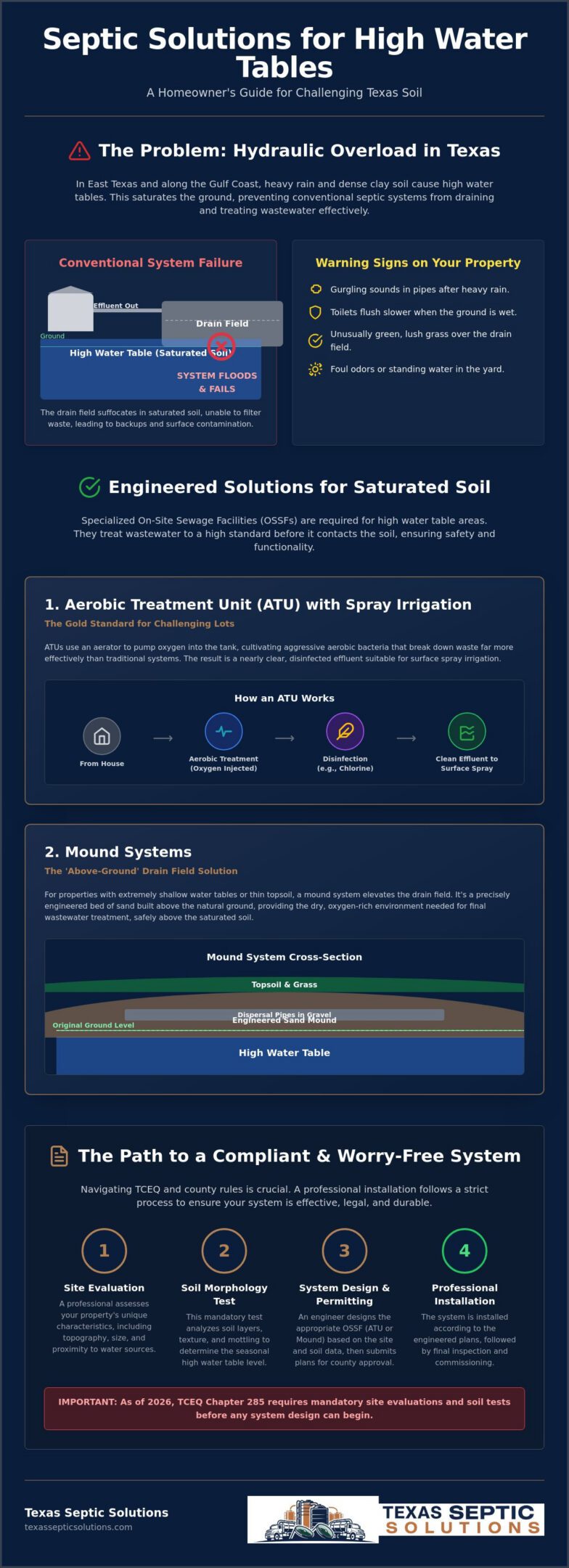
A high water table means the groundwater is sitting dangerously close to the surface, often within just a few feet of your lawn. In East Texas and the Gulf Coast, this is a common hurdle due to heavy rainfall and dense clay soils that don’t drain well. When you are looking for a septic system for high water table areas Texas, you aren’t just buying a tank. You’re investing in an engineering solution that prevents your backyard from becoming a swamp. Every homeowner should understand that soil isn’t just dirt; it’s a biological filter that requires specific conditions to work.
When the soil stays saturated, your system faces “hydraulic overload.” This happens because the ground is already full of water and cannot absorb the effluent coming from your house. Instead of soaking in, the waste sits on the surface or backs up into your pipes. This isn’t just a plumbing headache; it’s a serious environmental risk. Saturated drain fields can allow untreated waste to reach groundwater, potentially contaminating local wells and ecosystems. Keeping your system functional is about protecting your family’s health and the local Texas environment.
Watch for the warning signs that your property is struggling with groundwater levels. You might hear gurgling in your pipes after a heavy storm or notice that your toilets flush slower when the ground is wet. If you see patches of bright green, lush grass over your drain field while the rest of the yard is dormant, your system is likely failing to disperse waste properly. These symptoms suggest that the water table is interfering with the natural treatment process.
Why Conventional Gravity Systems Fail in Saturated Soil
Gravity-fed systems are designed for dry, porous soil that acts as a natural filter. These On-site sewage facilities (OSSF) rely on oxygen-rich environments to treat bacteria. In saturated ground, the “biomat,” which is the layer of helpful bacteria in your drain field, literally suffocates. Without oxygen, the treatment process stops and the soil pores clog. Many homeowners think pumping the tank more often will help, but that’s a temporary fix. Pumping doesn’t change the fact that the soil is too wet to accept more liquid.
Texas Soil Morphology and Groundwater Dynamics
Professional installers in areas like Cleveland and Houston use soil morphology to design systems that last. They look for “mottling,” which are spots of color in the soil that reveal where water has historically stood, even if the ground is dry today. Texas often experiences seasonal high water tables where the ground stays dry for months but becomes fully saturated during the spring rains. Understanding these dynamics is the only way to ensure your system meets 2026 TCEQ standards and remains functional year-round, regardless of the weather.
Best Septic System Options for High Water Table Areas in Texas
Finding the right septic system for high water table areas Texas homeowners can rely on means moving beyond basic gravity tanks. When soil stays wet, it’s legally classified as unsuitable for standard drain fields. This is why specialized On-Site Sewage Facilities (OSSFs) have become the standard across the Gulf Coast and East Texas. These systems are engineered to treat wastewater to a high standard before it ever touches your soil. This ensures your property stays clean and your toilets keep flushing even when the ground is saturated.
Aerobic Treatment Units (ATUs) with Spray Irrigation
Aerobic Treatment Units are often called the gold standard for challenging Texas lots. Unlike conventional systems that sit idle, an ATU uses an electric pump to bubble oxygen through the wastewater. This creates an environment where aerobic bacteria thrive. These bacteria are much more aggressive than the anaerobic ones found in standard tanks, and they break down waste until the effluent is a nearly clear liquid.
For properties with high groundwater, this treated liquid is typically dispersed through surface spray irrigation. Because the water is disinfected with chlorine before it’s sprayed, it doesn’t need the soil to provide the primary treatment. This makes it a legal and highly effective option for sites where a traditional drain field would simply drown. If you’re unsure which setup fits your lot, getting a new septic system installation tailored to your specific soil morphology is the best way to avoid future failures.
Mound Systems: The ‘Above-Ground’ Solution
When the water table is extremely shallow or the topsoil is too thin, we often recommend a mound system. This approach literally moves the treatment process above the natural grade of your yard. We create an artificial dry zone by layering specific materials to act as a filter before the effluent reaches the natural soil. A typical mound includes:
- A layer of high quality sand to begin the filtration process.
- A gravel bed that houses the distribution pipes.
- A final covering of topsoil and grass to prevent erosion and blend the mound into your landscape.
While mound systems are highly effective, they do change the look of your backyard. They appear as a raised, landscaped bed. However, the trade-off is a system that works perfectly in areas where others would fail. Another low-profile alternative is drip irrigation. This uses flexible tubing buried just a few inches below the surface to slowly release treated wastewater. It’s an excellent choice for sensitive sites or heavily wooded lots where you want to preserve the natural look of the land while managing a high water table.
Design and Permitting: Navigating TCEQ and County Rules
Before you can break ground on a new installation, you need a plan that satisfies both the Texas Commission on Environmental Quality (TCEQ) and your local county officials. In regions like Harris, Liberty, and Montgomery counties, the permitting process is rigorous because the risk of groundwater contamination is so high. Designing a septic system for high water table areas Texas homeowners can trust requires more than just a basic layout. It demands a professional site evaluation that accounts for the “worst-case scenario.” We don’t just design for the dry summer months. We design for the peak rainy season when the ground is most vulnerable to saturation.
The total cost for permitting, including the site evaluation, design, and application fee, typically ranges between $700 and $1,800 in 2026. While this might seem like a significant upfront investment, it’s the only way to ensure your system is legal and functional. Local permit application fees alone usually fall between $200 and $500 depending on your specific county. Skipping these steps or using an unlicensed designer can lead to costly fines and a system that fails during the first heavy Gulf Coast downpour.
The Site Evaluation Process in Texas
A licensed site evaluator visits your property to dig “test pits” rather than just simple holes. They examine soil color, texture, and restrictive clay layers that might prevent proper drainage. This process is far more advanced than old-fashioned “perc tests” that only measured how fast water disappeared into the ground. Soil Morphology is the study of soil layers to predict water behavior. By identifying “mottling” or specific color patterns in the soil, an evaluator can determine the seasonal high water table even if they are performing the test during a drought. A professional site evaluation generally costs between $300 and $800, but it provides the essential data needed for a successful design.
Securing Your Septic Tank Installation Permit
Once the site evaluation is finished, the formal design is submitted to the county’s Designated Representative (DR). This official reviews the plans to ensure they comply with the updated 2026 Chapter 285 rules. Permits in high-water-table areas are frequently denied if the design fails to account for soil saturation or if the proposed system is too close to a water well. Texas Septic Solutions handles the entire paperwork and permitting process for local homeowners. We manage the communication with county officials and ensure every technical detail meets state standards, allowing you to focus on your home while we handle the red tape.
Maintaining a High-Water-Table Septic System in Texas
Maintaining a septic system for high water table areas Texas properties depend on requires a proactive mindset. When the ground is already soaked, your system has zero margin for error. Unlike a conventional gravity setup that might forgive a missed pumping, a high-water-table system, particularly an aerobic one, is a complex machine that needs consistent care to stay functional. Regular maintenance prevents the system from becoming overwhelmed by external groundwater, protecting both your home and the local environment from contamination.
One of the most critical daily tasks for homeowners with spray irrigation is managing the chlorine disinfection system. Because the treated liquid is dispersed on the surface, the chlorine must be present to kill any remaining pathogens. If you let the chlorine tablets run out or the liquid bleach reservoir go dry, you are essentially spraying untreated waste into a yard that is already struggling with drainage. Additionally, you must practice “load leveling” during the rainy season. This means spreading out water heavy tasks like laundry and dishwashing over several days. When the soil is saturated, a sudden surge of 100 gallons of water can cause the system to back up because the ground simply cannot accept it fast enough.
The Importance of a Septic System Maintenance Plan
In Texas, the TCEQ requires homeowners with aerobic systems to maintain an ongoing service contract with a licensed provider. These contracts typically cost between $300 and $500 per year in 2026. During a professional inspection, a technician checks the air compressor, cleans the filters, and tests the submersible pumps and alarms. This oversight ensures that your system meets legal standards and operates efficiently. For a deeper look at what these service visits entail, read our Septic System Maintenance Plan guide. Keeping these components in peak condition is the best way to avoid the high cost of a total system failure.
Troubleshooting During the Texas Rainy Season
Heavy rains can trigger a septic tank alarm going off, which often signals that the water level in the tank is too high. This is frequently caused by “Inflow and Infiltration” (I&I), where groundwater leaks into the system through cracked pipes, loose manhole covers, or unsealed tank seams. If your alarm sounds after a storm, silence it and immediately reduce your water usage inside the house. Check your yard for standing water over the tank area, as this can force water into the system. If you suspect your system is struggling with the current water table, contact us for an emergency septic service to prevent a messy backup into your home. Professional intervention can often identify a small leak before it turns into a catastrophic hydraulic overload.
Choosing the Right Partner for Your Texas Septic Installation
Installers who primarily work in dry, rocky regions often struggle with the unique engineering required for a septic system for high water table areas Texas homeowners need. In these saturated environments, a “standard” installation is a recipe for disaster. You need a partner who understands that the soil in Cleveland, Houston, and Cypress behaves differently than the rest of the state. These areas feature heavy clay that expands when wet and contracts when dry, putting immense pressure on underground tanks and lines. We don’t just drop a tank in a hole; we engineer a solution that accounts for these shifting dynamics and high groundwater levels.
When comparing long-term costs, it’s tempting to look only at the initial installation price. While a conventional system might cost between $6,000 and $12,000, it often fails within a few years if installed in a high-water-table zone. In contrast, an aerobic system might range from $12,000 to over $20,000, but it is specifically designed to handle saturated conditions. Choosing the right system from the start saves you from the nightmare of emergency repairs, environmental fines, and the eventual cost of replacing a failed traditional unit. We ensure every project meets the strict 2026 TCEQ standards, giving you a system that is both legal and durable.
Expert Design for Long-Term Reliability
East Texas topography presents unique challenges, from flat coastal plains to heavily wooded lots with poor drainage. We customize every design to fit the specific footprint of your property while ensuring full compliance with the latest environmental protection laws. Our team doesn’t just walk away once the permit is signed. We provide peace of mind through 24/7 support and emergency readiness. If a heavy storm ever causes your high-water-table system to struggle, we are ready to respond immediately to keep your home functional.
Your Next Steps: From Evaluation to Installation
The path to a reliable system starts with a professional site and soil evaluation. This is the only way to accurately determine the depth of your water table and the best system type for your lot. Whether you are dealing with a failing unit that needs a septic system repair or you are building a new home on a challenging site, our team guides you through every phase. We handle the design, the permitting, and the final installation with a focus on long-term stability. Contact Texas Septic Solutions today to schedule your consultation and ensure your property is prepared for whatever the Texas weather brings.
Secure Your Property Against the Texas Rainy Season
Managing a property with high groundwater doesn’t have to be a constant source of stress. By choosing a specialized septic system for high water table areas Texas homeowners can ensure their homes remain functional and environmentally safe even during the heaviest Gulf Coast storms. A successful installation relies on a precise site evaluation and a design that meets the latest 2026 TCEQ regulations. Whether you opt for an aerobic treatment unit or a mound system, your focus should be on long term reliability and professional maintenance.
Our team of licensed TCEQ installers is here to help you navigate these soil challenges. We have been serving Cleveland, Houston, and the surrounding areas since 2026, providing the local expertise needed for tricky soil conditions. We also offer 24/7 emergency septic response to give you a safety net when you need it most. Don’t wait for the next downpour to find out if your system can handle the pressure.
Schedule your high-water-table site evaluation with Texas Septic Solutions today!
You deserve a home that works perfectly, rain or shine. Let’s get started on a solution that keeps your backyard dry and your system running smoothly for years to come.
Frequently Asked Questions
Can I install a traditional septic system in a high water table area in Texas?
No, you generally cannot use a traditional gravity system if your groundwater is too high. Texas Commission on Environmental Quality (TCEQ) regulations require a specific amount of unsaturated soil to properly treat wastewater. When the water table is high, the soil stays saturated, which prevents the natural filtration process and leads to system failure or environmental contamination.
What is the most reliable septic system for wet East Texas soils?
Aerobic Treatment Units (ATUs) are the most dependable septic system for high water table areas Texas properties often require. These systems use oxygen to break down waste inside the tank, producing high quality effluent that can be safely dispersed through surface spray or drip irrigation. This setup works perfectly even in the dense, wet clay common throughout East Texas and the Gulf Coast.
How much does a high-water-table septic system cost in Texas?
The total investment for these specialized systems depends on your specific soil morphology, the required engineering, and local county permit fees. Systems designed for saturated soil, such as aerobic units or mound systems, involve more complex components like pumps, aerators, and advanced controllers. You should also factor in the cost of a mandatory professional site evaluation and the long term maintenance contract required by the state.
Is an aerobic system mandatory if I have a high water table?
It isn’t always mandatory, but it is often the most practical and cost effective solution. A licensed site evaluator will determine if your soil can support a mound system or a low pressure dosing system instead. However, in many flood-prone or high-groundwater areas of Texas, an aerobic system is the only design that can meet the strict vertical separation requirements set by the TCEQ.
How often should I pump my septic tank if my yard is flood-prone?
You should follow the standard pumping schedule of every three to five years, but you need more frequent professional inspections. Flood-prone yards can experience “Inflow and Infiltration,” where groundwater forces silt and extra liquid into your tank. Regular inspections ensure that your pumps and alarms are working correctly and that the tank hasn’t been prematurely filled with debris from local runoff.
What happens if my septic system is underwater during a Texas flood?
Stop using your water immediately if your drainfield or tank area is submerged. Floodwater can enter your system and cause raw sewage to back up into your home’s drains. Once the water recedes, you should have a professional inspect the electrical components of your aerobic system and check the tank for structural integrity before resuming normal use.
Do I need a special permit for a mound system in Harris County?
Yes, any On-Site Sewage Facility (OSSF) in Harris County requires a specific permit through the county’s engineering or health department. Because mound systems are considered “non-standard” designs, the permitting process involves a detailed review of your professional site evaluation and engineering plans. We handle this technical paperwork to ensure your mound system complies with all local and state safety codes.
How does a high water table affect my septic drainfield’s lifespan?
A high water table can significantly shorten the life of a traditional drainfield by causing constant hydraulic overload. When the soil stays saturated, oxygen cannot reach the helpful bacteria that treat the waste, leading to a thick layer of sludge called a biomat that eventually clogs the system. Choosing a system designed for high groundwater prevents this premature failure and protects your long term investment.