
Commercial Septic System Permits in Cypress, TX: The 2026 Business Guide
Your commercial building project in Harris County is effectively dead in the water until your septic paperwork is finalized. Securing commercial septic system permits Cypress TX involves much more than just filling out a simple form. It’s a high-stakes coordination between state 30 TAC 285 regulations and local engineering standards that can feel overwhelming to even the most seasoned property managers. We understand the anxiety of staring at the ePermits portal, wondering if you’ve hired the right Professional Engineer or if a Sanitarian’s seal is actually sufficient for your specific food service establishment.
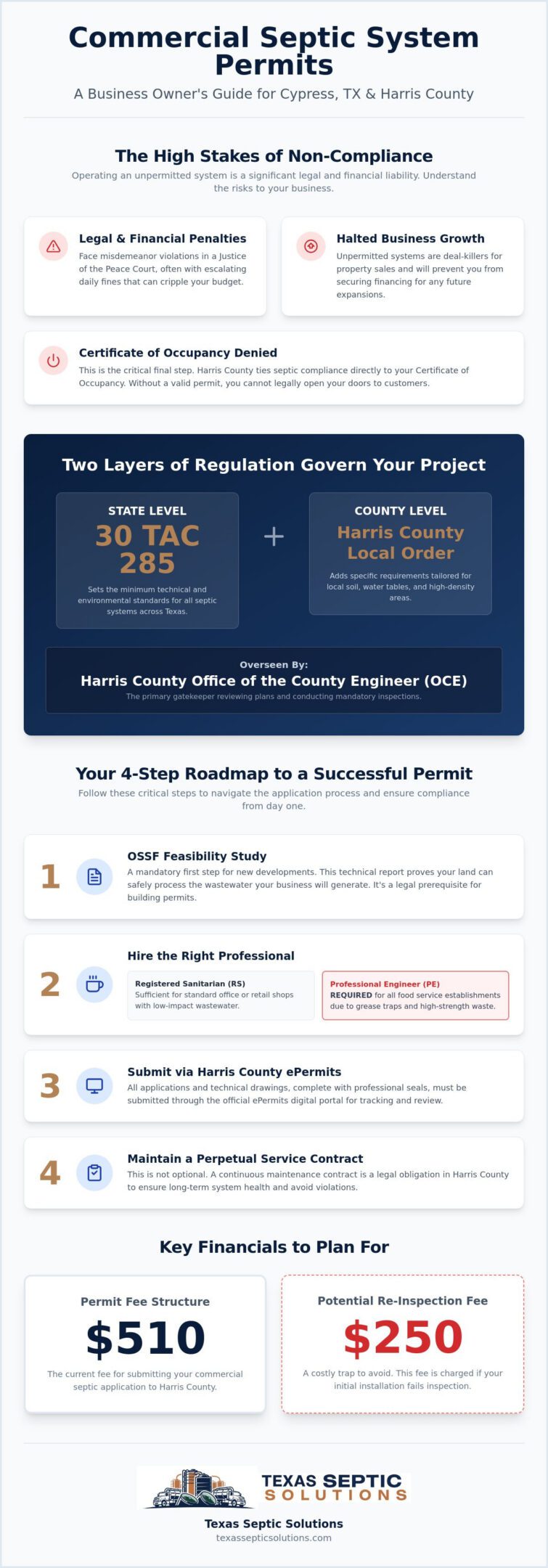
At Texas Septic Solutions, we believe the permitting process shouldn’t be the bottleneck that delays your grand opening or leads to costly misdemeanor violations. This guide provides a clear roadmap to navigate the 2026 requirements with ease, ensuring your Cypress property remains fully compliant from day one. We’ll walk you through the current $510 fee structure, the necessity of perpetual maintenance contracts, and how to avoid the $250 re-inspection traps that catch many local business owners off guard. By the end of this article, you’ll have the confidence to move your project forward without the fear of technical rejection or unexpected delays.
Key Takeaways
- Identify the specific Harris County and state 30 TAC 285 regulations that make commercial septic standards more rigorous than residential requirements.
- Learn the essential steps for obtaining commercial septic system permits Cypress TX, starting with a mandatory OSSF Feasibility Study for any new development.
- Understand your legal obligation to maintain a perpetual service contract to avoid misdemeanor violations and ensure long-term system health.
- Master the Harris County ePermits portal by gathering the exact professional engineering seals and site plans required for a successful submission.
- Discover how professional installation and proactive maintenance programs provide a reliable safety net for your business’s daily operations.
Understanding Commercial OSSF Requirements in Cypress and Harris County
If you are planning a development in unincorporated Harris County, securing commercial septic system permits Cypress TX is one of your first major hurdles. Most businesses in this area rely on an On-site Sewage Facility (OSSF) because they lack access to centralized municipal sewer lines. These systems are not just larger versions of residential septic tanks. They are complex infrastructure projects designed to handle high-volume wastewater, chemical cleaners, and potential contaminants that a standard home never encounters. Because the environmental stakes are higher, the regulations are significantly more rigid.
Obtaining commercial septic system permits Cypress TX requires a higher level of scrutiny than a standard backyard setup. While a licensed sanitarian can often handle residential designs, commercial projects, particularly those involving food service or high employee counts, typically demand the seal of a Texas-registered Professional Engineer. The Harris County Office of the County Engineer (OCE) oversees this entire process. They now require all applications and technical drawings to go through the ePermits digital portal. This system tracks everything from your initial feasibility study to the final inspection, ensuring that every commercial property in Cypress meets modern environmental safety benchmarks.
Who Regulates Your Cypress Septic System?
The rules governing your property come from two primary sources. At the state level, 30 TAC 285 sets the minimum standards for all Texas septic systems. However, the Harris County Local Order adds a secondary layer of specific requirements tailored to our local soil conditions and high water tables. You must verify if your property sits within the Cypress city limits or remains in an unincorporated area, as this determines which agency holds jurisdiction. The Office of the County Engineer acts as the primary gatekeeper, reviewing plans and conducting the mandatory inspections that allow your business to stay operational.
The Consequences of Non-Compliance
Neglecting the permitting process isn’t just a minor oversight. It’s a significant legal and financial liability. If you operate an unpermitted system, you could find yourself in a Justice of the Peace Court facing misdemeanor violations. These legal headaches often come with daily fines that can quickly escalate. From a real estate perspective, unpermitted systems are absolute deal-killers. They will halt a property sale or prevent you from securing financing for an expansion. Most critically, Harris County ties your septic compliance directly to your Certificate of Occupancy. If your permit isn’t in good standing, you simply cannot legally open your doors to the public.
The OSSF Feasibility Study: Why Your Commercial Project Needs Professional Design
Before you break ground on a commercial site in Cypress, Harris County requires an OSSF Feasibility Study. Think of this as the essential foundation for obtaining commercial septic system permits Cypress TX. It’s a technical proof-of-concept that proves your land can safely process the wastewater your business will generate. If your project involves creating a new plat for the property, this study isn’t optional; it’s a legal prerequisite. Without a signed and sealed feasibility report, the Office of the County Engineer won’t issue the building permits you need to start construction.
Professional Engineer vs. Registered Sanitarian
Many business owners get confused about who they need to hire for their design. Harris County regulations allow both Professional Engineers (PE) and Registered Sanitarians (RS) to submit plans, but the nature of your business dictates the choice. For a standard office or retail shop with low-impact waste, a Registered Sanitarian is usually enough. However, if you’re launching a food service establishment, you must hire a Professional Engineer. The Texas Commission on Environmental Quality (TCEQ) mandates this because food waste involves complex treatment needs like grease traps and high-strength waste calculations. We frequently coordinate with these design experts to ensure your plans transition smoothly into a successful commercial septic system permits Cypress TX approval.
What is Included in a Feasibility Study?
A feasibility study is a comprehensive analysis of your property’s physical constraints. It isn’t just about digging a hole; it’s about engineering a solution that lasts for decades. The process evaluates several critical factors to ensure your business stays compliant and operational. The study includes:
- Soil Analysis: Determining how quickly water moves through your specific soil type and identifying any restrictive layers.
- Daily Usage Calculations: Estimating water flow based on your business type, employee count, and maximum occupancy.
- Topography and Setbacks: Mapping out the system to ensure it stays a safe distance from wells, property lines, and floodplains.
Getting these details right during the design phase is the best way to avoid project delays. If you’re unsure where to start with your site layout, our team can help guide you through the initial steps of a new septic system installation to ensure your design is both practical and compliant.
Maintenance Contracts: The Key to Legal Compliance in Harris County
Securing your initial commercial septic system permits Cypress TX is only the first step of a long-term legal commitment. In Harris County, the law requires every commercial aerobic system to remain under a continuous maintenance contract with a licensed provider. This isn’t a “set it and forget it” utility. The Harris County Wastewater Quality Permitting division monitors these contracts through a digital tracking system. If your service agreement expires, your maintenance provider is legally required to notify the county. This oversight ensures that high-capacity systems don’t fail and contaminate local groundwater, which is why a one-time $125 fee for perpetual maintenance contract filings is a standard part of the county’s regulatory process.
What Your Maintenance Plan Must Cover
A compliant plan does more than just check boxes for a county inspector; it acts as an essential insurance policy for your daily business operations. High-traffic businesses like restaurants, gas stations, or retail centers put immense stress on their aerobic components every hour they are open. A professional contract ensures a technician checks chlorine levels, tests pump functionality, and inspects spray heads at least three times per year. These detailed findings are then uploaded directly to the Harris County ePermits system to prove you are in compliance. Following structured septic system maintenance plans prevents the kind of sludge buildup that leads to catastrophic backups and foul odors that drive away customers.
Choosing a Licensed Maintenance Provider in Cypress
When selecting a partner to manage your system, always verify their credentials through the Texas Commission on Environmental Quality (TCEQ). A licensed provider understands the specific reporting deadlines and technical nuances that keep your commercial septic system permits Cypress TX in good standing year after year. For high-traffic businesses, the most valuable asset is a partner who offers 24/7 emergency septic service. A system failure on a busy holiday weekend shouldn’t force an emergency closure. You should also ensure your provider integrates routine septic system pumping into your long-term schedule. Regular pumping removes the non-biodegradable solids that inspections alone can’t eliminate. This proactive care prevents system-wide failures and protects the significant capital investment you’ve made in your property’s infrastructure.
Step-by-Step: Navigating the ePermits System for Your Cypress Business
The Harris County ePermits portal is the central hub for managing your application for commercial septic system permits Cypress TX. This digital platform has replaced the old paper-based system, requiring business owners or their contractors to create a secure account to upload technical drawings and track review progress. While the digital shift aims for efficiency, the system is notoriously unforgiving of incomplete data. Most project delays happen because documents are missing the required professional seals or are uploaded into the wrong category. We suggest gathering every technical file from your engineer before you even log in to start the process.
Once you initiate the application, be prepared to pay the required $510.00 commercial septic permit fee directly through the portal. This payment triggers the formal review by the Watershed Protection Group. If the county engineers find discrepancies in your site plan or daily usage calculations, they will issue comments through the portal. You must address these technical notes promptly to keep your project moving. If you find the digital interface confusing, our team can guide your new septic system installation through every stage of this online process.
Critical Documentation for Commercial Applications
Harris County requires a specific set of documents for a commercial OSSF permit to be considered complete. You cannot simply submit a general plot plan. Your application must include:
- Detailed Site Plans: These must clearly show the location of all existing and proposed buildings, driveways, and utility easements.
- Erosion and Sediment Control (ESC) Plans: Essential for new construction to prove that runoff won’t impact neighboring properties or local watersheds.
- Professional Design Specifications: For Cypress businesses, these must include the soil testing results and the specific engineering seals discussed in previous sections.
The Inspection and Approval Flow
After your plans are approved, the county issues an “Authorization to Construct.” This is your green light to begin the physical work, but it doesn’t mean the permitting process is over. You must schedule two critical inspections through the portal: the “open hole” inspection and the final inspection. To secure a next-day inspection slot, your licensed installer must notify the county by 3 p.m. the previous day. Inspectors will verify that the tank depth, pipe gradients, and aerobic components match the approved engineering plans exactly. Be aware that a failed inspection triggers a $250.00 re-inspection fee, so it’s vital to ensure the system is 100% ready before the inspector arrives on-site.
Texas Septic Solutions serves as the critical bridge between your business goals and the Harris County Office of the County Engineer. We’ve managed countless applications for commercial septic system permits Cypress TX, so we know exactly how to navigate the ePermits portal without the common technical errors that stall projects. Our team doesn’t just install tanks; we provide a full-service experience that starts during the feasibility phase and continues long after the final inspection. By handling the complex coordination between engineers, sanitarians, and county inspectors, we eliminate the administrative burden from your plate and ensure your project stays on schedule. Our local expertise means we anticipate county comments before they’re even made, often saving our clients weeks of back-and-forth revisions. We treat every commercial property like it belongs to a neighbor, focusing on straightforward communication and dependable results.
Commercial Installation Excellence
We specialize in high-capacity systems tailored for the unique demands of restaurants, retail centers, and industrial sites in Cypress. Whether your project requires a complex septic system repair to bring an older property up to 2026 standards or a completely new installation, we prioritize code compliance and durability. We understand that construction delays cost money. That’s why we work efficiently to minimize business downtime. Our installers understand the nuances of Harris County soil conditions and high water tables, ensuring every component of your OSSF passes the “open hole” inspection the first time. We focus on building systems that handle high flow rates and meet the specific grease trap requirements for food service establishments without compromising on long-term reliability.
Ready to Start Your Commercial Project?
Choosing a “one-stop” shop for your design, installation, and long-term maintenance needs provides a level of stability that separate contractors can’t match. We don’t just walk away once the permit is finalized. Our comprehensive care includes routine pumping and 24/7 emergency septic service to protect your business reputation from unexpected failures. This long-term partnership ensures that your commercial septic system permits Cypress TX remain valid through consistent reporting and maintenance. We understand that a commercial system is a major investment. By integrating routine pumping into your maintenance schedule, we extend the life of your equipment and prevent the high costs of emergency repairs. We’re built for the high-pressure demands of unexpected failures, giving you peace of mind that your facility stays open and compliant. If you’re ready to secure your permit and move your project forward, we’re here to help. Contact Texas Septic Solutions for your Cypress commercial permit needs and let us handle the technical details while you focus on growing your business.
Launch Your Cypress Project with Confidence
Navigating the complex landscape of commercial septic system permits Cypress TX doesn’t have to be a source of project delays or legal anxiety. Success in 2026 starts with a rigorous engineering feasibility study and ends with a lifelong commitment to professional maintenance. By understanding the specific Harris County technical requirements and mastering the ePermits portal, you’ve already taken the most important steps toward a fully compliant commercial property. Remember that your permit is more than just a one-time hurdle; it’s an ongoing promise to protect our local Cypress environment through consistent, professional oversight and reporting.
As a Licensed Harris County Maintenance Provider specializing in commercial system design and installation, Texas Septic Solutions is ready to act as your reliable local authority. We provide the 24/7 emergency service availability your business needs to stay operational through any utility crisis. You don’t have to tackle these technical regulations alone. Get Expert Help with Your Commercial Septic Permit in Cypress today to ensure your project moves forward without a hitch. We look forward to helping your business grow and thrive in our community.
Frequently Asked Questions
Do I need a Professional Engineer for a commercial septic permit in Cypress?
Yes, you typically need a Professional Engineer (PE) if your business is a food service establishment. While a Registered Sanitarian can design systems for standard commercial waste, Texas regulations require a PE seal for high-strength waste found in restaurants. This ensures your system handles grease traps and high-volume flow according to strict environmental standards.
How long does the Harris County commercial septic permit process take?
The timeline for obtaining commercial septic system permits Cypress TX varies based on the county’s current review volume and the complexity of your design. Once your engineer uploads the plans to the ePermits portal, the initial review phase often takes several weeks. After approval, you must provide 24-hour notice for inspections, with a 3 p.m. deadline for next-day scheduling.
What happens if my commercial septic system fails its inspection?
If your system fails a construction inspection, you must correct the technical issues and pay a $250.00 re-inspection fee. The county won’t issue your final “Authorization to Use” until the installation matches the approved engineering plans exactly. Working with an experienced installer helps you avoid these extra costs and keeps your project on schedule.
Can I change my permit information once the application is submitted?
You can update information through the ePermits portal, but significant design changes usually require a formal re-submission. Minor administrative updates are manageable, but shifting the system location or changing the tank type after the review has started will likely trigger new engineering fees. It’s best to finalize your site plan before the first digital upload.
How often does a commercial septic system in Harris County need to be inspected?
Commercial aerobic systems require professional inspections at least three times per year under a mandatory maintenance contract. Your licensed provider performs these checks to verify chlorine levels and mechanical functionality. These recurring inspections are a legal requirement to keep your commercial septic system permits Cypress TX valid and avoid county violations.
Is a feasibility study required for every new commercial building in Cypress?
A feasibility study is mandatory whenever you create a new plat for a commercial property in unincorporated Harris County. This study proves the land can safely support an OSSF while meeting all state and local setback requirements. You’ll need this signed and sealed report before the Office of the County Engineer issues your building permits.
What are the penalties for operating a commercial septic system without a maintenance contract?
Operating without a contract can lead to misdemeanor violations in Justice of the Peace Courts. Because Harris County tracks these agreements digitally, a lapse in coverage is reported immediately to the Watershed Protection Group. This can result in daily fines or the revocation of your Certificate of Occupancy, effectively forcing your business to close.
How do I submit my maintenance contract to Harris County?
You or your licensed maintenance provider must upload the contract directly to the Harris County ePermits portal. There is a one-time $125.00 fee for filing these perpetual maintenance agreements. Once the system processes your payment and document, your permit status updates to show you are in full legal compliance.