
How to Get San Jacinto County Septic Permits: A Step-by-Step 2026 Guide
Your dream home in East Texas shouldn’t be held hostage by a stack of confusing paperwork and the fear of a failed inspection. Securing San Jacinto County septic permits is a critical step that ensures your land stays healthy and your investment remains legal, especially with the significant TCEQ rule changes rolling out in early 2026. While the bureaucracy might feel like a hurdle, it’s actually a safety partnership designed to protect your property for decades to come.
It’s completely normal to feel overwhelmed by technical soil requirements or the prospect of dealing with multiple government agencies. We understand that you want to avoid fines and get your system installed without any expensive surprises. This guide simplifies the entire permitting process, offering a clear, homeowner-focused roadmap. You will discover the current fee structures, how to handle the dual requirements of the county and the San Jacinto River Authority, and exactly what’s needed to pass your inspections the first time. We’ve broken down the timeline so you can move forward with confidence and clarity.
Key Takeaways
- Understand why all septic work requires an On-Site Sewage Facility (OSSF) permit to maintain property value and community safety.
- Follow a clear roadmap for submitting San Jacinto County septic permits at the Coldspring office, including updated 2026 fee requirements.
- Learn how professional site evaluations and local soil types determine the best septic system design for your specific land.
- Prepare for the final inspection by identifying common pitfalls that lead to permit rejection or system failure.
- Discover how expert installation simplifies the technical paperwork and ensures your project meets all local and state regulations.
Understanding San Jacinto County Septic Permits (OSSF)
An On-site sewage facility (OSSF) is the technical term for the private wastewater treatment system serving your home. In our corner of East Texas, these systems are more than just a tank and some pipes; they are vital pieces of infrastructure that protect our local environment. The San Jacinto County Permit Department, located in Coldspring, manages all San Jacinto County septic permits to ensure that every system installed is safe for your family and the community. This oversight is necessary because a poorly designed system can lead to groundwater contamination or property damage that costs a fortune to fix.
Securing a permit isn’t just a legal hoop to jump through. It’s a safety partnership. By following the official process, you’re ensuring your system can handle the specific demands of your household and the unique characteristics of your land. With the Texas Commission on Environmental Quality (TCEQ) set to finalize major rule updates in Spring 2026, staying on the right side of the law is more important than ever. Bypassing this process can lead to heavy fines, legal headaches, and a complete halt to your construction project. If you ever plan to sell your property, a lack of proper permitting will likely stop the sale in its tracks.
When is a Permit Legally Required?
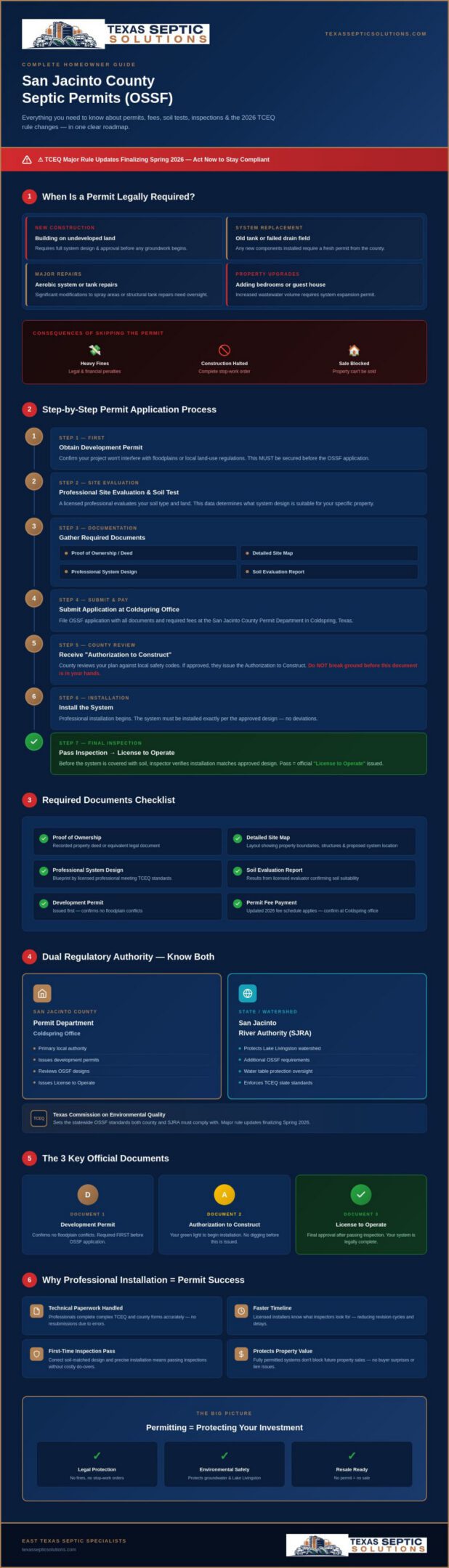
You can’t simply dig a hole and install a system on your own. San Jacinto County requires an approved permit for almost any work involving wastewater. You’ll need to start the application process if you’re planning any of the following:
- New Construction: Building a home on previously undeveloped land requires a full system design and approval.
- System Replacement: If an old tank is leaking or a drain field has failed, you’ll need a permit to install the new components.
- Major Repairs: Significant modifications to an aerobic system’s spray area or the structural repair of a tank usually require county oversight.
- Property Upgrades: Adding bedrooms or a guest house often increases your wastewater volume, necessitating a permit to expand your existing system.
The Role of the Permit Department
The team in Coldspring acts as the primary authority for local sanitation. Their job is to review technical designs to make sure your wastewater doesn’t impact nearby Lake Livingston or the local water table. They verify that every design meets the latest TCEQ standards for safety and efficiency. Before you can even apply for the OSSF permit, you’ll also need to secure a development permit. This ensures your project sits outside of floodplains and aligns with local land-use rules. Once the installation is complete and passes a final inspection, the department issues your official “License to Operate,” which is the final stamp of approval for your system.
Step-by-Step: How to Apply for a Septic Permit
Applying for San Jacinto County septic permits is a linear process that requires precision at every stage. Before you even look at a septic application, you must first obtain a development permit from the county. This preliminary step confirms that your proposed project won’t interfere with established floodplains or local land-use regulations. Once that’s secured, you can move forward with the On-Site Sewage Facility (OSSF) paperwork. You’ll need to submit a professional design and a site evaluation conducted by a licensed professional. This design acts as the blueprint for your system, ensuring it meets the technical standards mandated by the Texas Commission on Environmental Quality (TCEQ).
After you submit your application and pay the required fees, the county will review your plan. If everything aligns with local safety codes, they’ll issue an “Authorization to Construct.” This is your official green light to begin the installation. It’s vital that you don’t break ground before this document is in your hands. Once the system is installed but before it’s covered with soil, you must schedule a final inspection. The inspector will verify that the physical installation matches the approved design. If you’re feeling overwhelmed by the technical requirements, our team can guide you through a new septic system installation to ensure your paperwork and project stay on track.
Gathering Your Documentation
Preparation is the best way to avoid delays at the permit office. You’ll need several key documents ready for submission:
- Proof of Ownership: A recorded property deed or a similar legal document showing you own the land.
- Site Map: A detailed layout showing the location of the house, the proposed septic tank, the drain field, and any nearby water wells.
- Professional Design: Technical drawings signed by a licensed designer or professional engineer.
- Affidavit to the Public: A document filed with the County Clerk’s Office (which includes a $21.00 filing fee) for aerobic systems.
Working with the Coldspring Office
The San Jacinto County Permit Department is located at 1 State Hwy. 150, Room 3, in Coldspring. As of 2026, the residential OSSF permit fee is $310.00, while commercial permits are $410.00. Be aware that if your property falls under the jurisdiction of the San Jacinto River Authority (SJRA), you’ll also need to account for their separate $300.00 permit fee. Typical turnaround times for permit approval in East Texas range from one to two weeks. To keep things moving, ensure every line of your application is filled out clearly. If you have questions, the local Code Enforcement Officer is generally helpful, but they expect your technical documentation to be complete and professional upon arrival.
Technical Requirements: Soil Tests and System Design
The success of your application for San Jacinto County septic permits hinges entirely on what lies beneath the surface of your property. You cannot simply choose a system based on price or personal preference; the land makes that decision for you. A professional site evaluation is mandatory because it provides the technical data the county needs to approve your design. Without a licensed site evaluator’s report, your permit application won’t be considered. This process identifies the soil texture, structure, and restrictive horizons that dictate how well your land can process wastewater.
In San Jacinto County, soil conditions vary significantly from one lot to the next. If your property features high-drainage sandy soil, you might qualify for a conventional gravity-fed system. However, much of East Texas contains heavy clay that holds water like a sponge. In these cases, the county typically requires an aerobic treatment system with spray or drip emitters. Properties near Lake Livingston face additional scrutiny. If your land sits within a floodplain, your design must include specific flood-proofing measures to prevent environmental contamination during high-water events. This often involves elevating components or using specialized sealing techniques to satisfy both county and San Jacinto River Authority standards.
The Mandatory Soil Analysis
A licensed evaluator must perform a thorough analysis of your property’s absorption rates and identify the seasonal high water table. These factors are the primary drivers of your total project budget. Understanding these results early helps you estimate your septic system replacement cost and avoid financial surprises. You cannot skip this step for a legal permit. The county requires the evaluator’s specific findings to be attached to your OSSF application to prove the proposed system can actually function on your site.
Designing for Compliance
Your system design must match the daily wastewater flow of your household. The county calculates this based on the number of bedrooms rather than the current number of occupants. This ensures the system remains functional even if a larger family moves in later. Design compliance also requires strict adherence to setback rules. Your tanks and drain fields must maintain specific distances from water wells, property lines, and bodies of water. A professional designer ensures these gaps are maintained, protecting your local environment and preventing your permit from being rejected due to layout errors.
Inspections and Final Approval: The Finish Line
The inspection is the final gatekeeper for San Jacinto County septic permits, and it’s the moment where your system’s design is tested against reality. After the “Authorization to Construct” is issued and the system is built, the county inspector must visit the site to verify the work. The most important rule during this phase is to leave the system “open.” You must not backfill the trenches or cover the tanks with soil until the inspector has performed their walk-through. If you cover the components prematurely, the inspector will require you to uncover them for viewing, which leads to added labor costs and significant project delays.
Common reasons for a system failing its final permit check often involve small technical oversights. If the tank depth doesn’t match the approved design or the pipe slope is slightly off, the system won’t function as intended. In San Jacinto County, a failed inspection carries a financial penalty; a reinspection fee equal to half the original permit fee is required for each return visit. Once the inspector confirms the installation matches the technical blueprints and meets the 2026 TCEQ standards, they will issue your official “License to Operate.” This document is the legal proof that your system is safe and compliant.
The Inspection Checklist
Inspectors follow a rigorous set of criteria to ensure your system won’t fail or contaminate the local environment. They aren’t just looking at the tank; they’re checking the entire infrastructure. This includes:
- Pipe and Slope Verification: Ensuring the inlet and outlet pipes have the correct fall to prevent clogs or backups.
- Repair Standards: Confirming that any septic system repair or modification aligns with the current safety codes.
- Component Testing: For aerobic systems, the inspector will test the high-water alarms and electrical control panels to ensure they trigger correctly during a malfunction.
After the Permit: Staying Compliant
Receiving your final approval is a major milestone, but it also begins your long-term responsibility as a system owner. For aerobic systems, Texas law requires a continuous maintenance contract to keep your permit valid. You’ll typically start with a two-year initial contract provided by your installer. It’s also vital to keep your permit records in a safe place, as you’ll need them to prove compliance during any future property sales. If your septic tank alarm goes off after your system is operational, don’t ignore it. While it might be a simple fix, it’s a signal that your system needs professional attention to stay within county guidelines.
If you want to ensure your system passes inspection and stays compliant for years to come, we can help. Our team provides professional septic system maintenance to take the guesswork out of your long-term property care.
Why Professional Installation is Key to Permit Success
Attempting to manage the technical nuances of San Jacinto County septic permits on your own can quickly turn a home improvement project into a bureaucratic nightmare. The permit office in Coldspring requires precise documentation, and even a minor error in your site map or system design can lead to an immediate rejection. Hiring a professional installer isn’t just about the physical labor; it’s about leveraging their expertise to ensure your application passes the first time. Professionals understand the local regulatory environment and the specific expectations of county inspectors, which saves you both time and the cost of potential reinspection fees.
A licensed installer handles the heavy lifting of the site evaluation and soil testing process. As we discussed earlier, the heavy clay soils common in East Texas require specialized system designs that can handle slow absorption rates. A professional knows how to interpret soil structure data to recommend the most efficient system for your specific lot. This expertise ensures that your design meets all TCEQ and county standards before the paperwork even hits the desk of the Code Enforcement Officer. This proactive approach eliminates the guesswork and provides a foundation for a system that will last for decades.
The Risks of DIY Permitting
Attempting to permit and install a system without professional guidance carries significant financial and legal risks. Incorrect soil interpretation is a frequent cause of early system failure. A design that doesn’t account for high water tables or poor drainage will eventually lead to surfacing sewage or household backups. Additionally, the county can issue fines for non-compliant construction or for starting work before you have the official “Authorization to Construct” in hand. Perhaps the most overlooked risk is the long-term impact on property value. If you ever decide to sell your home, a title search will reveal any unpermitted septic work, which can derail a sale or force you to pay for a complete system replacement to meet 2026 codes.
How Texas Septic Solutions Simplifies the Process
We provide a comprehensive, turnkey service that removes the burden of permitting from the homeowner. Our team manages every detail, from the initial site prep and soil analysis to the final walkthrough with the county inspector. We maintain a deep familiarity with San Jacinto County’s specific local requirements, ensuring your project stays on schedule and within budget. We don’t just walk away once the tank is in the ground. We offer customized septic system maintenance plans to keep your system legal and functional for the long haul. This all-encompassing approach gives you the peace of mind that your home’s most critical utility is in expert hands.
Secure Your Property with a Compliant Septic System
Getting your wastewater system right is one of the most important investments you’ll make for your home. By understanding the technical requirements and following the official steps for San Jacinto County septic permits, you protect your property value and the local environment. Remember that your land’s soil is the ultimate guide for your system’s design, and skipping the professional inspection phase can lead to expensive setbacks. A legal, permitted system isn’t just about following the rules; it’s about long-term functionality and peace of mind for your family.
You don’t have to face the permit office or complex technical designs alone. Our team brings deep Local East Texas Expertise to every project, ensuring your installation meets 2026 standards from day one. We offer 24/7 Emergency Support and Comprehensive Maintenance Plans to keep your system running smoothly long after the final inspection. Let Texas Septic Solutions handle your San Jacinto County septic permit and installation! We’re ready to help you build a reliable foundation for your home.
Frequently Asked Questions
How much does a septic permit cost in San Jacinto County?
A residential OSSF permit in San Jacinto County costs $310.00, while commercial permits are $410.00 as of early 2026. You should also account for the $21.00 fee to file the “Affidavit to the Public” with the County Clerk. If your property falls under the San Jacinto River Authority’s jurisdiction, they require a separate $300.00 fee. These costs are set by the county and state authorities.
How long does it take to get a septic permit approved in Coldspring?
Most homeowners receive permit approval within one to two weeks of submitting a complete application in Coldspring. This timeline depends on the accuracy of your technical design and the current workload of the Code Enforcement Officer. To avoid delays, ensure your site evaluation is conducted by a licensed professional before you head to the office at 1 State Hwy. 150.
Can I design my own septic system in Texas?
No, you cannot design your own septic system unless you are a TCEQ-licensed professional engineer or a registered sanitarian. Texas law requires that all San Jacinto County septic permits include a design signed by a licensed professional. This ensures the system protects public health and meets the 2026 state standards for wastewater treatment and environmental safety.
What is a site evaluation, and why do I need one for my permit?
A site evaluation is a mandatory field test where a licensed professional analyzes your soil texture and checks for the seasonal high water table. This data is required for your permit because it proves your land can safely absorb wastewater. Without this technical report, the county cannot determine if a conventional or aerobic system is the right choice for your specific property.
Do aerobic septic systems require a different permit than conventional ones?
Both systems use the same basic OSSF permit application, but aerobic systems require additional documentation. For an aerobic permit, you must file a notarized “Affidavit to the Public” and provide proof of a signed two-year maintenance contract. Conventional gravity systems are simpler but are only permitted if your soil evaluation shows high absorption rates that meet state requirements.
What happens if I install a septic system without a permit in San Jacinto County?
Installing a system without a permit can result in heavy fines and a “red tag” that halts all construction on your property. The county may require you to dig up the unpermitted system at your own expense to prove it meets code. You’ll also face significant legal hurdles or a total block when trying to sell the property in the future.
Who do I contact to check the status of my septic permit application?
You should contact the San Jacinto County Permit Department directly at their Coldspring office to check your application status. Their office is located at 1 State Hwy. 150, Room 3. It’s helpful to have your property’s legal description or your development permit number ready to help the staff locate your file quickly and provide an accurate update.
Does a septic permit expire if I don’t build the system right away?
Yes, San Jacinto County septic permits are valid for exactly one calendar year from the date they are purchased. If you don’t complete the installation and pass the final inspection within that 12-month window, the permit becomes invalid. In this case, you’ll need to submit a new application, provide updated paperwork, and pay the current fees again to move forward.