
The Complete RV Park Septic System Maintenance Checklist for Cleveland, TX
Imagine it’s a sweltering Saturday afternoon in July and every site in your park is full, but instead of happy guests, you’re facing a line of complaints about odors and slow drains. For owners in Liberty County, a system failure during peak occupancy is more than an inconvenience; it’s a direct threat to your reputation and your bottom line. Reliable RV park septic system maintenance Cleveland TX is the only way to prevent these high-stress scenarios before they start. We understand that managing a commercial system means balancing fluctuating loads and strict Texas regulations that are changing as we move into 2026.
You likely already know that high-traffic systems require a much more aggressive approach than a standard residential setup. This guide provides our 2026 maintenance checklist designed specifically for Cleveland park owners who want zero downtime and total compliance with Liberty County environmental health standards. We’ll walk you through the essential steps to extend your system’s lifespan, from managing the 5,000-gallon wastewater threshold to meeting the mandatory inspection schedules for aerobic units. By the end of this article, you’ll have a clear roadmap to keep your park running smoothly all year long.
Key Takeaways
- Learn why peak-load weekends are the biggest threat to your commercial system and how to prepare for high-volume traffic.
- Follow a 2026 checklist for RV park septic system maintenance Cleveland TX to ensure zero downtime during your busiest months.
- Identify the specific RV chemicals and “flushable” solids that can destroy your system’s natural balance and cause immediate backups.
- Master the pumping and inspection frequencies required to protect your drain field from East Texas clay soil conditions.
- Understand how to maintain compliance with Liberty County environmental standards while accessing 24/7 emergency support for peace of mind.
Understanding the High-Demand RV Park Septic Environment in Cleveland, TX
Running an RV park in Cleveland means managing a utility system that works significantly harder than any standard residential setup. While a home system handles a predictable flow of water from a few residents, your park faces massive fluctuations. On a quiet Tuesday, your system might be coasting, but by Saturday afternoon, a full park of campers can overwhelm a neglected tank. This high-volume environment is exactly why RV park septic system maintenance Cleveland TX requires a specialized approach. You aren’t just managing waste; you’re managing a commercial-scale biological processor that is constantly under pressure.
Peak load weekends are the single greatest threat to your infrastructure. When dozens of RVs dump their black water tanks simultaneously, it creates a hydraulic surge. This rush of water doesn’t just fill the tank; it disrupts the natural settlement process. In a healthy system, solids sink to the bottom and fats float to the top. A massive surge of water stirs these layers together, often forcing solids into the drain field where they cause expensive clogs. Cleveland’s environmental factors add another layer of complexity. Our high East Texas humidity slows down evaporation, and the local clay soil doesn’t absorb liquid as quickly as sandy regions. If your system isn’t tuned to handle these specific local conditions, you’re looking at a recipe for surface ponding and system failure.
Why RV Waste is Different from Residential Sewage
RV waste is much more concentrated than what you’ll find in a typical house. Most RVs use low-flush toilets that use very little water, meaning the ratio of solids to liquids is much higher. This creates a thick sludge that takes longer to break down. To understand how septic systems work, you have to recognize the role of bacteria. Unfortunately, many campers use holding tank additives containing formaldehyde or zinc to control odors. These chemicals are designed to kill bacteria, which is the exact opposite of what your park’s septic tank needs to function. Additionally, “flushable” wipes are a common culprit in park settings. These wipes don’t break down like toilet paper and can quickly snag on pipe joints, leading to massive backups during your busiest weekends.
The Role of System Capacity in Cleveland Park Management
Your system was designed for a specific daily flow, typically measured in gallons per day. If you’ve added more pads or if your guests are staying longer, you might be exceeding that design capacity. Signs of an under-designed system include persistent odors, sluggish drains in the bathhouse, or damp spots near the drain field even during dry spells. It’s also vital to monitor surge flows from guest check-out times. Sudden surge flows can physically wash out beneficial bacteria and untreated waste directly into your secondary treatment area. This “washout” effect effectively resets your tank’s biological clock, making it much harder for the system to recover before the next wave of guests arrives.
The Ultimate 2026 RV Park Septic Maintenance Checklist
A reactive approach to your utilities is a recipe for disaster in a high-occupancy environment. To maintain a healthy facility, you need a proactive routine that accounts for the constant stress of commercial use. Effective RV park septic system maintenance Cleveland TX relies on catching small issues before they escalate into park-wide failures. For broader guidelines on general care, you can also reference the EPA septic maintenance checklist, though park owners must follow a much more accelerated schedule than homeowners.
Use the following intervals to guide your staff through 2026:
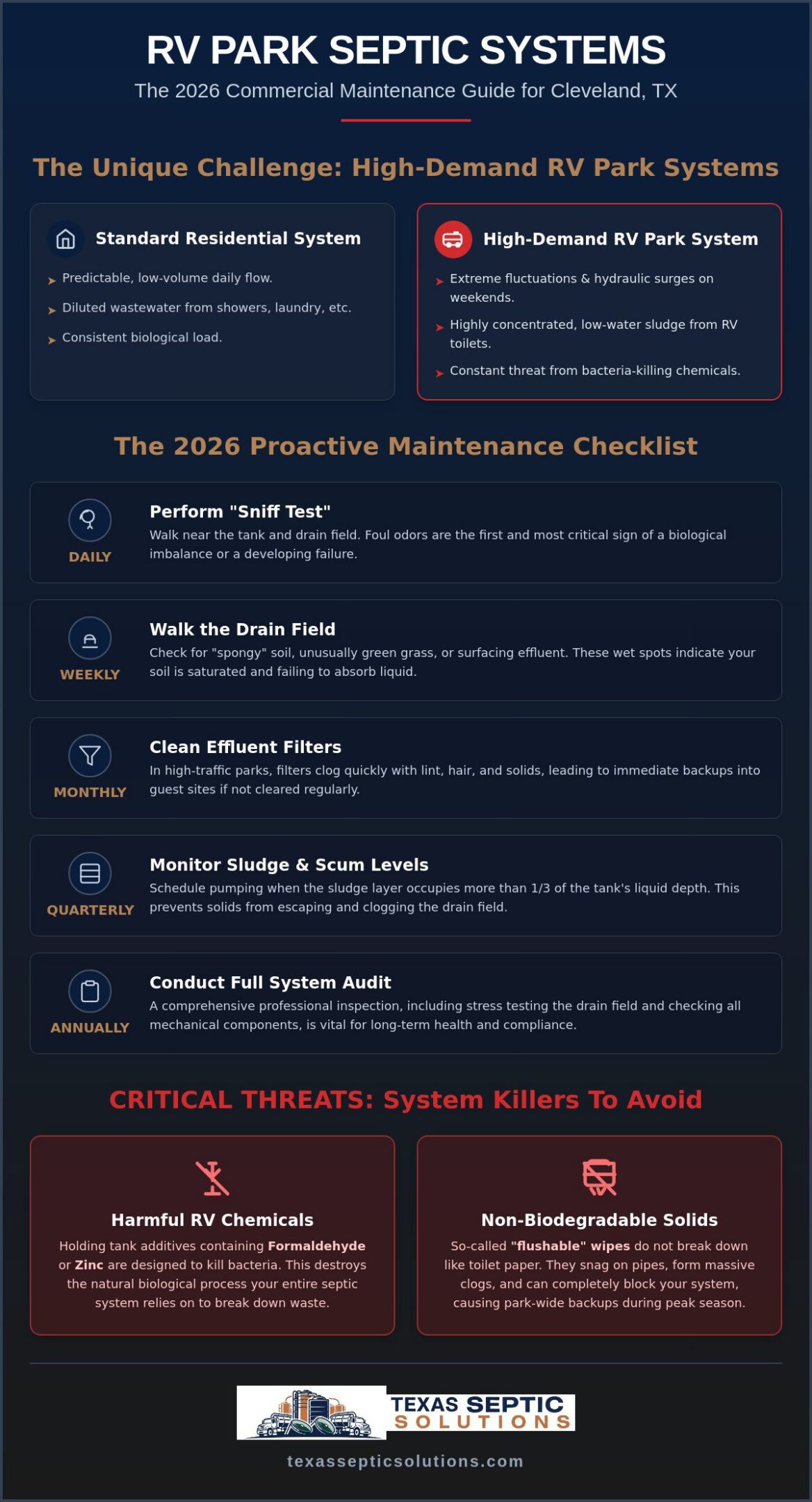
- Daily: Perform a “sniff test” near the tank and drain field. Foul odors are the first sign of a biological imbalance.
- Weekly: Walk the drain field to look for “spongy” soil or surfacing effluent. These wet spots indicate that your soil is struggling to absorb the load.
- Monthly: Clean the effluent filters. In high-traffic parks, these filters can clog with lint and hair quickly, leading to backups into guest sites.
- Quarterly: Monitor sludge and scum levels. If the sludge layer occupies more than one-third of the tank’s liquid depth, it’s time to pump.
- Annually: Conduct a full system audit, including stress testing the drain field and checking all mechanical components.
Weekly and Monthly Owner Tasks
Your team is the first line of defense. Ensure that all septic tank riser lids are bolted down and have airtight seals to prevent rainwater from entering the system during Cleveland’s heavy storms. You should also train your staff on how to respond if they see a septic tank alarm triggered. An alarm usually means the pump has failed or the water level is dangerously high. Finally, keep all trees and deep-rooted vegetation at least ten feet away from the drain field to prevent root intrusion, which can crush pipes and ruin your soil’s absorption capacity.
Professional Maintenance Milestones
While daily checks are vital, certain tasks require a licensed expert. In Liberty County, aerobic systems are legally required to be inspected three times per year by a licensed provider. These inspections ensure your aerators, spray heads, and disinfection units are working correctly. Investing in professional septic system maintenance plans provides you with the documentation needed for TCEQ compliance. It also ensures that float switches and pump controls are tested under load. If you’re concerned about your current capacity, we can help you evaluate your system through Texas Septic Solutions to ensure your infrastructure is ready for the upcoming season.
Combating RV Chemicals and Non-Biodegradable Solids
Most park owners focus on pumping schedules, but what your guests flush is often the silent killer of your infrastructure. Effective RV park septic system maintenance Cleveland TX requires a strict policy on what enters your drains from the moment a camper hooks up. RV holding tanks are frequently treated with aggressive chemicals that protect the guest’s comfort but destroy your facility’s biological balance. Without a plan to manage these inputs, your tanks become little more than holding vessels for toxic sludge.
Managing Chemical Toxicity in the Tank
Chemicals like formaldehyde, glutaraldehyde, and zinc salts are common ingredients in RV toilet treatments because they stop odors instantly. However, these substances are biocides, meaning they are designed specifically to kill living organisms. When these chemicals hit your main tank in high concentrations, they stop the natural decomposition process that keeps your system healthy. Biological death in a septic tank occurs when the bacterial colony is completely neutralized by chemicals, leaving solids to accumulate without any natural breakdown. Following the EPA septic system maintenance guidelines helps you understand why maintaining this bacterial balance is non-negotiable for long-term functionality. If you suspect a chemical kill has occurred, you may need to use specialized bacterial additives to jumpstart the colony and prevent a total system stall.
Physical Blockage Prevention
Non-biodegradable solids are the second major threat to your park’s plumbing. While many products are marketed as “flushable,” they simply don’t break down in a commercial septic environment. These wipes and heavy paper products can snag on pipe joints or settle in the tank’s inlet, leading to immediate backups that frustrate guests. While hydro-jetting can clear these stubborn lines, the cost and guest complaints make prevention a much smarter strategy for your bottom line.
Installing effluent filters is a critical step for any Cleveland park. These filters act as a final screen, catching stray solids before they can migrate into your drain field and cause permanent soil clogging. To keep guests on your side, implement a “septic-safe” rule and use clear signage in bathhouses and at check-in. Focus on educating campers about the “3 Ps” of septic usage: only Pee, Poop, and septic-safe Paper should go down the drain. Simple educational flyers or a quick mention during check-in can save you from a middle-of-the-night emergency call during the busy season.
Pumping and Inspection Schedules for East Texas Soils
In Cleveland and the surrounding Houston area, the ground beneath your feet dictates how your utilities perform. Unlike sandy regions that drain quickly, East Texas is notorious for heavy clay soils. These soils hold onto water, meaning your drain field has a limited capacity to process liquid effluent. When you combine this geological challenge with the massive wastewater surges of a full park, RV park septic system maintenance Cleveland TX becomes a delicate balancing act. If the ground is already saturated from our frequent heavy rains, your system has nowhere to send treated water, leading to hydraulic overload.
To prevent a total failure, you must follow the “Third-of-Tank” rule. While residential owners might wait years to pump, commercial park owners should pump as soon as the sludge and scum layers occupy one-third of the tank’s total liquid capacity. Waiting any longer increases the risk that solids will migrate into your drain field, which is often a death sentence for systems installed in clay-heavy earth.
Determining Your Pumping Frequency
Your pumping schedule shouldn’t be a guessing game. A busy RV park often requires pumping every 6 to 12 months, depending on your seasonal occupancy rates. During peak summer months or major local events, the accumulation of solids happens much faster than during the quiet winter season. We recommend using a tool called a “Sludge Judge” to get an accurate measurement of accumulation. Don’t make the mistake of delaying pumping until the off-season to save on costs. If your tank is full in August, waiting until November will likely result in a system backup during your most profitable weeks.
Drain Field Health in Clay-Heavy Soil
Protecting the soil is just as important as maintaining the tank. Signs of soil saturation include persistent standing water or unusually lush, bright green grass over the drain lines. You must also strictly prevent soil compaction. Never allow vehicles, heavy mowing equipment, or guest overflow parking on top of the drain field area. Compacted clay loses its ability to “breathe,” which effectively chokes the system. If you notice slow-draining sites or sewage surfacing in the yard, you may need a professional septic system repair to restore functionality to failing lines. Staying ahead of these issues with a dedicated plan for RV park septic system maintenance Cleveland TX is the only way to avoid the high cost of a total drain field replacement. For a comprehensive evaluation of your park’s soil health and drainage capacity, contact the experts at Texas Septic Solutions today.
24/7 Support with Texas Septic Solutions
Managing an RV park is a 24-hour job, and your infrastructure doesn’t always wait for business hours to fail. When you’re facing a utility crisis in the middle of a holiday weekend, you need a partner who understands the local landscape and the high stakes of your business. We specialize in RV park septic system maintenance Cleveland TX, providing the industrial-scale pumping and rapid-response repairs required to keep your gates open. As your neighborly experts, we take pride in supporting the Cleveland community with reliable, straightforward service that property owners can trust.
Our approach is built on readiness. We maintain specialized commercial pumping equipment designed to handle the high-volume sludge levels common in RV parks. Whether you need a routine pump-out or a complex repair to a pressurized system, we bring the accountability of a local authority to every job site. We don’t just fix the immediate problem; we look for the root cause to ensure your system stays functional through the entire season. By choosing a local partner, you’re ensuring that your service provider is never more than a few miles away when minutes count.
Emergency Response for Park Shutdown Prevention
A major backup during a peak occupancy weekend can lead to a total park shutdown and devastating financial losses. Our 24/7 emergency septic service is designed to prevent this exact scenario. If a lift station fails or a main line clogs, our team responds immediately to perform a site evaluation. In many cases, we can implement bypass pumping. This temporary solution moves wastewater around the failed component, allowing your guests to continue using their facilities while we perform the necessary repairs. We prioritize these critical commercial failures to ensure your reputation remains intact and your guests stay happy.
Long-Term Partnership and Compliance
Beyond emergency repairs, we help you navigate the complex regulatory environment of Liberty County. We assist with the documentation required for permit renewals and ensure your inspections meet TCEQ standards. A customized maintenance plan from Texas Septic Solutions acts as a cost-saving insurance policy, catching wear and tear before it leads to a catastrophe. Part of this partnership involves planning for the future, including helping you understand potential septic system replacement costs if your current infrastructure is reaching its limit. If you’re ready to secure your park’s future with professional RV park septic system maintenance Cleveland TX, contact us today for a comprehensive consultation.
Secure Your Park’s Reputation for the 2026 Season
Proactive care is the only way to protect your business from the unique stresses of high-occupancy weekends and the biological challenges of RV waste. By following a strict inspection schedule and managing what your guests flush, you prevent the costly backups that lead to negative reviews and lost revenue. Remember that Cleveland’s clay soil doesn’t forgive neglect. Staying ahead of sludge accumulation ensures your drain field remains healthy even during the wettest East Texas months.
Partnering with licensed Texas septic professionals gives you access to specialized commercial pumping equipment and the peace of mind that comes with 24/7 emergency service availability. We are here to help you master RV park septic system maintenance Cleveland TX so you can focus on your guests while we handle the infrastructure. Get a Commercial Maintenance Quote for Your Cleveland RV Park today to ensure your facility is ready for whatever the next season brings. Your park’s success starts with a system you can depend on.
Frequently Asked Questions
How often should an RV park septic tank be pumped in Cleveland, TX?
Most busy RV parks in the Cleveland area require pumping every 6 to 12 months. Unlike a residential system that might last three years, your high-traffic tanks accumulate solids much faster due to the concentrated nature of RV waste. Pumping frequency depends on your seasonal occupancy rates and your total tank capacity.
Can I use residential septic additives in a commercial RV park system?
Residential additives usually aren’t strong enough to handle the chemical load of a commercial RV system. These systems often deal with biocides from guest holding tanks that stall the biological process. You need professional-grade bacterial treatments to jumpstart a system that has suffered from chemical toxicity or a total biological stall.
What are the signs that my RV park drain field is failing?
Look for lush, bright green patches of grass or spongy soil over your drain lines. These are clear signs that the effluent isn’t being absorbed and is instead surfacing. You might also notice persistent sewage odors or sluggish drains in your park bathhouses during peak occupancy weekends.
Is it illegal to allow guests to use formaldehyde-based chemicals in my park?
While there isn’t a specific state law banning the possession of formaldehyde, discharging it into your septic system can cause biological failure and lead to permit violations. Many park owners implement a strict ban on these chemicals to protect their RV park septic system maintenance Cleveland TX efforts. It’s best to require guests to use enzyme-based holding tank treatments.
How much does emergency septic repair cost for a commercial system?
The cost of emergency repairs depends on the time of day, the severity of the failure, and the specific components that need attention. Factors like whether you need bypass pumping or a full pump replacement will influence the final total. We recommend a maintenance plan to catch these issues before they become expensive after-hours emergencies.
What should I do if my septic alarm goes off on a busy Saturday?
Silence the alarm and call for emergency service immediately. An alarm usually indicates a high-water level or a pump failure, meaning you have limited time before a backup occurs. Stop all water usage in the park if possible and check your electrical breakers while you wait for a professional technician to arrive.
Do I need a special permit for an RV park septic system in Liberty County?
Yes, the Liberty County Permit & Inspection Department manages all OSSF permitting for the Cleveland area. If your park treats more than 5,000 gallons of wastewater per day, you’ll also need to secure a domestic wastewater permit from the TCEQ. Compliance with these local and state standards is critical for staying operational.
How can I prevent guests from flushing wipes into the system?
Education and accessibility are your best tools for preventing clogs. Place clear signage in every bathroom and provide trash cans in all stalls so guests have an alternative to flushing wipes. Including a “septic-safe” rule in your check-in paperwork helps guests understand that your RV park septic system maintenance Cleveland TX depends on their cooperation.