
New Home Septic System Inspection Cypress: The Ultimate 2026 Buyer’s Checklist
Would you gamble $20,000 on a home inspection that never even looks underground? While a standard home inspector checks the roof and the foundation, they often skip the most expensive component of a rural or suburban property. Buying a house is stressful enough without the fear of inheriting a failing tank or a massive repair bill just weeks after moving in. You want to focus on your new life in the community, not worrying about whether a complex aerobic system meets the 2026 Harris County regulations.
We know the technical side of waste management feels overwhelming, especially with the heavy clay soil and high water table unique to our area. This guide ensures your new home septic system inspection Cypress provides total clarity, protecting your investment before you sign the final papers. You’ll learn exactly what a professional mechanical audit involves, from camera scopes to verifying the $369 Harris County residential permit status. We also provide a clear first year maintenance plan so you can move into your new home with absolute confidence and peace of mind.
Key Takeaways
- Learn why standard home inspections usually stop at the surface and why a simple “dye test” fails to provide a complete picture of system health.
- Discover the specific steps involved in a new home septic system inspection Cypress to identify hidden tank cracks or failing mechanical components.
- Spot surface-level red flags like ponding water or oversaturated soil that indicate the drain field is struggling with local clay conditions.
- Understand how hydraulic load testing works to prove a system can handle daily wastewater flow without backing up into your new home.
- Learn to read between the lines of an inspection report to catch high water levels and corrosion before they turn into a major financial surprise.
Why a Standard Home Inspection Isn’t Enough for Cypress Septic Systems
Buying a home in Cypress involves many moving parts. Most buyers rely on a general inspector to flag potential issues before closing. While these professionals are experts at checking HVAC systems and electrical panels, they often lack the specialized equipment needed for a deep dive into your wastewater setup. A standard inspection is usually just a visual check. It doesn’t account for the complex underground ecosystem that manages your home’s waste. To truly understand how septic systems work, you must look inside the tank rather than just at the bathroom fixtures.
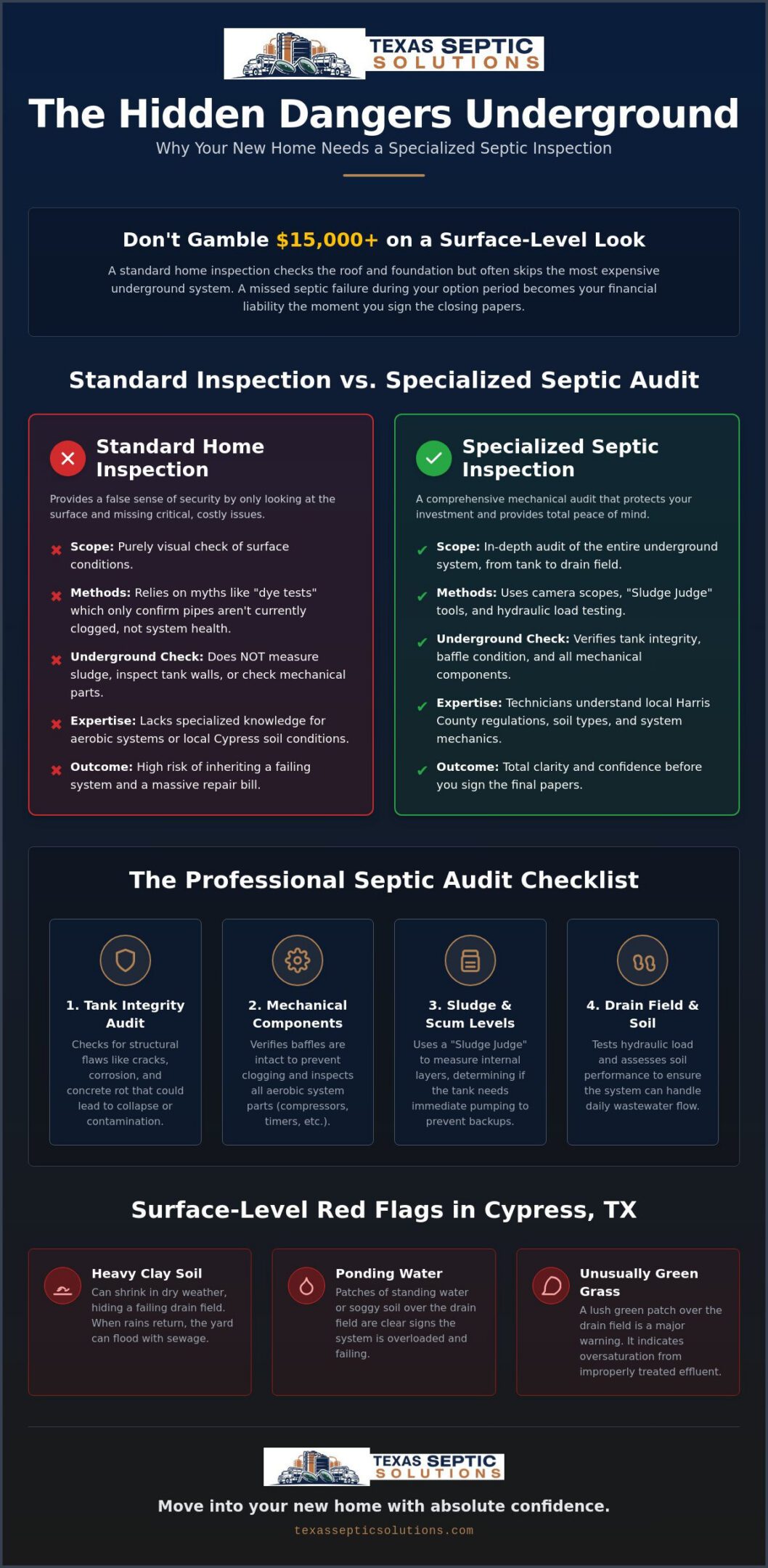
You might hear about a “dye test” as a standard procedure for real estate transactions. This is largely a myth. A simple flush with colored water only tells you if the pipes are currently clear. It fails to reveal if the tank is cracked or if the sludge levels are dangerously high. Without a professional new home septic system inspection Cypress experts provide, you’re essentially guessing about the health of a system that could cost $15,000 or more to replace. A missed failure during the option period becomes your financial liability the moment you sign the closing papers.
Cypress presents unique challenges due to its heavy clay soil. During dry Texas summers, this clay shrinks and cracks, which can actually hide a failing drain field. Effluent might disappear into those cracks temporarily, making a broken system look functional. Once the rainy season hits and the clay expands, you’ll find yourself with a yard full of sewage. We look beyond the current weather conditions to see how the soil is actually performing.
The Limitations of Visual Inspections
General inspectors often look for “lush green grass” as a sign of a healthy yard. In the septic world, an unusually green patch over the drain field is a major red flag. It often means the soil is oversaturated because the system can’t process waste fast enough. Standard inspections also skip measuring the scum and sludge layers inside the tank. Without these measurements, you won’t know if the previous owner followed a proper pumping schedule or if the system is months away from a total backup.
Specialized Knowledge for Aerobic vs. Anaerobic Systems
Cypress properties feature a mix of older anaerobic systems and modern aerobic units. Aerobic systems are like miniature municipal treatment plants. They have air compressors, electrical control panels, and spray heads that require a technician’s eye. Harris County and the TCEQ have strict rules for these units, including mandatory maintenance contracts. A general inspector won’t check the timer settings or the chlorine levels in your disinfection chamber. We ensure every mechanical component meets local standards so you don’t inherit a compliance nightmare.
The Core Inspection Checklist: Tank Integrity and Mechanical Components
A professional new home septic system inspection Cypress buyers trust goes far beyond a visual scan of the yard. Our team performs a mechanical audit of the entire underground infrastructure. We start with a tank material audit. Concrete tanks are common in older Cypress properties, but they can suffer from concrete rot caused by sewer gases. Plastic and fiberglass tanks are more resistant to corrosion but can crack if the soil shifts. We look for these structural flaws that could lead to groundwater contamination or a total tank collapse.
Next, we examine the baffles. These T-shaped pipes at the inlet and outlet are your drain field’s first line of defense. If the outlet baffle is corroded or missing, solids float right into your pipes and clog the soil. This is a common issue that often goes unnoticed until it’s too late. To check the current load, we use a Sludge Judge. This tool allows us to see the internal layers of scum and sludge. If the levels are too high, we’ll recommend septic tank pumping as a condition of the sale. Keeping up with these Texas Commission on Environmental Quality (TCEQ) regulations ensures the system remains legal and functional.
Safety is just as important as functionality. We verify that all lids and risers are secure and in good condition. Damaged lids are a severe safety hazard for children and pets, and they often don’t meet modern local codes. If you’re moving into a new property, you want the peace of mind that comes from knowing every access point is locked down and watertight.
Inside the Tank: What We Look For
We specifically watch for signs of back-flow. If the water level in the tank is higher than the outlet pipe, it means the drain field isn’t accepting water, and it’s pushing back into the tank. This is a major red flag for a failing system. We also inspect the partition wall in multi-compartment tanks. If this wall is compromised, the separation of solids and liquids fails, sending raw waste into the secondary chamber. Finally, we pull and clean the effluent filter, which acts as a safety net for your drain field.
Electrical and Control Systems
Modern aerobic systems rely on electricity to function. We test the high-water alarm to ensure it works before you experience a septic tank alarm going off in the middle of the night. Our team inspects the control panel for moisture or scorched wires, which can indicate an aging pump or aerator. For spray-irrigation systems, we verify the timer settings. You don’t want your sprinklers running while the kids are playing in the yard. If you’re unsure about the state of a system, a quick chat with the team at Texas Septic Solutions can help clarify any technical concerns.
Evaluating the Drain Field and Soil Performance in Cypress
Once the tank components are verified, the focus shifts to the most critical and expensive part of the infrastructure: the drain field. This area is responsible for the final treatment of wastewater. In our region, the local geology plays a massive role in how these systems perform. A new home septic system inspection Cypress must account for the heavy clay soils prevalent in zip codes like 77429 and 77433. This “black gumbo” clay has a low absorption rate, meaning it doesn’t soak up water quickly. If a system was poorly designed or the soil has become compacted over time, you’ll face major issues the moment you start doing regular laundry loads.
We begin with a thorough surface inspection. While a yard might look fine at first glance, we look for “ponding” or soft, spongy spots that indicate the soil is already at its limit. Foul odors or unusually lush, dark green vegetation often signal that effluent is rising to the surface rather than filtering down. To prove the field can actually handle a family’s daily water usage, we perform hydraulic load testing. By introducing a controlled volume of water into the system, we can observe if the field handles the stress or if the water levels in the tank begin to rise, suggesting a looming failure.
Our technicians also use specialized probes to check the lateral lines. We’re looking for physical obstructions like root intrusion from nearby trees or pipes that have been crushed by heavy equipment or vehicles. These mechanical blockages are common in older properties and can’t be fixed by simply pumping the tank. Identifying these issues during your due diligence period is the only way to avoid a surprise bill after closing.
The Impact of Local Topography
We evaluate how the rest of the property affects your septic health. If a driveway or roof gutter drains directly toward the septic area, the field will stay perpetually saturated. This prevents it from treating wastewater effectively. We also verify that the system maintains a safe distance from property lines and any existing water wells. Soil compaction is another silent killer; if a previous owner parked a boat or trailer over the lines, the soil’s ability to “breathe” and absorb water is often permanently ruined.
Advanced Field Diagnostics
For homes with systems approaching the 20-year mark, we often suggest a camera inspection of the lateral lines. The typical lifespan of a Cypress drain field is between 20 and 30 years, so knowing the internal condition of the pipes is vital. If we find significant sludge buildup or pipe sagging, it’s a clear sign that a septic system repair is necessary to restore the leach field’s functionality. Catching these problems early allows you to negotiate repairs with the seller rather than paying for them yourself later.
Understanding the Inspection Report: Critical Red Flags to Watch For
Receiving your report after a new home septic system inspection Cypress is the moment of truth. This document serves as your roadmap for negotiations and your primary protection against future expenses. We don’t just hand you a list of parts; we explain what each finding means for your property’s functionality. Certain red flags indicate immediate health hazards or system failures that require a resolution before you move in. Ignoring these signs can lead to a $20,000 surprise just months after you’ve settled into your new home.
- High Water Levels: If the tank water is above the outlet pipe, the system is currently backed up. This usually points to a clogged drain field or a pump that has already given out.
- Corroded Baffles: These pipes prevent solids from entering your soil. If they’re gone, your drain field is likely already damaged by sludge buildup.
- Inoperative Aerator: In aerobic systems, the aerator is the heart. If it’s dead, the system is discharging raw, untreated waste into the yard, which is a major environmental violation.
- Roots in the Tank: This isn’t just a landscaping issue. Roots only get inside if there are structural cracks, which means groundwater is also leaking in and overloading the system.
- Failed Alarm System: The high-water alarm is your only warning before a backup hits your kitchen sink. A failure here is a non-negotiable safety risk that needs immediate attention.
The Difference Between Maintenance Issues and System Failure
It’s vital to distinguish between a simple repair and a total catastrophe. Replacing an effluent pump is a standard maintenance item that doesn’t necessarily mean the system is failing. However, if the inspection reveals the soil in the drain field can no longer absorb water, you’re looking at a full replacement. In these cases, you need to understand the septic system replacement cost to negotiate fairly with the seller. A failed report is a powerful tool; it allows you to ask for a price reduction or require the seller to complete repairs before closing.
Post-Inspection Action Plan
Once you have the facts, ask the seller for their pumping and service records. Harris County requires aerobic systems to have at least three inspections per year, so these logs should be readily available. If the report shows damage, get a professional quote for the specific repairs before your option period expires. Finally, use the data to draft a septic system maintenance plan for your first year of ownership. If the report has left you with more questions than answers, contact Texas Septic Solutions for a clear explanation of your next steps.
Securing Your New Home with Texas Septic Solutions
Cypress real estate agents and savvy buyers trust our process because we treat every inspection as if we were the ones buying the home. A new home septic system inspection Cypress requires a partner who understands the local landscape and the urgency of real estate deadlines. We provide fast turnaround times on every report, ensuring you have the data you need before your option period expires. Our “Real Estate Septic Audit” goes beyond the surface to identify hidden structural issues, protecting your investment from the $12,000 to $25,000 costs associated with unexpected aerobic system failures.
We offer a seamless transition from the initial inspection to long-term care. If our audit reveals that repairs are necessary, we provide clear, itemized quotes that can be used for seller concessions. You won’t be left with a list of problems and no way to solve them. We are built to handle everything from routine pumping to complex mechanical repairs, making us a one-stop solution for your new property’s utility needs. Our goal is to move you from uncertainty to a clear maintenance plan for your first year of homeownership.
The Neighborly Expert Advantage
Our team lives and works in the Cypress, Houston, and Cleveland areas. This local presence means we have first-hand experience with the specific black gumbo clay challenges in your new neighborhood. Our inspectors are also active technicians. They don’t just read manuals; they spend every day in the field fixing the exact systems they inspect. Every report we deliver is transparent and includes clear photos of the tank internals, mechanical components, and drain field conditions. You get actionable recommendations rather than vague technical jargon.
Ready to Schedule Your Cypress Inspection?
Secure your investment before you sign the dotted line. Contact us today to schedule your professional evaluation. We provide 24/7 emergency support for urgent real estate deadlines, so you never have to worry about a slow response holding up your home purchase. After you close, join our septic system maintenance Texas program. It’s the most reliable way to keep your new home running smoothly and ensure your system meets all local Harris County regulations for years to come.
Take Control of Your Property’s Future
Take the guesswork out of your home purchase. A visual check of the yard doesn’t reveal the true state of your underground infrastructure. You need a mechanical audit that evaluates tank integrity, baffle health, and the specific performance of the drain field in our local clay soil. Securing a professional new home septic system inspection Cypress buyers trust is the only way to avoid inheriting expensive repairs or environmental violations. These insights give you the leverage needed to negotiate fairly before the option period ends.
Our team provides comprehensive Real Estate Audit Reports designed to protect your wallet and your peace of mind. We serve Cypress, Houston, and the surrounding areas with the expertise of local technicians who know these systems inside and out. Whether you’re facing a tight closing deadline or need a 24/7 emergency response for a sudden backup, we’re ready to support your transition into your new home. Don’t let a hidden septic failure ruin your move-in day.
Schedule Your Cypress Septic Inspection Today and start your journey as a homeowner with complete confidence. We look forward to being your long-term partner in maintaining a healthy, functional home.
Frequently Asked Questions
How much does a septic inspection cost in Cypress, TX?
A comprehensive septic inspection for a real estate transaction in the Cypress area typically costs between $400 and $900 in 2026. This professional audit is more intensive than a routine check because it often includes camera scopes of the lateral lines and hydraulic load testing. These specialized procedures ensure that you aren’t inheriting a system with hidden structural cracks or a failing drain field.
Do I really need a separate septic inspection if I have a general home inspection?
Yes, a specialized new home septic system inspection Cypress is necessary because general home inspectors usually only perform a visual check of the plumbing fixtures. They don’t have the equipment to measure sludge levels or inspect the internal integrity of the tank. A dedicated septic professional focuses on the mechanical health of the underground ecosystem, which is often the most expensive component of the property.
How long does a professional septic inspection take?
A thorough inspection usually takes between two and four hours to complete. The timeframe depends on the type of system and whether the tank lids are already exposed or need to be uncovered. Aerobic systems typically take longer because the technician must test the electrical control panel, aerator, and spray heads to ensure they meet local Harris County requirements.
What happens if the septic system fails the inspection during my home purchase?
A failed inspection report serves as a powerful negotiation tool before you close on the house. You can request that the seller pays for the necessary repairs or ask for a price reduction based on professional repair quotes. Keep in mind that if a system fails, Harris County charges a $97 reinspection fee once the repairs are finished to verify compliance.
Should the septic tank be pumped before or after the inspection?
The tank should always be inspected before it is pumped. Inspecting a full tank allows the technician to see the “working” liquid levels and identify if there is any backflow from the drain field. Once the initial levels are verified, the tank is often pumped during the inspection so the technician can check the floor and walls for structural cracks or root intrusion.
How often should a septic system in Cypress be inspected after I move in?
Texas state law requires aerobic septic systems to have at least three inspections per year under a valid service contract. These frequent checks ensure the disinfection process and mechanical parts are functioning correctly. If your new home has a conventional anaerobic system, a professional inspection and pumping every two to three years is generally sufficient to maintain soil health.
Can a septic inspection detect if the system is too small for the family size?
Yes, technicians compare the tank’s gallon capacity against the number of bedrooms and the home’s potential occupancy. If a previous owner added bedrooms without upgrading the septic system, the tank may be undersized for your family. We verify that the system meets the current Texas Commission on Environmental Quality (TCEQ) standards for the home’s size to prevent future backups.
What is the most common reason for septic failure in the Cypress area?
The primary cause of failure in Cypress is soil saturation within the heavy “black gumbo” clay. This soil has very low absorption rates, which can lead to drain field failure if the system is overloaded with water or if the tank hasn’t been pumped regularly. Without routine maintenance, solids escape the tank and clog the soil pores, eventually requiring a complete and costly system replacement.