
Mobile Home Septic System Installation in Cleveland, TX: The 2026 Homeowner’s Guide
Did you know that starting your site work without the right paperwork could cost you double in permit fees this year? In Liberty County, the regulations for mobile home septic system installation Cleveland TX have never been stricter, and the heavy East Texas clay doesn’t make the process any easier. You’re likely already feeling the pressure of coordinating your move while worrying if your soil will even pass a perc test. It’s frustrating to navigate county offices when all you want is to get your home set up and functional without unnecessary delays.
We agree that the technical side of wastewater can feel overwhelming, especially when you’re trying to figure out the right sizing for a double-wide or dealing with a high water table. This guide provides the exact roadmap you need to design, permit, and install a TCEQ-compliant system that passes inspection the first time. We will walk you through the 2026 permitting steps, the mandatory “Affidavit to the Public” requirements, and the timeline you can expect from your initial soil test to your move-in day.
Key Takeaways
- Understand why local building permits are a prerequisite for septic approval and how to avoid double-fee penalties in Liberty County.
- Master the 5-step roadmap for a mobile home septic system installation Cleveland TX, beginning with a mandatory site evaluation.
- Identify the best system for your property by comparing conventional setups against aerobic units designed for heavy East Texas clay.
- Calculate your required tank capacity based on bedroom count rather than residents to ensure your system meets state sizing standards.
- Simplify your move-in timeline with a turnkey approach that manages everything from initial soil tests to the final county inspection.
Understanding Mobile Home Septic Requirements in Cleveland, TX
The Texas Commission on Environmental Quality (TCEQ) sets the baseline for every on-site sewage facility in the state. However, Cleveland residents must answer to local Authorized Agents (AAs) in either Liberty or Montgomery County, depending on exactly where their property line sits. These local offices manage the day-to-day enforcement of 30 TAC Chapter 285, ensuring that every mobile home septic system installation Cleveland TX meets strict safety standards. You aren’t just installing a tank; you’re building a regulated piece of infrastructure that protects our local groundwater and the San Jacinto River basin.
You might have heard the “10-acre rule” mentioned by neighbors, suggesting that large plots don’t need permits. In reality, this is often a myth in the Cleveland area. Local authorities have the legal power to be stricter than the state. Because our region deals with high water tables and dense clay, most lots require a formal permit and inspection to prevent environmental contamination. Understanding what a septic system is involves recognizing it as a mini-treatment plant on your property that must be engineered specifically for your land’s unique footprint. Additionally, Liberty County requires a building permit as a prerequisite for any septic approval, so you can’t skip steps without facing penalties.
TCEQ vs. HUD: Who Regulates Your Waste?
It’s a common mistake to assume that the HUD “red label” on your manufactured home covers your utilities. While the Department of Housing and Urban Development (HUD) regulates the construction and safety of the home itself, they have no jurisdiction over how you handle wastewater once it leaves the structure. Your home’s compliance with federal manufacturing standards doesn’t exempt you from state septic laws. Following the rules in 30 TAC Chapter 285 is mandatory for any permanent placement of a mobile home septic system installation Cleveland TX.
Cleveland Soil Profiles: The Clay Challenge
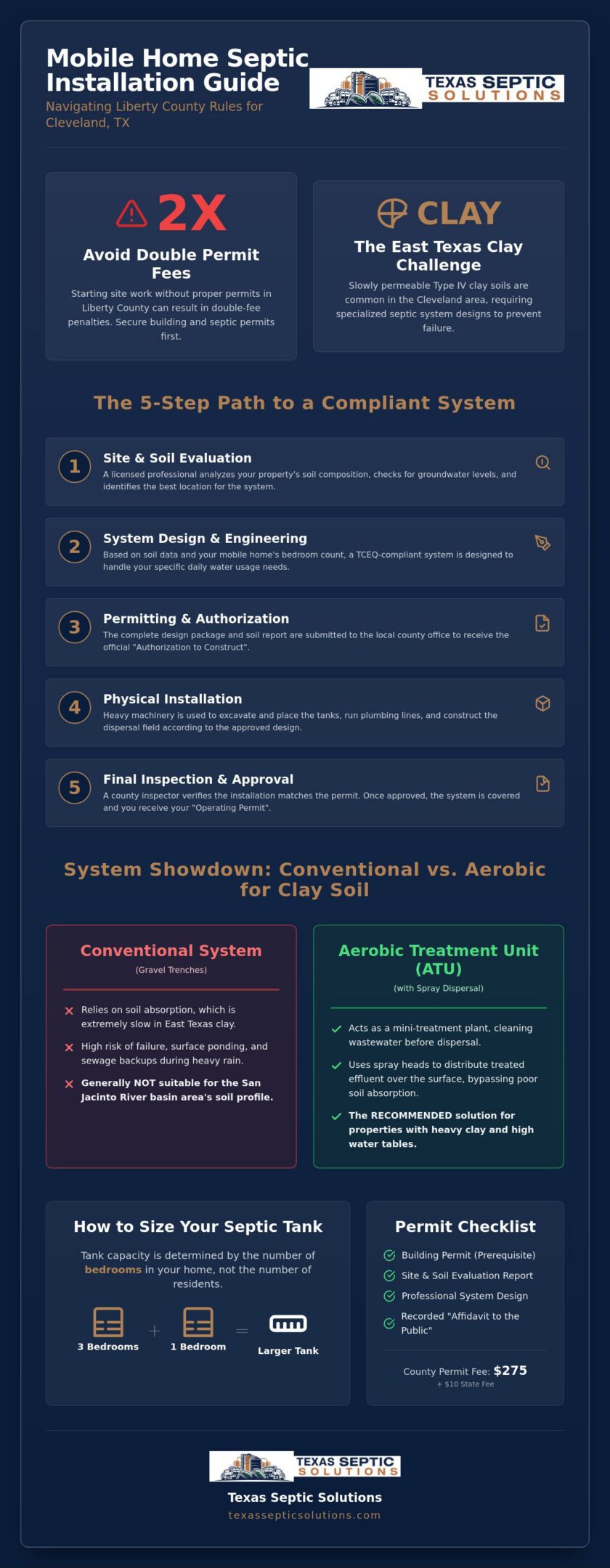
The San Jacinto River basin area is notorious for its Type IV clay soils. These soils are fine and slowly permeable, meaning they don’t absorb water quickly. During the heavy rainfall common in East Texas, these “tight” soils can become saturated, leading to system failure if the design is inadequate. Traditional gravel trenches often fail here because the “perc” rate is simply too slow for the ground to process effluent effectively. Soil texture and permeability directly dictate the total square footage and specific technology required for your dispersal field.
The 5-Step Mobile Home Septic Installation Process
Installing a waste system for your manufactured home is a sequence of events that requires precision and timing. You don’t just dig a hole and drop in a tank. Every mobile home septic system installation Cleveland TX follows a strict regulatory path to ensure long term reliability and environmental safety. This process ensures that your home is ready for move-in without the threat of sewage backups or legal fines. While it might seem like a lot of red tape, following these steps helps you avoid the double-permit penalties enforced by Liberty County for unpermitted work.
The journey from bare land to a functioning utility involves five distinct phases:
- Phase 1: Site Evaluation. A licensed professional visits your property to perform a soil analysis and check for groundwater levels.
- Phase 2: System Design. Your system is engineered based on the bedroom count of your mobile home. This determines the daily water usage capacity.
- Phase 3: Permitting. We submit the design and soil report to the local county office. You must receive “Authorization to Construct” before any dirt is moved.
- Phase 4: Physical Installation. This is the heavy lifting. We place the tanks, run the lateral lines, and set up the dispersal field.
- Phase 5: Final Inspection. A county inspector verifies the work before we cover the system. Once approved, you receive your Operating Permit.
If you’re feeling overwhelmed by these requirements, our team provides new septic system installation services that manage every step of this process for you.
Securing Your Cleveland Septic Permit
In Liberty County, the permitting process is a prerequisite for your building permit. You must submit a complete application package that includes a site evaluation, a professional design, and a recorded “Affidavit to the Public” from the County Clerk. As of June 2026, the county charges a $275 permit fee plus a $10 state fee. Don’t rush this part. Typical turnaround times for local reviews can take several business days. Missing a single signature or an outdated soil report will lead to an immediate rejection.
Professional Soil Testing (Perc Tests)
A soil test is the most critical part of the design. It’s more than just a “perc test” where you pour water into a hole. A licensed evaluator examines soil horizons to see how well the earth can treat wastewater. In Cleveland, the presence of heavy clay and high water tables often means traditional systems won’t work. These tests follow Texas septic system regulations to ensure your system won’t fail during our frequent East Texas rainstorms. The soil report dictates whether you need a standard gravity system or a more advanced aerobic unit.
Choosing the Right System: Conventional vs. Aerobic
Choosing the right technology for your mobile home septic system installation Cleveland TX depends almost entirely on what lies beneath your topsoil. While there are two primary types of systems used in our area, the geography of East Texas often makes the choice for you. Conventional systems are the traditional choice, consisting of a watertight tank and a series of underground gravel trenches. These rely on gravity and well-draining soil to filter effluent. However, because Cleveland is dominated by dense clay, these systems are becoming increasingly rare for new manufactured home setups.
Aerobic Treatment Units (ATUs) have become the modern standard for local homeowners. These systems use an electric pump to inject oxygen into the waste, which allows aerobic bacteria to break down solids much faster than a conventional tank. The treated water is then typically dispersed through a spray irrigation system or a drip line. Because these systems involve mechanical components like air compressors and timers, they require a dedicated septic system maintenance plan to stay in compliance with state law and ensure the unit operates reliably for years.
When an Aerobic System is Mandatory
In many parts of Liberty and Montgomery County, an aerobic system isn’t just an upgrade; it’s a legal requirement. TCEQ guidelines state that if your soil is classified as Type IV clay or if your property has a high water table, a conventional drain field is “unsuitable.” For mobile home owners near local creeks or low-lying areas, aerobic systems provide a higher level of treatment that protects the environment even when the ground is saturated from heavy seasonal rains. Most new installations in East Texas now utilize this technology to guarantee long term functionality.
Comparing Footprints and Lot Layouts
The layout of your lot often dictates which system will fit. A conventional drain field requires a large, flat area of undisturbed soil, which can be difficult to find on smaller mobile home lots. In contrast, aerobic spray zones are more flexible and can often be designed to fit within tighter footprints. You must also account for setback requirements from your home’s foundation and property lines. A septic tank must be installed at least 50 feet away from a private water well to prevent cross-contamination. These spacing rules ensure that your system remains accessible for future service while keeping your drinking water and home structure safe.
Sizing and Site Prep for Manufactured Homes
Getting the sizing right for your mobile home septic system installation Cleveland TX is a matter of following the “Bedroom Rule” set by the state. Many homeowners assume that a double-wide needs a larger tank simply because the home has a bigger footprint. In reality, Texas regulatory standards calculate daily water usage based on the number of bedrooms and the total square footage, not the number of people currently living there. A three-bedroom single-wide and a three-bedroom double-wide often require the same tank capacity because their potential wastewater output is identical in the eyes of the law.
Site preparation is just as vital as the tank itself. You must ensure the “pad” where your mobile home will sit is stable and level before we begin digging. If the home settles unevenly after the septic is connected, it can put immense pressure on the main sewer line, leading to cracks or complete disconnects. We also look closely at your home’s plumbing stub-out. Aligning the tank inlet perfectly with the home’s exit point prevents “belly” in the line where waste can collect and cause clogs. Using modern, water-saving fixtures in your new home can also help by reducing the total daily load on your dispersal field, which is especially helpful during the wet East Texas winters.
Plumbing Connections and Skirting
The connection between your home and the septic tank must maintain a consistent slope of at least 1/4 inch per foot. Without this specific drop, gravity won’t be enough to move waste effectively, leading to frequent backups. When you apply skirting to your mobile home, it’s easy to accidentally hide the very cleanouts you’ll need for future service. We ensure these access points remain reachable outside the skirting line. Protecting these lines from physical damage or the occasional hard freeze is a standard part of a professional setup.
If you’re ready to break ground on your new property, we can handle the entire new septic system installation from the first shovel to the final pipe connection.
Planning for Future Maintenance
Thinking about maintenance during the installation phase saves you hundreds of dollars later. We strongly recommend installing septic tank risers, which bring the access lids up to ground level. This means a pumper truck won’t have to dig up your yard just to inspect or clean the tanks. You should also plan your lot layout so that heavy trucks have a clear, reinforced path to reach the system in all weather conditions. Avoid the temptation to plant trees or drive vehicles over your new drain field, as soil compaction is a leading cause of premature system failure in our heavy clay areas.
Why Texas Septic Solutions for Your Cleveland Installation?
Choosing a partner for your mobile home septic system installation Cleveland TX shouldn’t be another source of stress during your move. We understand the specific challenges of East Texas land. From the dense clay soils to the rigorous permitting requirements in Liberty and Montgomery Counties, our team has navigated these hurdles hundreds of times. We don’t just install a tank; we provide a complete utility foundation for your new home. We handle the heavy lifting so you can focus on the excitement of your new space.
Our turnkey service model covers every phase of the project. This includes the initial site evaluation, professional system design, and the final county walk-through. You won’t have to juggle multiple contractors or worry about missing a deadline at the permit office. We also know that utility issues don’t always happen during business hours. That’s why we maintain a commitment to 24/7 readiness, ensuring you have access to emergency septic repair and ongoing maintenance whenever you need it. Clear, honest communication is our baseline from the first phone call to the final inspection.
The ‘Neighborly Expert’ Advantage
Our team lives and works in the same communities we serve. We’ve built strong professional relationships with Liberty County inspectors, which helps us ensure your application is accurate and compliant before it even hits their desk. We prioritize the long-term health of your system over “quick-fix” installations that might save a few dollars today but lead to failure tomorrow. Serving manufactured home owners in the Cleveland community is a point of pride for us. We treat every project with the accountability and care expected of a local authority.
Ready to Start Your Installation?
The best time to start your septic planning is well before your home is delivered to the lot. Securing your permits and completing the soil evaluation early prevents your home from sitting on a property without working utilities. We’re ready to help you navigate this timeline with a custom plan tailored to your specific acreage. If you’re ready to secure a system that offers long-term reliability and peace of mind, contact Texas Septic Solutions for a consultation today. We’ll provide a clear, detailed quote based on your specific site conditions and home size.
Secure Your Cleveland Home’s Future Today
Setting up your new manufactured home should be an exciting milestone, not a regulatory headache. We’ve covered why the heavy clay soils in East Texas often require advanced aerobic systems and how the Liberty County permitting process serves as the gatekeeper to your move-in date. By understanding the “Bedroom Rule” for sizing and prioritizing site preparation, you ensure that your mobile home septic system installation Cleveland TX is built for long-term reliability rather than just a quick inspection pass.
At Texas Septic Solutions, we take pride in being your local authority for wastewater management. Our team of Licensed TCEQ Installers provides the turnkey support you need to navigate both Liberty and Montgomery County requirements with ease. We stand by our work with 24/7 Emergency Support, ensuring your home remains functional through every season. Don’t let paperwork or soil tests slow down your progress.
Schedule Your Mobile Home Septic Consultation in Cleveland and let our experts handle the technical details while you focus on making your new house a home. We look forward to helping you get settled.
Frequently Asked Questions
Do I need a different type of septic system for a mobile home than a regular house?
No, the technology used for a manufactured home is essentially the same as a site-built residence. Both utilize a treatment tank and a dispersal field regulated by the same state standards. The primary differences involve the specific plumbing connection points and the way we calculate daily wastewater flow based on your home’s bedroom count.
Can I connect my mobile home to an existing septic tank in Cleveland?
You can only connect to an existing system if it passes a professional inspection and meets current capacity requirements for your new home. We must verify that the tank is in good condition and that the dispersal field can handle the daily flow. If the existing system was never permitted or is undersized, a new mobile home septic system installation Cleveland TX will be required.
What size septic tank does a 3-bedroom double-wide mobile home need?
A three-bedroom home typically requires a 1,000-gallon tank to meet standard regulatory requirements. While the tank size is standard, the type of system depends on your soil. In the Cleveland area, heavy clay often necessitates an aerobic treatment unit with a spray or drip field rather than a traditional gravity system.
How long does it take to install a septic system for a mobile home in Texas?
The entire process usually takes between two and four weeks from start to finish. While the physical digging and pipe laying only take two or three days, the site evaluation, professional design, and county permit review consume the majority of the timeline. We recommend starting this process at least a month before your home delivery date.
Is it possible to install my own septic system for my mobile home to save money?
No, Liberty County regulations require that all septic systems be installed by licensed professionals. Attempting a DIY installation can lead to significant legal penalties and a refusal of your operating permit. The county also enforces a policy that doubles the permit fee for any work started without the proper professional authorization.
What happens if my mobile home septic system fails the final inspection?
If a system fails, the installer must correct the specific technical issues identified by the county inspector before any dirt is moved to cover the tanks. You cannot receive an Operating Permit or move into the home until the system passes a follow-up inspection. This is why we prioritize precision during the initial construction phase to ensure a first-time pass.
How much space do I need for a septic system on a small mobile home lot?
The amount of space required depends on the soil quality and the system type. Conventional drain fields need a large, unobstructed area, while aerobic spray systems are more flexible for smaller footprints. You must still account for mandatory setbacks, such as keeping spray zones at least 20 feet away from property lines and 50 feet from water wells.
Does a mobile home septic system require more pumping than a standard home?
Mobile home systems do not require more frequent pumping if they are sized correctly for the home’s occupancy. Most systems should be pumped every three to five years to remove accumulated solids. Staying consistent with this schedule is the best way to ensure the long-term success of your mobile home septic system installation Cleveland TX and avoid emergency backups.