
Low Pressure Dosing Septic System Maintenance: The 2026 Homeowner Checklist
If you think your low pressure dosing system works like a standard gravity drainfield, you’re one mechanical glitch away from an expensive backyard swamp. It’s a common mistake; however, because your system relies on a high-head pump to distribute effluent evenly, your approach to low pressure dosing septic system maintenance needs to be far more precise. You’ve likely felt that spike of anxiety when a pump alarm sounds or noticed a patch of grass that’s just a little too green. We understand how stressful it is to manage a complex utility you can’t see, especially with Texas regulations evolving throughout 2026.
We’re here to help you take control of your home’s functionality and protect your investment. By following a proactive care schedule, you can extend the life of your effluent pump and avoid the emergency backups that ruin your weekends. This guide provides a clear roadmap for staying compliant with the latest TCEQ Chapter 285 rules and explains why you should always check with your local permitting authority before making modifications. We’ll show you how to spot early warning signs, which tasks are safe for DIY, and when the law requires a licensed professional to step in.
Key Takeaways
- Understand how pressurized distribution works so you can protect the high-head pump that powers your entire system.
- Learn to spot early warning signs like surface “ponding” or lush green spots that indicate clogged orifices or distribution failures.
- Master a proactive schedule for low pressure dosing septic system maintenance to ensure you meet the latest 2026 Texas regulatory standards.
- Discover why managing solids is more critical for LPD systems than traditional gravity setups and how to keep your pump tank alarm-free.
- Gain clarity on which tasks are safe for DIY and when a professional maintenance contract is required to prevent a total system collapse.
What is a Low Pressure Dosing (LPD) Septic System?
A Low Pressure Dosing (LPD) system is a specialized type of On-Site Sewage Facility (OSSF) designed for properties where traditional gravity drainfields won’t work. While a standard gravity setup relies on the slope of the land to move wastewater, an LPD system uses a high-head pump to distribute treated effluent evenly across the entire drainfield. This even distribution is the key to its success. In a gravity system, the liquid often concentrates in one small area, which can lead to soil saturation and premature failure. LPD systems solve this by using a network of small-diameter pipes with precisely drilled holes, called orifices. When the pump turns on, it creates enough pressure to force the effluent out of every hole at once. This ensures the entire soil treatment area is utilized, which is vital for long-term reliability.
In many parts of Texas, our soil isn’t exactly “septic friendly.” We often deal with heavy clay that doesn’t absorb water quickly or thin rocky soil that doesn’t filter it well enough. To understand the foundational mechanics of waste treatment before it reaches the pump, you can read more about What is a Septic System? and its basic components. The LPD version adds a secondary “pump tank” after the initial pretreatment tank to handle the pressurized distribution. Because of these mechanical parts, low pressure dosing septic system maintenance is more involved than just pumping a tank every few years.
The Role of the Effluent Pump
The effluent pump is the heart of your system. Its primary job is to manage “dosing” cycles. Instead of letting water flow out whenever a toilet flushes, the pump waits until the tank reaches a certain level. It then pushes a specific volume of liquid into the drainfield. Some systems use “demand dosing,” which triggers based on water levels. Others use “timed dosing,” which spreads the water out over 24 hours to prevent the soil from becoming overwhelmed during heavy use. Because this pump is a mechanical part submerged in water, it’s often the most expensive component to replace if low pressure dosing septic system maintenance is ignored.
LPP vs. Shallow Narrow Drainfields
If you own property in the Houston area, you might have a variation called a Low Pressure Pipe (LPP) system or a Shallow Narrow Drainfield. While they operate on similar principles, the installation depth and trench width vary. Shallow narrow trenches are usually only 6 to 12 inches wide. This design maximizes soil filtration in difficult areas but makes it harder to find the pipes if you don’t have your “as-built” drawings. These drawings are essentially a map of your system; they show exactly where the manifold and valves are buried. Keeping these records is a critical part of your home maintenance toolkit because it prevents accidental damage during landscaping or repairs.
The Ultimate LPD Maintenance Checklist
Keeping your system running smoothly requires a proactive approach. Unlike gravity systems that often fail slowly over years, an LPD failure can happen rapidly if the pump or orifices aren’t monitored. Effective low pressure dosing septic system maintenance starts with your eyes and ears. You don’t need to be an engineer to spot early warning signs, but you do need to be consistent. By following a structured schedule, you can protect your drainfield and avoid the stress of unexpected backups.
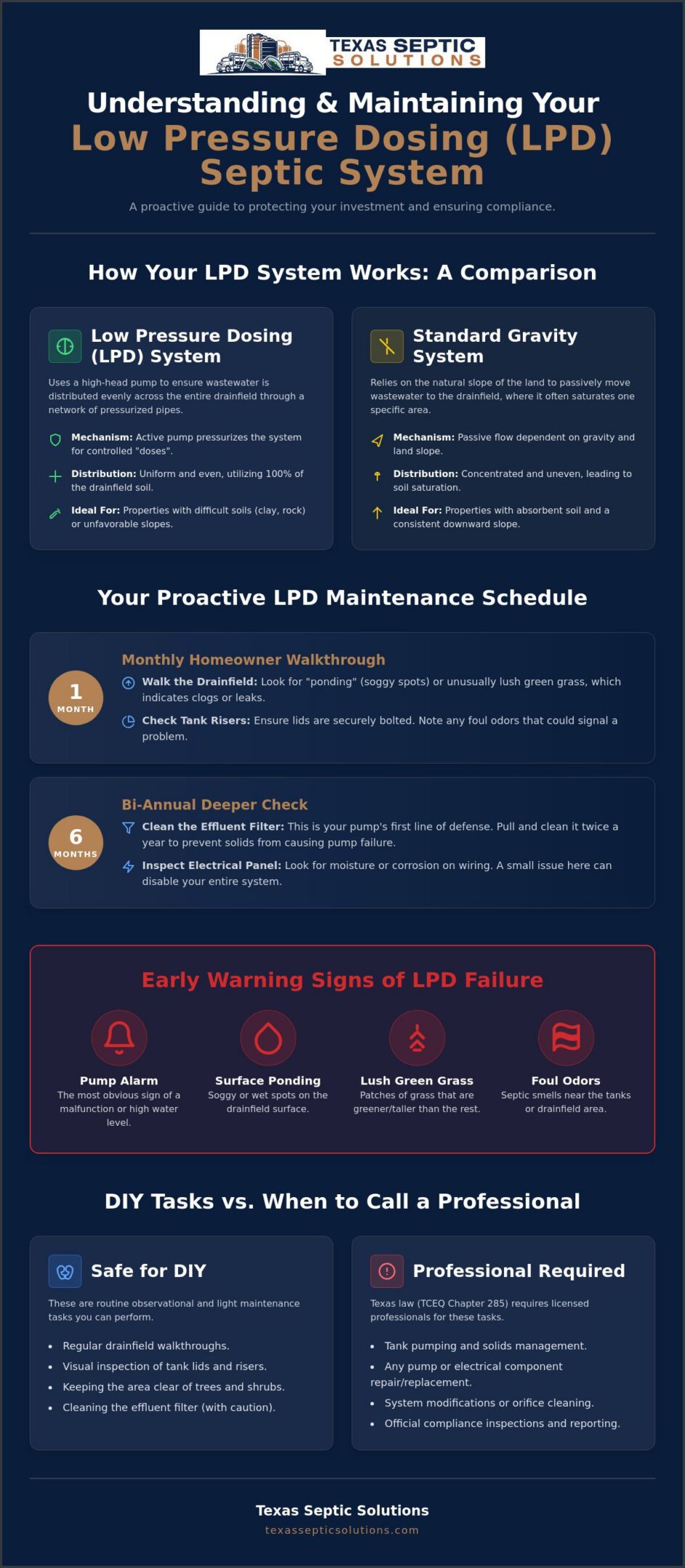
Start with a walk across your drainfield. Look for “ponding” or soggy spots directly over the lateral lines. If you notice patches of grass that are significantly greener or taller than the rest, it usually indicates that an orifice is clogged or a pipe has a leak, causing uneven distribution. You also need to keep this area clear of trees and heavy shrubs. Invasive roots are drawn to the moisture in your lateral lines and can easily plug the small 1/8-inch holes that distribute the effluent. Only native grasses should grow over your LPD field to ensure the soil can breathe and filter waste properly.
Inside the pump tank, the effluent filter is your first line of defense. We recommend a 6-month rule: pull and clean this filter twice a year to prevent solids from reaching the pump. If this filter becomes neglected, the pump has to work much harder to push liquid through, which leads to overheating and premature motor failure. While you’re near the tank, take a quick look at your electrical control panel. Check for signs of corrosion on the wiring or moisture inside the box. In our humid Texas climate, even a small amount of corrosion can lead to a short circuit that leaves your pump dead in the water.
Monthly Homeowner Walkthrough
Every month, take five minutes to inspect your pump tank riser. Ensure the lids are bolted down tight and check for any unusual foul odors that might suggest a venting problem. Pay attention to your household water habits to avoid “slug loading.” This happens when you run the laundry, dishwasher, and multiple showers all at once, which can overwhelm the pump’s capacity. Listen for any loud clicking, grinding, or buzzing coming from the control box. If the system sounds off, it’s better to request septic system repair early rather than waiting for the high-water alarm to scream.
Annual Professional Requirements
Once a year, a licensed professional should perform a “squirt test” on your system. This process involves opening the terminal ends of your lateral lines to measure the residual pressure. It’s the only way to verify that the pump is still delivering the exact pressure required by the original design. During this visit, the technician will also flush the lateral lines to remove any accumulated “biomat” or fine sludge that has settled in the pipes. They will also verify that your float switches are positioned correctly and that the pump “draw-down” rate is within the manufacturer’s specifications.
Managing the Pump Tank and Alarm System
The pump tank is the command center of your LPD system. While the first tank in your system handles the initial settling of solids, the pump tank is where the heavy lifting occurs. It houses the effluent pump, several float switches, and the high-water alarm sensor. These components work together to ensure that wastewater is delivered to the drainfield in controlled doses. Because this tank contains moving mechanical parts and electrical sensors, it requires a higher level of attention than a standard gravity tank. Neglecting low pressure dosing septic system maintenance in this specific area is the fastest way to trigger a system-wide failure.
One of the biggest risks to an LPD system is “solids carryover.” In a traditional gravity system, a small amount of sludge escaping the primary tank might just settle in the drainfield pipes. In an LPD system, those same solids will clog the tiny orifices in your lateral lines or, worse, jam the pump’s intake. This is why regular pumping is so critical. If the primary tank gets too full, solids spill over into the pump tank. This forces the pump to work with “dirty” water, which grinds down the internal impellers and leads to a shortened lifespan. A clean tank means a healthy pump.
You should also be aware of “silent” pump failures. Sometimes a pump will continue to hum or vibrate as if it’s working, but it’s no longer actually moving liquid. This can happen if the impeller is stripped or if the pump has become air-locked. If you notice your pump running for unusually long periods without the water level dropping, you’re likely facing a mechanical issue. Catching this before the high-water alarm triggers can save you from a messy backup in your home.
Septic Tank Alarm Going Off: Immediate Steps
When that red light starts flashing and the buzzer sounds, it’s easy to panic. Your first step should be to silence the alarm at the control panel. However, silencing the noise doesn’t fix the problem. You should immediately implement a “water diet” in your home. Stop running the laundry and dishwasher, and keep showers as short as possible. You typically have about 24 hours of reserve capacity in the tank before a backup occurs. For a step-by-step walkthrough, check out our guide on what to do when your septic tank alarm is going off. If the level doesn’t drop after a few hours of restricted use, you may need to call for emergency septic service to prevent a total overflow.
Float Switch Maintenance
Float switches are the “eyes” of your pump tank. They tell the pump when to turn on, when to turn off, and when to trigger the alarm. Unfortunately, these floats can become weighted down by grease or tangled in “flushable” wipes that should never have been put down the drain. During a maintenance check, we perform a “tether check” to ensure the switches can move freely through their full range of motion. Replacing a faulty float switch is a relatively inexpensive fix. If a stuck float causes the pump to run dry for hours, you might end up replacing the entire pump, which is a much more significant investment.
Troubleshooting LPD Issues in East Texas Soils
East Texas soil, particularly around Houston, Cypress, and Huffman, presents a unique challenge for LPD systems. The high clay content means the soil doesn’t just “take” water; it has to be persuaded. This is why low pressure dosing septic system maintenance is so critical in our region. Over time, a layer called “biomat” can form at the soil interface. This is a biological film of bacteria that, while necessary for treatment, can become too thick and prevent effluent from soaking in. When this happens, the pressure from the pump meets resistance. You might see water backing up into the pump tank even if the pump itself is perfectly healthy.
Heavy Houston rains add another layer of difficulty. During a tropical downpour, the ground can become so saturated that there’s nowhere for the effluent to go. This effectively “drowns” the drainfield. If your system is already struggling with root intrusion, the problem worsens. Roots from nearby trees are naturally drawn to the nutrient-rich water inside your LPD pipes. They can find their way into the tiny 1/8-inch orifices, acting like a plug. If you notice “squirt height” disparities, where one lateral line has high pressure but another is barely trickling, roots or debris are the likely culprits. Consistency in your low pressure dosing septic system maintenance routine is the only way to catch these imbalances before they lead to a total field failure.
Signs of Drainfield Saturation
Identifying the difference between a mechanical pump failure and a saturated soil interface is key. If you see effluent surfacing in your yard, it’s more than just a nuisance; it’s a major regulatory violation in Texas. The TCEQ takes surfacing sewage seriously because of the potential health risks to the community. Often, this saturation is caused by heavy vehicle traffic. Driving a truck or even a heavy riding mower over shallow narrow drainfield trenches can crush the pipes or compact the soil. This destroys the soil’s ability to filter waste and leads to immediate pooling.
Correcting Pressure Imbalances
Your system uses a manifold and ball valves to ensure each line receives the same amount of water. If these are out of adjustment, one part of your field will be overworked while another stays dry. A septic system repair specialist can recalibrate these valves to restore the proper dosing volume. Sometimes, the fix is as simple as cleaning the distal head, which is the removable cap at the end of each pipe. Flushing out the accumulated silt from these ends often restores full flow instantly. If your yard is showing signs of distress, it’s time to schedule a professional septic system repair to protect your drainfield’s longevity.
Professional Maintenance Plans and Texas Compliance
Low pressure dosing systems are complex utilities that require more than just an occasional glance. Under the Texas Administrative Code (TAC) Title 30, Chapter 285, the TCEQ sets strict standards for On-Site Sewage Facilities. Because LPD systems involve mechanical pumps and pressurized distribution, many Texas counties and local health districts act as “Authorized Agents” to enforce even stricter local rules. In many jurisdictions, you’re legally required to maintain a valid maintenance contract with a licensed provider. This isn’t just about following the law; it’s about protecting your property and the local environment from groundwater contamination. Staying current with your low pressure dosing septic system maintenance is the only way to ensure your home remains in full regulatory compliance through 2026 and beyond.
The financial benefit of professional oversight is clear when you look at the big picture. The ROI of a septic system maintenance plan becomes obvious the moment you avoid a catastrophic failure. Replacing a failed LPD drainfield in the difficult clay soils of East Texas can easily cost $15,000 or more. A proactive plan identifies worn float switches, clogged orifices, and pump fatigue long before they lead to a total system collapse. When you hire a Texas-certified provider, you’re getting an expert who understands the specific “squirt height” and residual pressure requirements that keep your drainfield from becoming a soggy, expensive mess.
Why DIY is Not Enough for LPD
While we encourage homeowners to perform monthly visual checks, the technical aspects of pressure dosing require specialized tools. We use precision pressure gauges to verify that each lateral line is receiving the exact dosing volume specified in your system’s engineered design. If a line shows a pressure drop, we use specialized jetting equipment to clear biomat or root intrusions that a standard garden hose can’t touch. There’s also the matter of legal liability. If you sell your property in Texas, documented maintenance records are often required by lenders and savvy buyers. Having a professional log of your low pressure dosing septic system maintenance provides the “paper trail” needed for a smooth real estate transaction.
Your Next Steps for System Longevity
It’s time to stop being reactive and start being proactive. If you’ve been waiting for an alarm to go off before calling for help, you’re risking a high-pressure failure that could “drown” your drainfield. Scheduling a comprehensive LPD inspection is the first step toward long-term peace of mind. At Texas Septic Solutions, we specialize in managing these high-performance systems for neighbors in Cleveland, Cypress, and throughout the Houston area. We’ll help you transition to a schedule that extends the life of your expensive effluent pump and keeps your yard dry. Contact us today for an LPD-specific maintenance quote and let us handle the technical details while you enjoy your home.
Protect Your Home’s Value with Proactive Care
Your LPD system is a sophisticated piece of engineering designed to handle the specific challenges of Texas soil. By keeping a close eye on pump tank alarms and maintaining a clear drainfield, you’ve already taken the first steps toward preventing a system-wide failure. Remember that low pressure dosing septic system maintenance isn’t just a suggestion; it’s a legal requirement in many Texas counties to ensure environmental safety and long-term property value. Consistent attention now prevents the stress of a saturated yard later.
We’re ready to help you manage these complexities with TCEQ-compliant inspections and specialized LPD diagnostic equipment. Our team provides the reliable oversight needed to catch small glitches before they become expensive disasters. If an unexpected issue does arise, you can count on our 24/7 Emergency Rapid Response to get your household back on track. We take pride in being your local partner for all things septic.
Secure Your LPD System with a Professional Maintenance Plan Today
Don’t wait for a soggy yard to take action. Taking charge of your maintenance today ensures a dry yard and a functional home for your family for years to come. We’re here whenever you need us.
Frequently Asked Questions
How often should a low pressure dosing septic tank be pumped?
You should pump your LPD septic tank every 3 to 5 years. Because these systems are highly sensitive to solids carryover, keeping the primary tank clean is the best way to prevent pump damage and orifice clogs. Household size and water usage habits will determine if you need more frequent service. Regular pumping ensures that only clear effluent moves into the pump tank, which is a core part of effective low pressure dosing septic system maintenance.
What is the average lifespan of an LPD effluent pump in Texas?
A high-quality effluent pump in Texas typically lasts between 10 and 15 years. This lifespan assumes you stay consistent with low pressure dosing septic system maintenance and keep the effluent filter clean. Electrical surges or pumping “dirty” water with high solids will significantly shorten this timeframe. Replacing the pump is a major expense, so protecting it with regular float and filter checks is vital for your budget.
Can I use a garbage disposal with a low pressure dosing system?
We strongly recommend avoiding garbage disposals with an LPD system. Disposals introduce finely ground food particles and grease that bypass the initial settling process in the primary tank. These solids can quickly clog the small 1/8-inch orifices in your lateral lines, leading to expensive repairs and potential drainfield failure. It’s much safer to compost food scraps or dispose of them in the trash to keep your system running smoothly.
Why is there water standing over my LPD drainfield trenches after it rains?
Standing water after heavy rain is often due to the saturated clay soils common in the Houston area. If the water disappears within 24 hours of the rain stopping, the ground was likely just overwhelmed by the volume of a Texas downpour. However, if the ponding remains during dry weather or smells like sewage, you’re likely facing a broken lateral line or a clogged distribution orifice that needs professional attention.
How do I know if my LPD system is demand-dosed or timed-dosed?
You can identify your dosing type by looking at the control panel inside your electrical box. Timed-dosed systems feature a programmable timer or clock that manages exactly when the pump runs throughout the day. Demand-dosed systems rely entirely on the float switches to trigger a cycle once the water reaches a specific height. Knowing your dosing type helps you understand how much water your system can handle during guest visits.
What happens if the power goes out to my LPD pump tank?
If the power goes out, your effluent pump will stop functioning immediately. Your pump tank has a limited reserve capacity, usually enough for about 24 hours of very conservative use. You should stop all non-essential water usage, like laundry or dishwashing, until power is restored. If the power stays out for an extended period, the tank will eventually fill up and could cause a backup into your home.
Does a low pressure dosing system require a special type of septic tank?
Yes, an LPD system requires a multi-tank configuration. It typically uses a standard primary tank for settling followed by a dedicated secondary pump tank. This setup ensures that only the clearest liquid reaches the pump and the pressurized lateral lines. This protects the mechanical components from heavy sludge and prevents the small holes in your drainfield pipes from becoming plugged with debris that should have stayed in the first tank.
Is it normal for my septic alarm to chirp during heavy water usage?
A chirping alarm during heavy water usage is a warning that your tank has reached its high-water limit. This often happens after multiple showers or back-to-back laundry loads that “slug load” the system. While the alarm is doing its job, it’s a sign that you need to spread out your water usage. If the alarm continues to chirp for more than a few hours after you stop using water, the pump may have failed.