
Aerobic Septic System Maintenance Cost in Houston: 2026 Price Guide & Checklist
Did you know that a simple lapse in your paperwork could trigger TCEQ fines of $100 or more every single day? In Harris County, your aerobic maintenance contract is more than just a service agreement; it is a legal insurance policy that keeps your home compliant and your backyard safe. We know it’s frustrating to manage the aerobic septic system maintenance cost Houston requires, especially when our local clay soil and heavy rains put constant pressure on your equipment. You shouldn’t have to wonder if your system will fail during the next big storm or if you’re overpaying for basic compliance.
This 2026 guide breaks down what you need to know about mandatory service contracts and fair-market pricing for the Houston area. We’ll provide a professional checklist to help you audit your service provider and ensure every mandatory inspection meets Texas law. You’ll gain a clear understanding of what a quality inspection looks like, helping you avoid unexpected aerator failures and keeping your property in good standing with the county. Let’s make sure your system stays reliable and your budget stays on track.
Key Takeaways
- Learn why Texas law mandates exactly three inspections per year and how to avoid daily non-compliance fines from the TCEQ.
- Get a clear breakdown of the aerobic septic system maintenance cost Houston homeowners can expect in 2026, including the factors that influence contract pricing.
- Use our professional inspection checklist to verify your technician is performing essential checks on aerators and pumps during every site visit.
- Understand the critical visual indicators of a healthy system, such as clear effluent and a lack of odors, to spot potential issues before they become repairs.
- Discover how to verify provider licensing and why choosing a local expert ensures faster response times during Houston’s unpredictable weather.
Why Aerobic Septic Maintenance is Mandatory in Houston
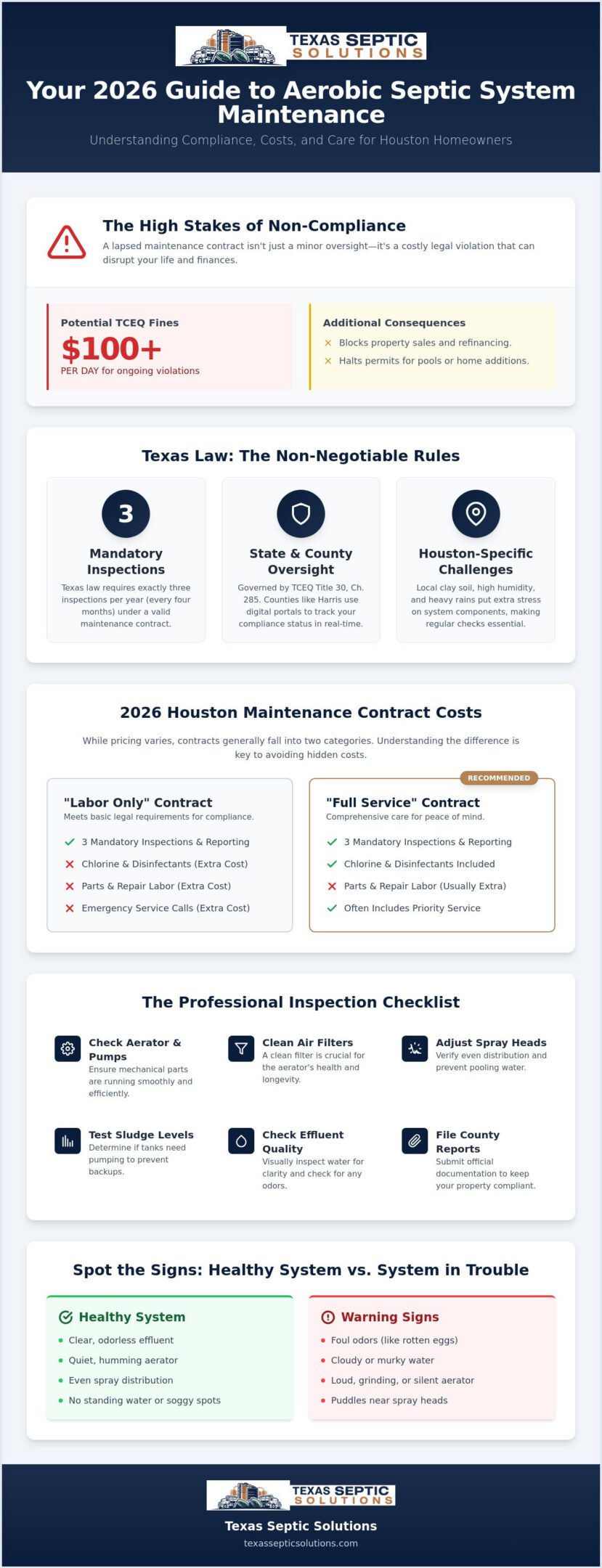
If you own a home in a Houston suburb, you likely have an aerobic system because our local clay soil doesn’t drain well enough for traditional septic setups. Under Texas law, specifically Title 30, Chapter 285 of the Texas Administrative Code, these systems are classified as On-Site Sewage Facilities (OSSF) and require strict oversight. Because an aerobic treatment system uses mechanical parts to treat wastewater to a high standard, the state mandates that it must be inspected every four months. This means you are legally required to have exactly three inspections per year under a valid maintenance contract. Understanding the aerobic septic system maintenance cost Houston homeowners face starts with recognizing that these contracts are a legal mandate, not an optional service.
Counties like Harris, Montgomery, and Liberty maintain digital databases to track these contracts. When your provider files a report, the county sees it immediately. If your contract expires, your status in the system flips to “Lapsed.” This isn’t just a minor clerical error; it’s a red flag for local health departments that can lead to inspections and unwanted legal attention.
The Legal Cost of Non-Compliance
Ignoring your maintenance requirements can get expensive fast. Homeowners who fail to keep an active service contract can face fines of up to $100 per day for ongoing violations. Beyond daily penalties, a lapsed status often halts property transactions. If you’re trying to sell your home or apply for a permit to build a pool, the county will likely block the process until your septic records are current. A Licensed Maintenance Provider (MP) is a professional certified by the TCEQ to perform these mandatory inspections and file the necessary compliance reports on your behalf.
Local Houston Regulatory Nuances
While the state sets the baseline rules, enforcement varies by county. Harris County, for instance, uses specific electronic reporting portals like “Small Batch” to manage the thousands of systems in its jurisdiction. Each county employs a Designated Representative (DR) who audits these records and performs site visits to ensure systems aren’t discharging untreated waste into the environment. Our local climate adds another layer of difficulty. Houston’s high humidity and heavy seasonal rains put immense stress on the mechanical aerator. Without regular checks, these components can burn out or flood, leading to a system failure that the county DR will definitely notice during an audit. Keeping your aerobic septic system maintenance cost Houston budget predictable depends on catching these small mechanical issues before they turn into major county violations.
Average Aerobic Septic System Maintenance Cost in Houston (2026)
Budgeting for your home utilities requires a clear look at the ongoing aerobic septic system maintenance cost Houston homeowners face. While the price of a legal maintenance contract is influenced by several variables, the Houston market remains highly competitive compared to other regions in Texas. Your specific cost will depend on the size of your system, the distance your provider must travel, and whether you choose a basic compliance plan or a comprehensive service package. Many homeowners opt for a “Base Contract” to satisfy county requirements, but these often exclude essential items like emergency service calls or the cost of replacement parts. When comparing providers, it’s vital to look past the initial price tag and see what’s actually covered in the fine print.
What is Included in a Professional Contract?
A standard professional contract ensures you stay compliant with the three mandatory inspections required by Texas law. Your provider doesn’t just visit your property; they must also file detailed reports with the appropriate county authorities. A quality service agreement should include labor for cleaning the air filters, adjusting spray heads for even distribution, and checking the sludge levels in your tanks. You’ll find two main types of agreements in the Houston area: “Labor Only” and “Full Service.” A Labor Only contract covers the inspections and reporting, while a Full Service option typically includes the regular replenishment of chlorine. If you’re unsure which level of care your system needs, you can find helpful educational resources through the Texas A&M AgriLife Extension to better understand your responsibilities as a system owner.
Hidden Costs and Potential Extras
The most common “hidden” expense in aerobic maintenance is the cost of chlorine tablets or liquid bleach for disinfection. Depending on your water usage, these consumables can add a significant amount to your annual operating budget. Electricity is another factor, as your aerator must run constantly to keep the beneficial bacteria alive. Beyond the maintenance contract, you must also plan for periodic pumping. While pumping isn’t part of a standard maintenance agreement, it’s essential every three to five years to prevent solids from migrating into your pump chamber. Neglecting these basics can lead to total system failure, and the septic system replacement cost in Texas is a much heavier burden than simple annual upkeep. If you want to keep your system running smoothly without the stress of missing paperwork, request a maintenance quote from a local expert who understands Houston’s specific regulatory environment.
The Ultimate Houston Aerobic Septic Inspection Checklist
When you invest in the aerobic septic system maintenance cost Houston requires, you should see more than just a truck parked in your driveway for five minutes. A proper inspection is a thorough mechanical and biological audit of your home’s wastewater treatment plant. We recommend that homeowners occasionally step outside during a scheduled visit to observe the process. Knowing what a quality inspection looks like ensures your system remains compliant with Texas law and prevents expensive emergency repairs. A healthy system should produce effluent that is clear and free of foul odors, indicating that the beneficial bacteria are doing their job correctly.
Mechanical and Electrical Components
The technician should start with the “Big Three”: the aerator, the pump, and the alarm system. The aerator is the heart of your system, providing the oxygen necessary for bacteria to break down waste. Your tech must check the air pressure and clean or replace the air filter to prevent the motor from overheating. Next, they should head to the control box. In the Houston area, fire ants and high humidity are the primary enemies of electrical components. Technicians should inspect the wiring for corrosion and ensure no ant mounds are interfering with the circuitry. Finally, the technician must manually lift the float switches in the pump tank. This triggers the high-water alarm, proving that the system will alert you before an actual backup occurs in your home.
Disinfection and Effluent Quality
Once the mechanical parts are verified, the focus shifts to the treatment quality. Your technician is required to perform a chlorine residual test. This confirms that the water being sprayed onto your lawn is properly disinfected and safe for your family and pets. They will also use a “sludge judge,” which is a long, clear tube used to measure the depth of solids in your tanks. This measurement is the only accurate way to determine if it’s time to schedule a pumping service. Ensuring the effluent is clear and odorless is the ultimate goal of every aerobic inspection. If the spray looks cloudy or smells like raw sewage, the biological balance is off and needs immediate adjustment.
The final step of a professional audit is the spray field evaluation. The technician should walk your yard while the pump is running to check for clogged spray heads or broken nozzles. Pooling water in the yard is often a sign of a broken pipe or a misaligned head that can lead to county citations if left unaddressed. By following this checklist, you can be certain that your maintenance provider is delivering the comprehensive care your Houston home deserves.
How to Choose a Houston Maintenance Provider
Selecting a partner for your home’s utility needs is about more than just finding the lowest aerobic septic system maintenance cost Houston offers. You need a team that’s licensed by the Texas Commission on Environmental Quality (TCEQ) as either a Maintenance Provider (MP) or a Maintenance Technician (MT). Licensing is your first line of defense, but local proximity is just as critical. A provider based in nearby areas like Cypress or Cleveland can reach a Houston property much faster during a flash flood or a mechanical failure than a company servicing the entire state. When your system is under stress from a heavy Gulf storm, every minute counts toward preventing a backup into your home.
Evaluating a provider’s reputation involves more than just glancing at a star rating. Look for feedback that highlights “Reliable Local Authority” traits. You want to see comments about technicians who take the time to explain their work and consistently show up on schedule. It’s one thing to have a signed contract; it’s another to have a partner who actually answers the phone when a high-water alarm goes off at 2 AM on a rainy Tuesday. Reliability isn’t just a marketing term in the septic industry; it’s the difference between a minor adjustment and a disastrous lawn flood.
Questions to Ask Before Signing
Before you commit to a long-term agreement, get specific answers to these questions to ensure you’re getting full value for your aerobic septic system maintenance cost Houston investment:
- Do you handle the county reporting, or do I? A professional provider should handle all electronic filings with Harris, Montgomery, or Liberty counties as part of their service.
- What is your emergency response time for contract holders? Priority service should be a standard benefit for those with a maintenance plan.
- Are repairs discounted if I have a maintenance plan with you? Many reputable companies offer reduced labor rates or parts discounts for their regular maintenance clients.
Red Flags in a Maintenance Provider
Watch out for the “Drive-By” inspection. If a technician spends less than ten minutes at your property and never opens the tank lids, they aren’t performing a legal inspection. You should also be wary of any provider that fails to leave a written or digital report immediately after the visit. Without that report, you have no proof for the county that the work was completed. If your system starts acting up between these visits, don’t wait for your next scheduled stop. Use our guide on what to do when your septic tank alarm is going off to stay safe while you wait for a professional. If you’re looking for a team that treats your home like their own, contact Texas Septic Solutions for a maintenance agreement that actually protects your property and your peace of mind.
Texas Septic Solutions: Reliable Aerobic Care in Houston
Managing your home’s utilities shouldn’t feel like a second job. At Texas Septic Solutions, we simplify the complex requirements of aerobic system ownership by acting as your dedicated compliance partner. We understand that the aerobic septic system maintenance cost Houston homeowners budget for needs to provide more than just a certificate; it needs to provide actual protection for your property. Our team serves a wide range of local communities, including Cleveland, Houston, Cypress, Huffman, and Shepherd. By focusing on these specific areas, we ensure our technicians are always nearby when you need us most.
We pride ourselves on being a true “one-stop” resource for our neighbors. Many providers only handle inspections, leaving you to find a different company for repairs or pumping. We take a different approach. Whether you need a new septic system installation, a quick pump repair, or routine septic system pumping, our team has the equipment and expertise to handle it all. This comprehensive model means you don’t have to juggle multiple contractors or worry about whether your maintenance provider and repair technician are on the same page. We oversee the entire lifecycle of your system to ensure it performs reliably for years to come.
Our Professional Maintenance Approach
Our maintenance process is built around transparency and total compliance. We handle all the detailed reporting required by Harris or Montgomery County, ensuring your records stay current in their digital databases. You won’t have to worry about missing a deadline or facing a county audit alone. For our contract customers, we offer clear, upfront pricing with no hidden “trip fees” or surprise surcharges. We also specialize in long-term system preservation. By catching small issues during routine visits, we help you avoid the high costs associated with major component failures or premature system replacement. Our 24/7 emergency septic service means that even if a Houston storm causes an unexpected failure, a “neighborly expert” is only a phone call away.
Ready to Secure Your System?
Protecting your home and your budget starts with a reliable maintenance plan. We invite you to experience the peace of mind that comes with having a seasoned professional watching over your system’s health. We’ll work with you to create a plan that fits your specific usage and ensures your home remains in good standing with Texas environmental laws. Don’t wait for an alarm to go off before you find a partner you can trust. Request your Houston aerobic maintenance quote today and let us take the stress out of your septic care.
Protect Your Home and Your Peace of Mind
Maintaining your aerobic system doesn’t have to be a source of stress or confusion. By understanding the aerobic septic system maintenance cost Houston homeowners face and using a professional checklist, you can keep your property compliant with Texas law while avoiding the heavy fines associated with lapsed contracts. Remember that a reliable provider does more than just file reports; they act as a guardian for your home’s functionality, catching mechanical issues before they turn into costly emergencies.
Our team is ready to help you navigate these requirements with the care and expertise your property deserves. As TCEQ Licensed Maintenance Providers with 24/7 emergency service available, we serve Houston, Cleveland, and the surrounding communities with a focus on long-term system health. We’re built to handle everything from routine inspections to complex repairs, ensuring your system stays reliable regardless of the weather. Get a Professional Aerobic Maintenance Plan from Texas Septic Solutions. Taking this proactive step today ensures your backyard remains safe and your home stays in good standing for years to come.
Frequently Asked Questions
Is an aerobic septic maintenance contract required by law in Houston?
Yes, Texas law requires every owner of an aerobic septic system to maintain a valid service contract with a licensed provider. Under TCEQ regulations, these systems must be inspected every four months to ensure they are treating wastewater safely. Local authorities in Harris, Montgomery, and Liberty counties use digital databases to track these contracts and ensure every property remains compliant.
How much does a typical aerobic maintenance contract cost per year in 2026?
The aerobic septic system maintenance cost Houston homeowners expect to pay covers three mandatory inspections and the filing of compliance reports with the county. While the contract price is a significant part of your budget, you should also account for the annual costs of electricity and chlorine tablets. Most local providers offer tiered plans ranging from basic labor only agreements to comprehensive full service packages.
Can I maintain my own aerobic septic system in Texas to save money?
Texas state rules allow homeowners to maintain their own systems after the unit has been installed for two years, but local restrictions often apply. In the Houston area, counties like Harris may require you to complete a training course or pass a competency evaluation before they’ll accept your self-reports. Most homeowners find that the time and technical knowledge required make professional service a more reliable choice.
What happens if I miss an inspection or my contract lapses?
A lapsed contract immediately puts your property in a “non-compliant” status within the county’s tracking system. This can lead to daily fines of up to $100 until a new contract is signed and filed. Beyond the financial penalties, a missing maintenance record will block you from selling your home or getting permits for any property improvements like pools or home additions.
Do maintenance contracts include the cost of chlorine tablets?
Most standard “Base” maintenance contracts do not include the cost of chlorine tablets or liquid bleach. These are considered consumables that the homeowner is responsible for replenishing. However, many providers offer “Full Service” plans that include chlorine delivery and installation as part of the annual fee, which can save you the hassle of handling the chemicals yourself.
How often does an aerobic system need to be pumped compared to a conventional one?
Aerobic systems typically need to be pumped every three to five years, which is a similar timeframe to conventional septic tanks. The main difference is that aerobic systems are much more sensitive to sludge buildup. If the solids get too high, they can clog your spray heads or damage the pump, so your technician will measure the sludge depth during every four month inspection.
What should I do if my aerobic system alarm starts going off between inspections?
If your alarm sounds, you should immediately reduce your indoor water usage and check the red light on your control box. Most alarms indicate either a high water level in the tank or a failure in the aerator pump. Contact your maintenance provider right away; most professional contracts include priority response times for these types of mechanical failures.
Why is my aerobic system spraying water that smells like rotten eggs?
A foul odor usually indicates that your system isn’t getting enough oxygen or has run out of chlorine. This often happens when the aerator pump fails or the air filter is completely clogged, causing the beneficial bacteria to die off. Without oxygen, the system becomes anaerobic and produces the sulfurous smell you’re noticing in your spray field.