
Texas Septic Tank Installation Permits: The Complete 2026 Guide
Did you know that roughly 25% of the Texas population relies on an on-site sewage facility to keep their property functional? If you’re planning a new build or a major upgrade, you might feel like securing a septic tank installation permit is a hurdle designed to stall your progress. It’s completely normal to feel overwhelmed by the overlapping rules between the Texas Commission on Environmental Quality and your local county health department. Nobody wants to face a surprise fine or a project delay because of a missed soil test or a filing error.
We understand that you just want your home to be safe and legal without the stress of deciphering Title 30, Chapter 285 of the Texas Administrative Code on your own. This guide will help you move through the permitting process with total confidence, from the initial site evaluation to the final inspector’s sign-off. We’ll show you exactly which authorities to contact, how to handle the state application fees, and what to expect during your system inspection so you can get back to focusing on your home.
Key Takeaways
- Understand why an OSSF permit is a legal requirement in Texas and how it protects your property investment.
- Learn the step-by-step sequence for securing a septic tank installation permit, starting with a professional soil evaluation and site design.
- Identify the essential documents you need, including a detailed site plan that accounts for wells and property lines to avoid common rejections.
- Discover the most frequent mistakes that cause permitting delays, such as incorrect setback distances, and how to fix them before you submit.
- Find out how professional permit management during a new system installation can save you weeks of paperwork and coordination with county inspectors.
Why You Need a Septic Tank Installation Permit in Texas
In Texas, a septic system isn’t just a tank in the ground; it’s legally classified as an On-site Sewage Facility (OSSF). Under Title 30, Chapter 285 of the Texas Administrative Code, every new system or major modification requires a formal authorization before you can even break ground. The Texas Commission on Environmental Quality (TCEQ) sets these strict standards to ensure that wastewater is treated safely on your own property. While the TCEQ oversees the state, they often delegate the actual permitting and inspection duties to local county health departments or authorized agents. Obtaining a septic tank installation permit is the only way to prove your system meets these engineering and environmental requirements.
Think of this permit as a vital safety certificate for your land. It’s professional evidence that your system won’t contaminate your soil or your neighbor’s water supply. Beyond the legal mandate, having a valid permit protects your home’s resale value and your insurance eligibility. Most insurance companies won’t cover damage related to an unpermitted utility. You’ll find that securing a septic tank installation permit is a non-negotiable step if you ever plan to sell. Title companies and savvy buyers in the Lone Star State will look for these records during the closing process to ensure the property is up to code. Without this paperwork, you might find yourself stuck with a property you can’t legally transfer to a new owner.
Legal Consequences of Unpermitted Installations
In areas like Cleveland or Cypress, local inspectors take these rules seriously. If you’re caught installing a system without the proper paperwork, you’ll likely face a “Stop Work” order. This can lead to heavy daily fines that outpace the permit cost. In extreme cases, homeowners are forced to dig up and remove new equipment because it didn’t meet soil requirements. Most Texas title companies won’t close on a home sale if the OSSF isn’t properly registered.
Protecting the Texas Water Table
Living in Houston or Huffman means we must protect our shared water table. A failed or poorly designed system can leach raw sewage into the groundwater. The permitting process ensures your system is appropriately sized for your household’s actual usage. By verifying your soil and layout, the state ensures waste is treated properly. This prevents the spread of bacteria and protects our local community health for the long term.
The 2026 Texas OSSF Permitting Process: Step-by-Step
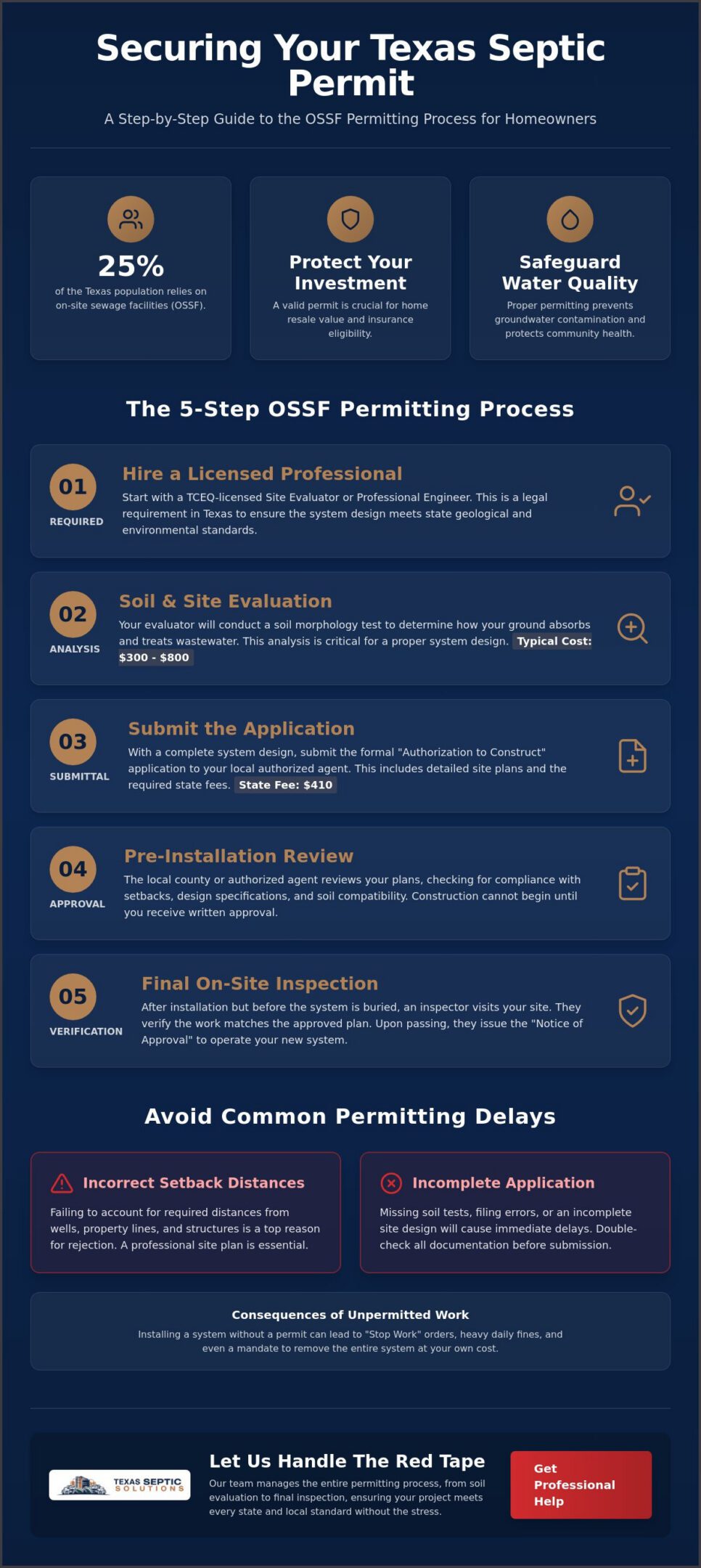
Securing your authorization is a structured journey that starts long before the first shovel hits the dirt. The state follows a specific sequence to ensure every system is safe for the environment and the homeowner. You can find the full regulatory framework on the official TCEQ septic system permit page, but the practical process usually breaks down into five clear steps. Following these in order prevents costly mistakes and ensures your project stays on schedule.
- Step 1: Hire a Licensed Professional. You must start by hiring a TCEQ-licensed Site Evaluator or a Professional Engineer. This is a legal requirement in Texas. These experts understand the specific geological needs of our region.
- Step 2: Soil and Site Evaluation. Your evaluator will perform a soil morphology test. This determines how well your ground can absorb and treat wastewater. Expect to pay between $300 and $800 for this detailed professional analysis.
- Step 3: Submit the Application. Once your system design is ready, you’ll submit the formal “Authorization to Construct” application. This includes the state’s $400 application fee plus a $10 regulatory fee.
- Step 4: Pre-Installation Review. The local Authorized Agent will review your plans. They check for proper setbacks and ensure the design matches your soil type. You cannot begin construction until you receive this written approval.
- Step 5: Final Inspection. After the system is installed but before it is covered with soil, an inspector must visit the site. If the work matches the approved plan, they will issue your “Notice of Approval” for operation.
If you find the technical requirements or the coordination with local officials stressful, we can help. Our team provides professional support for every stage of new septic system installation to ensure your project meets every state and local standard.
Identifying Your Local ‘Authorized Agent’
While the state sets the rules, local offices usually handle the paperwork. In Montgomery County or Harris County, the environmental health departments act as the “Authorized Agent.” It’s vital to contact the specific office for your jurisdiction because local fees can vary between $200 and $500. Some smaller municipalities may have their own OSSF offices separate from the county. Always verify your property’s exact jurisdiction before mailing in your septic tank installation permit application.
The Timeline for Approval in East Texas
In 2026, most East Texas counties aim to review permit applications within two to four weeks. However, high demand in growing areas can stretch this timeline. Factors like incomplete site plans or unsigned forms are the most common reasons for delays. If your application is returned for “deficiencies,” you’ll need to correct the errors and potentially pay a re-inspection fee. Ensuring your documentation is perfect the first time is the best way to keep your septic tank installation permit moving through the system.
Essential Documentation for Your Septic Permit Application
Preparing your paperwork correctly is the most effective way to avoid a rejection from the county. When you apply for a septic tank installation permit, the state requires specific technical evidence that your plan is safe for the environment. You’ll need to provide a legal description of your property, which is usually found on a current plat or survey. This confirms you have the legal right to install a system and that the proposed location matches your property lines exactly. Without a clear survey, inspectors can’t verify that your system stays within your boundaries.
If you’re installing an aerobic system, Texas law requires an “Affidavit to the Public.” This is a recorded document filed with the county clerk that notifies future buyers that the system requires an ongoing maintenance contract. It’s a standard part of Texas septic system laws designed to ensure long-term functionality and public safety. Your application must also include a professional design report. While standard systems for ideal soil might be simpler, many East Texas properties require engineered designs to handle heavy clay or high water tables. This report acts as the blueprint for your entire project.
The Soil and Site Evaluation Report
Gone are the days of the simple “perc test.” Today, Texas requires a professional soil profile conducted by a licensed specialist. A licensed evaluator will dig test holes to identify “restrictive horizons,” which are layers of rock or clay that stop water from draining. They also look for signs of seasonal groundwater that could flood a drain field. Your soil will be classified from Class Ia, which is coarse sand, to Class IV, which is heavy clay. This classification is the single most important factor in your septic tank installation permit because it dictates whether you can use a conventional drain field or if you must upgrade to an aerobic treatment unit.
Technical Design Specifications
Your designer must calculate your daily wastewater flow accurately. This isn’t based on how many people live in your house today. Instead, it’s based on the number of bedrooms and the total square footage of the home. A three-bedroom home has a different flow requirement than a five-bedroom estate. You’ll need a scaled drawing that shows exactly where the tanks and drain field will sit. It must also show “setbacks,” which are the required distances from your well, your neighbors’ wells, and any nearby creeks or property lines. For more on budgeting for these requirements, see our septic system replacement cost guide.
Avoiding Common Permitting Delays and Rejections
A rejection on your application doesn’t just hurt your pride; it can stall your entire construction timeline by weeks. Most delays in the septic tank installation permit process are entirely preventable. They usually happen because of clerical errors or a lack of coordination between the property owner and the designer. If your application is returned for “deficiencies,” you might even have to pay a re-inspection fee, which is typically half the price of the original permit fee. Getting it right the first time is the only way to keep your project moving.
Mismatched system designs are a major red flag for county agents. If your designer submits a plan for a conventional system but your soil report indicates heavy clay, the application will be rejected immediately. Local officials are trained to spot these discrepancies. They won’t risk the local environment on a system that is destined to fail. Always ensure your installer and site evaluator are on the same page before you sign any paperwork. Common reasons for immediate rejection include:
- Incomplete or unsigned application forms.
- Missing or expired maintenance contracts for aerobic systems.
- Failure to include the mandatory $410 state regulatory and application fees.
- Site plans that lack a North arrow or a clear scale.
Understanding Texas Setback Requirements
Setbacks are the non-negotiable buffer zones around your system. In Texas, the most critical rule is the 100-foot separation between any part of your septic system and a private well or public water line. You also need to maintain specific distances from property lines, creeks, and even your own swimming pool. Inspectors use laser-accurate measuring tools during the final site visit. If your tank is even two feet too close to a neighbor’s fence, they’ll likely require you to dig it up and move it before granting approval. These distances are strictly enforced to prevent cross-contamination and ensure long-term public health.
Planning for Future Land Use
It’s easy to focus only on the house you’re building today, but you must think about tomorrow. If you plan to add a workshop, a pool, or a paved driveway later, you need to disclose those plans now. Building over a drain field is strictly prohibited because it compacts the soil and prevents proper evaporation. By providing a full site plan that accounts for future outbuildings, you avoid the trap of building yourself into a corner. This foresight ensures your septic tank installation permit remains valid even as your property evolves over the next decade.
Don’t let paperwork errors stand in the way of your new home. If you’re ready to start your project without the headache of county rejections, contact us for a new septic system installation and let our experts handle the compliance for you.
Let Texas Septic Solutions Handle the Red Tape
Securing a septic tank installation permit shouldn’t feel like a second job. We’ve seen how easily property owners get bogged down in technical drawings and county regulations. That’s why we offer professional permit management as a core part of our turnkey installation service. Our team handles the back and forth with local county inspectors and TCEQ agents so you don’t have to. We make sure every detail of your system design meets the 2026 Texas OSSF standards, protecting your property’s health and your peace of mind for the long term.
Our approach is simple: we take the stress out of utility management. By managing the entire application process from start to finish, we eliminate the risk of those costly delays and rejections we discussed earlier. You won’t have to worry about missing a signature or miscalculating a setback distance. We’re your reliable local authority, built to handle both the technical precision of the build and the high pressure demands of regulatory compliance. We position ourselves as your partner, ensuring your home stays functional and legal without the typical paperwork headaches.
- Professional coordination with Montgomery, Harris, and Liberty County officials.
- Comprehensive application preparation including all state and local fees.
- Expert design alignment with specific soil classifications.
- Full management of the final inspection and ‘Notice of Approval’ process.
Our Professional Design and Permitting Service
Translating complex soil data into a permit-ready system design is what we do best. Whether your land has restrictive clay or sandy loam, we create a blueprint that the county will approve on the first try. For aerobic system owners, we also manage the legal filing of the ‘Affidavit to the Public’ with your county clerk. This ensures your property remains fully compliant from day one. Once your system is in the ground and approved, check out our septic system maintenance plan for post-permit care and long-term health.
Reliable Installation in Cleveland and Beyond
Local expertise matters when you’re dealing with specific county clerks in East Texas. We know the nuances of the permitting offices in Cleveland, Cypress, and Huffman. This neighborly expert vibe isn’t just about being friendly; it’s about knowing exactly what local inspectors look for during that final site visit. We’re committed to the community and take high accountability for every system we install. We aren’t just here for the installation; we’re here to be your long-term maintenance partner. Ready to start your project? Contact Texas Septic Solutions for a consultation today!
Start Your Project with Confidence
Obtaining a septic tank installation permit in Texas is more than just a legal hurdle; it’s a critical step in protecting your land and your family’s health. We’ve explored how a professional site evaluation and accurate documentation prevent the common rejections that stall so many East Texas projects. By understanding the specific setbacks and soil requirements for your county, you can avoid costly fines and ensure your system is built to last.
Our team of Licensed Texas OSSF Installers is ready to help you navigate these regulations with ease. We serve Cleveland, Houston, and all surrounding counties with a commitment to straightforward, expert service. Whether you need a new installation or 24/7 emergency support for an existing system, we have the experience to handle the technical details for you. Don’t let the red tape slow down your progress.
Get Your Professional Septic Installation Quote
We look forward to helping you build a safe and reliable utility system for your home.
Frequently Asked Questions
How much does a septic tank permit cost in Texas?
A septic tank installation permit in Texas involves a $400 TCEQ application fee along with a $10 state regulatory fee. You should also expect local county fees that generally range from $200 to $500 depending on your specific jurisdiction. These costs cover the administrative review of your site plan and the final physical inspection of the system before it is covered with soil.
Do I need a permit to repair an existing septic system?
You need a permit for any major repair or modification to an existing On-Site Sewage Facility. This includes replacing a tank, moving a drain field, or upgrading to an aerobic treatment unit. Minor repairs like replacing a broken pipe or a baffle usually don’t require a full permit. Always check with your local county inspector before starting work to avoid potential fines for unpermitted modifications.
How long is a Texas septic construction permit valid for?
A Texas “Authorization to Construct” is typically valid for one year from the date it is issued. If you don’t complete the installation and pass the final inspection within that 12 month window, the permit expires. You would then need to reapply and pay the application fees again. It is best to have your installer ready to go as soon as the paperwork is approved.
Can I design and install my own septic system in Texas?
Homeowners can legally design and install their own system if it serves their single-family residence, but you still must follow every state regulation. You’ll need to secure the same septic tank installation permit as a professional and pass all mandatory inspections. Given the technical nature of soil profiling and system engineering, most Texans find that hiring a licensed professional prevents expensive installation errors and project delays.
What happens if my septic permit application is denied?
If your application is denied, the local authority will issue a formal list of “deficiencies” that need correction. These are often related to incorrect setback distances or soil classifications that don’t match the system design. You’ll need to fix these errors and resubmit the plan for a new review. Keep in mind that a re-inspection often requires a fee equal to half of the original permit cost.
Do I need a permit for an aerobic septic system maintenance contract?
You don’t need a separate permit for the contract itself, but a valid maintenance contract is a legal requirement to maintain your OSSF permit. Texas law mandates that aerobic systems have a continuous contract with a licensed provider. You must submit proof of this contract to your local Authorized Agent every time it is renewed. Failing to maintain this contract can lead to the revocation of your operating authority.
Who is responsible for the final inspection—the installer or the county?
The local Authorized Agent, usually a county health inspector, is responsible for performing the final inspection. However, your licensed installer is responsible for scheduling this visit and must be present on-site during the review. The inspector checks that the tanks, alarms, and drain field match the approved engineering plans. The system must remain uncovered until the inspector gives the final “Notice of Approval” to backfill.
What is an ‘Authorized Agent’ in the context of Texas septic permits?
An Authorized Agent is a local governmental entity, such as a county or city, that has been delegated authority by the TCEQ to implement the OSSF program. They are your primary point of contact for applications, plan reviews, and site inspections. If you live in an area without a local Authorized Agent, you would work directly with the TCEQ regional office to secure your construction and operating permits.